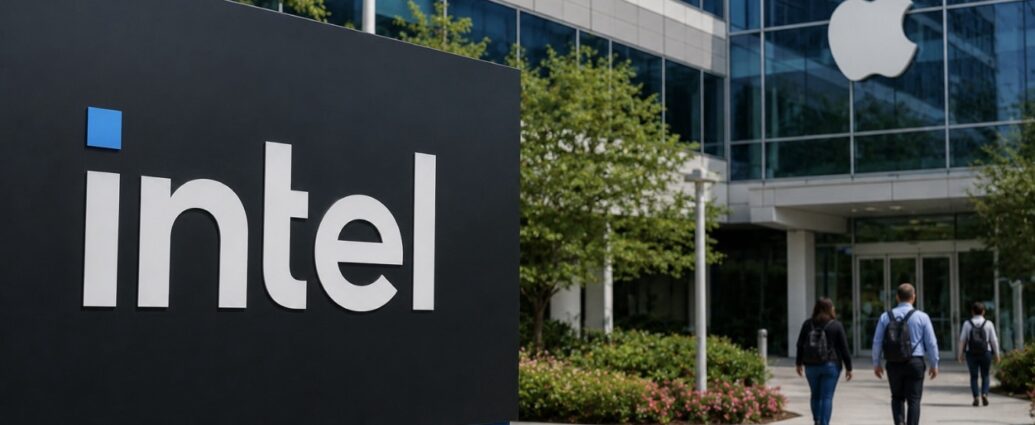
SANTA CLARA, Calif. — Intel appears to have completed one of the most dramatic corporate turnarounds in modern Silicon Valley history.
The chipmaker has reached a preliminary agreement with Apple to manufacture some of the processors powering future Apple devices, according to a report Friday from The Wall Street Journal, a breakthrough that would mark a major strategic victory for Intel’s foundry business and potentially reshape the balance of power inside the global semiconductor industry.
While the agreement has not yet been finalized, people familiar with the negotiations told the Journal the talks followed more than a year of intense discussions between the two companies. Neither Intel nor Apple confirmed details of the arrangement, including which devices or chip families could eventually move into Intel manufacturing facilities.
Even a limited production relationship would carry enormous significance.
Apple ships more than 200 million iPhones annually, alongside millions of Mac computers, iPads, and other devices. Any manufacturing role tied to Apple’s hardware ecosystem would immediately become one of the most important commercial wins in Intel’s modern history — and a defining validation of the company’s push to reinvent itself as a contract chip manufacturer for outside customers.
Wall Street reacted immediately.
Intel shares surged nearly 14% Friday, hitting an intraday record high of $130.57, surpassing even the company’s dot-com era peak and extending a staggering rally that has now pushed the stock nearly 500% above its 52-week low of $18.96 reached just one year ago.
Shares continued climbing Monday as investors absorbed the broader implications of the agreement and the accelerating momentum surrounding domestic semiconductor manufacturing. Apple shares also moved modestly higher.
The deal would represent a remarkable reversal for Intel, which just two years ago faced mounting concerns about technological stagnation, shrinking market share, manufacturing delays, and growing irrelevance compared to rivals including Taiwan Semiconductor Manufacturing Co. (TSMC), Nvidia, and AMD.
Instead, Intel has suddenly become central to Washington’s effort to rebuild American semiconductor independence.
According to the report, the Trump administration played a direct role in helping facilitate the discussions. President Donald Trump personally encouraged Apple CEO Tim Cook to deepen cooperation with Intel during a White House meeting, while Commerce Secretary Howard Lutnick has reportedly been coordinating broader conversations with major technology executives as part of an aggressive push to expand U.S.-based chip manufacturing capacity.
The administration’s strategic interest is substantial.
The U.S. government currently holds a 9.9% stake in Intel, acquired for approximately $8.9 billion, giving Washington a direct financial and geopolitical interest in the company’s recovery and long-term competitiveness.
The Apple talks also arrive after a cascade of partnerships that have rapidly transformed Intel’s standing inside the industry.
Last year, Nvidia announced a $5 billion equity investment in Intel tied to collaborations involving AI infrastructure and integrated consumer computing systems. Microsoft committed to using Intel’s advanced 18A manufacturing process for certain chip development efforts, while Amazon Web Services signed agreements to build custom chips using the same platform.
Companies controlled by Elon Musk, including Tesla, xAI, and SpaceX, have also reportedly partnered with Intel through the company’s expanding TeraFab manufacturing initiative in Texas.
At the center of the turnaround is Intel CEO Lip-Bu Tan, who took over in spring 2025 and moved aggressively to reposition Intel around advanced manufacturing and foundry services.
Tan recruited engineering and fabrication talent from TSMC, accelerated investment into Intel’s domestic manufacturing footprint, and aggressively pursued external partnerships designed to prove Intel could compete again at the highest end of semiconductor production.
The company’s foundry division — once viewed skeptically by investors and customers alike — is now projected to reach breakeven by 2027 based on the current pipeline of manufacturing agreements.
For Apple, the partnership could solve an increasingly important strategic problem.
The company currently relies overwhelmingly on TSMC to manufacture its most advanced chips, leaving Apple deeply dependent on a single supplier operating primarily in Taiwan — a geopolitical and operational concentration risk that has become more concerning as tensions involving China, trade policy, and AI-related chip demand intensify.
The explosion in demand for AI infrastructure has already strained TSMC’s manufacturing capacity, creating supply bottlenecks across the technology industry and raising concerns among major customers about long-term access to advanced fabrication slots.
Diversifying even part of Apple’s production to Intel would provide both manufacturing redundancy and significant political advantages at a time when domestic semiconductor production has become a major national priority in Washington.
The broader symbolism may be just as important as the commercial implications.
For decades, Intel represented the backbone of American semiconductor dominance before losing ground to Asian competitors and fabless chip designers. An Apple partnership would not simply mark another commercial agreement — it would signal that one of the world’s most demanding technology companies now believes Intel is once again capable of competing at the leading edge of global chip manufacturing.
If finalized, the Apple-Intel agreement could become one of the most consequential developments in the American semiconductor industry in a generation — reshaping supply chains, accelerating the domestic manufacturing race, and cementing Intel’s unlikely return from near-obsolescence to the center of the global technology economy.
JBizNews Desk
© JBizNews.com. All rights reserved. This article is original reporting by JBizNews Desk. Unauthorized reproduction or redistribution is strictly prohibited.