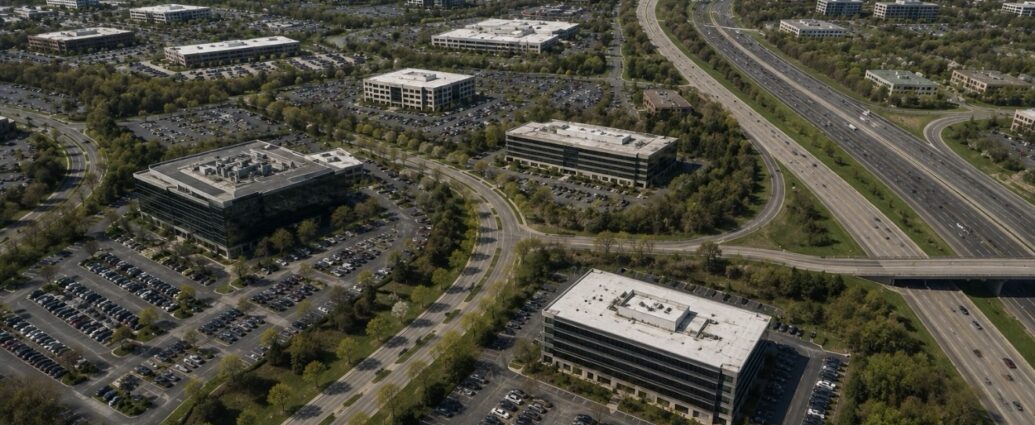
NEW YORK — A new economic and political fault line is quietly forming across America — not in factory towns or rural communities, but in the suburban office corridors surrounding the nation’s largest cities.
Researchers at Tufts University’s Fletcher School are calling it the “Wired Belt”: a growing cluster of suburban counties filled with highly educated white-collar workers whose jobs are increasingly vulnerable to artificial intelligence automation.
And according to the researchers behind the project, the political consequences could eventually rival — or exceed — the upheaval caused by the collapse of American manufacturing during the rise of the Rust Belt.
The concept comes from the university’s newly developed American AI Jobs Risk Index, an expansive effort mapping AI-related job vulnerability across 784 occupations and identifying where those workers are geographically concentrated.
What emerged was a striking pattern.
The workers most exposed to AI disruption are not spread evenly across the country. Instead, many are clustered in suburban rings surrounding major metropolitan areas in politically critical swing states including Pennsylvania, Michigan, Wisconsin, Georgia, and Arizona — the same regions that have repeatedly determined presidential elections over the past decade.
Unlike traditional blue-collar displacement, the workers at risk inside the Wired Belt are overwhelmingly professionals: writers, marketers, analysts, accountants, web designers, administrative coordinators, paralegals, and data specialists whose daily tasks increasingly overlap with the rapidly advancing capabilities of generative AI systems.
Bhaskar Chakravorti, dean of global business at the Fletcher School and lead researcher behind the study, believes that distinction matters enormously.
“These are people who are on LinkedIn,” Chakravorti told Fortune. “They know their congressman’s phone number. They’re good at writing, web design, data analysis, marketing.”
In other words, the workers most vulnerable to AI disruption may also be uniquely positioned to organize politically around it.
That possibility is becoming increasingly relevant as AI-driven restructuring accelerates throughout the corporate economy.
Across the technology sector alone, more than 95,000 jobs have already been eliminated during 2026, with industry estimates suggesting roughly 44% of those reductions are tied directly or indirectly to AI automation.
Major companies including Microsoft, Meta, Oracle, and Amazon have all announced large-scale workforce reductions this year while simultaneously increasing investment in artificial intelligence infrastructure, automation systems, and AI-assisted productivity tools.
The pattern is increasingly clear across corporate America: the same technologies companies are investing billions to deploy are beginning to reduce demand for many of the white-collar coordination and knowledge-work roles that defined suburban professional employment for much of the past two generations.
That overlap is precisely what makes the Wired Belt concept politically significant.
The suburban professional class has historically occupied a central role in American economic and electoral stability. These communities typically feature high voter participation, strong civic engagement, advanced education levels, and significant influence over local and national political narratives.
Researchers argue that if those workers begin experiencing widespread economic displacement — or even sustained fear of displacement — due to AI systems, the resulting political response could reshape the national conversation around technology, labor, regulation, and corporate power.
Unlike many industrial workers displaced during earlier globalization waves, these workers possess both the communication skills and institutional familiarity needed to mobilize quickly and effectively.
And unlike factory closures concentrated in isolated industrial regions, AI-driven displacement could emerge simultaneously across multiple suburban counties critical to both political parties.
The economic stakes are equally significant.
White-collar suburban workers collectively represent trillions of dollars in consumer spending, mortgage obligations, retirement investments, tax revenue, and local economic activity. A broad-based weakening of those employment categories could ripple outward into housing markets, retail spending, financial services, education systems, and regional tax bases.
For businesses, the challenge is becoming increasingly delicate.
Corporate executives are under enormous pressure from investors to deploy AI aggressively in pursuit of productivity gains and cost reductions. But doing so too visibly — particularly in politically sensitive regions already anxious about job security — may eventually create reputational, regulatory, and political backlash.
Exactly how the Wired Belt ultimately responds remains uncertain.
Some groups may push for stronger regulation limiting AI-driven labor replacement. Others may demand retraining programs, portable healthcare and retirement benefits, wage insurance, or new taxation frameworks tied to automation-related productivity gains.
Still others may simply seek slower deployment of AI systems across certain categories of professional work.
What researchers increasingly agree on, however, is that the debate is no longer theoretical.
Artificial intelligence is moving beyond isolated disruption inside Silicon Valley and beginning to reshape the economic foundation of mainstream suburban America — the very communities that helped define the modern middle and upper-middle class.
And if those communities begin to view AI less as a technological opportunity and more as an economic threat, the resulting political movement could become one of the defining forces in American life over the next decade.
The Rust Belt reshaped American politics around globalization and manufacturing decline.
The Wired Belt may soon do the same for artificial intelligence.
JBizNews Desk
© JBizNews.com. All rights reserved. This article is original reporting by JBizNews Desk. Unauthorized reproduction or redistribution is strictly prohibited.