America’s low-cost airline industry is rapidly entering survival mode.
With jet fuel prices surging, budget travelers pulling back, and Spirit Airlines collapsing under financial pressure earlier this month, Wall Street analysts now say the U.S. aviation sector is headed toward a major new consolidation wave that could permanently reshape the economics of discount air travel.
In a sharply worded industry assessment Monday, Deutsche Bank airline analyst Michael Linenberg said low-cost carriers are now “ripe” for mergers as the financial pressure from elevated oil prices spreads across the sector.
The comments mark one of the clearest signals yet that airlines once built around ultra-cheap fares may no longer be able to survive independently in a world of sustained high fuel costs and slowing consumer demand.
“The U.S. airline industry is primed for a new round of mergers,” Linenberg said, warning that carriers heavily dependent on price-sensitive leisure travelers are increasingly vulnerable as gasoline prices, airfare costs and broader consumer inflation continue rising.
The immediate catalyst is fuel.
Since the start of the U.S.-Iran conflict on February 28, U.S. jet fuel prices have surged nearly 70%, according to the Argus U.S. Jet Fuel Index, dramatically altering the cost structure for airlines whose business models depend on razor-thin margins and ultra-low ticket prices.
That cost shock already claimed its first major casualty.
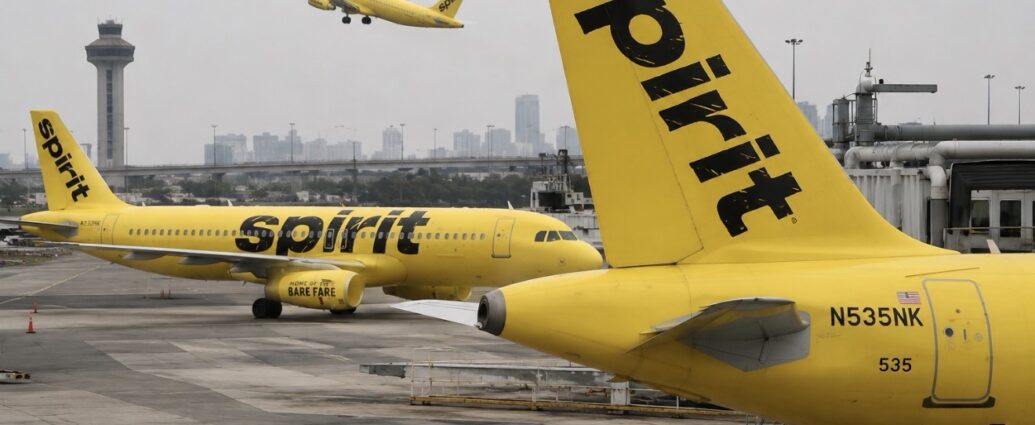
Spirit Airlines, one of America’s largest ultra-low-cost carriers, began an orderly wind-down of operations on May 2 after a second bankruptcy restructuring failed to stabilize the company.
The collapse stunned much of the industry because Spirit had spent years attempting to reduce debt, streamline operations and reposition itself financially following earlier restructuring efforts.
But the airline’s bankruptcy plans were built around assumptions that no longer reflected economic reality.
According to court and SEC filings, Spirit’s restructuring projected average 2026 jet fuel costs near $2.24 per gallon. By late April, however, prices had surged to approximately $4.51 per gallon, according to Patrick De Haan, Head of Petroleum Analysis at GasBuddy.
That nearly doubled fuel burden ultimately proved fatal.
“The sudden and sustained rise in fuel prices in recent weeks ultimately has left us with no alternative but to pursue an orderly wind-down,” Spirit Aviation Holdings Inc. said in an SEC filing announcing the closure.
At its peak, Spirit operated hundreds of daily flights and employed roughly 17,000 workers, becoming synonymous with ultra-cheap fares that pressured larger airlines to lower ticket prices across the industry.
Its collapse now carries major implications not only for airlines, but for consumers.
Industry analysts warn that fewer discount carriers competing for travelers could significantly reduce downward pressure on airfare pricing nationwide.
A study from the Massachusetts Institute of Technology found that low-cost carriers like JetBlue lower fares on routes they enter by roughly 8%, while ultra-low-cost airlines such as Spirit, Frontier, and Allegiant historically reduced prices by as much as 21%.
With Spirit gone and other budget airlines increasingly strained, those competitive pricing effects may weaken substantially.
For legacy airlines such as United Airlines, Delta Air Lines, and American Airlines, reduced low-cost competition could strengthen pricing power and improve margins at a time when premium travel demand remains relatively resilient.
The political backdrop surrounding Spirit’s collapse is equally significant.
In 2024, a federal judge blocked JetBlue Airways’ proposed $3.8 billion acquisition of Spirit Airlines after the Biden administration argued the merger would reduce competition and harm consumers through higher fares.
JetBlue ultimately terminated the deal and paid Spirit a $69 million breakup fee.
Spirit later entered bankruptcy again in 2025, and analysts now openly question whether the airline could have survived had the merger been approved before fuel prices exploded.
The regulatory environment today looks dramatically different.
Earlier this year, the Trump administration’s Department of Justice cleared Allegiant Air’s acquisition of Sun Country Airlines without objections — a move analysts view as a signal that regulators are now far more open to consolidation across the airline industry.
Deutsche Bank analysts described the Allegiant-Sun Country combination as a merger between two of the sector’s strongest-performing low-cost carriers, noting they were among the few discount airlines to maintain relatively stable profitability.
The acquisition will add approximately 22 million annual passengers, roughly $1 billion in revenue, and an estimated $135 million in free cash flow to Allegiant’s operations.
Meanwhile, reports from Semafor indicate JetBlue has hired advisers to explore potential merger discussions involving carriers including Alaska Airlines, Southwest Airlines, and even United Airlines.
For airline executives, the financial math is becoming increasingly difficult to ignore.
As long as Brent crude remains near $98 per barrel and geopolitical instability continues threatening global energy supplies, fuel costs alone could make standalone survival difficult for many ultra-low-cost carriers.
That reality is forcing airlines to fundamentally reconsider their operating structures, route strategies, and balance-sheet durability.
“There will undoubtedly be consolidation,” Linenberg said, warning that carriers are being forced to “readdress their cost basis” under the weight of sustained fuel inflation.
For travelers, however, the implications are more complicated.
The rise of ultra-low-cost airlines over the past two decades fundamentally reshaped American travel by making flying accessible to millions of lower-income and budget-conscious consumers.
If mergers accelerate and independent discount carriers disappear, economists warn that the industry emerging from this crisis may look significantly more concentrated — and significantly more expensive — than the airline market Americans entered at the start of 2026.
JBizNews Desk
© JBizNews.com. All rights reserved. This article is original reporting by JBizNews Desk. Unauthorized reproduction or redistribution is strictly prohibited.