One week after an Iranian missile struck the container ship CMA CGM San Antonio near the Strait of Hormuz, the disruption has evolved from a maritime security crisis into a growing economic shock now directly feeding into U.S. inflation, Federal Reserve policy expectations, and global supply-chain costs.
The economic consequences became unmistakable Tuesday morning when the Bureau of Labor Statistics reported that April inflation accelerated to 3.8% year-over-year, the highest annual Consumer Price Index reading since May 2023.
Economists increasingly say the prolonged disruption surrounding the Strait of Hormuz — one of the world’s most critical shipping and energy corridors — is now moving far beyond oil markets and embedding itself across transportation, freight, manufacturing, and consumer pricing throughout the global economy.
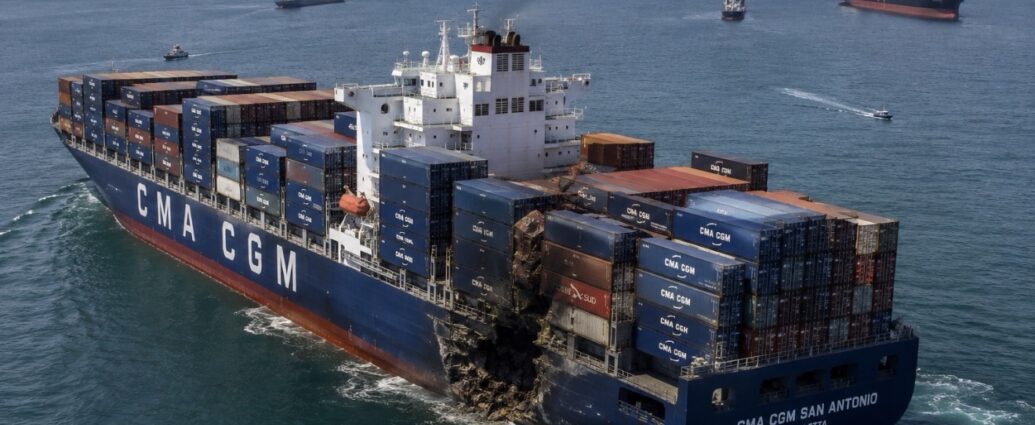
The crisis traces back to the May 5 missile strike on the CMA CGM San Antonio, a Maltese-flagged container ship operated by the world’s third-largest shipping company.
The vessel, bound for India, was struck while attempting to transit the strait without participating in “Project Freedom,” a temporary U.S.-backed maritime coordination program introduced by President Donald Trump one day earlier.
Eight crew members were injured in the attack, and the vessel sustained significant damage.
CMA CGM Chief Executive Rodolphe Saadé later expressed “full support” for the company’s seafarers as international shipping companies rapidly reassessed operations in the Gulf region.
Within 48 hours, Trump suspended Project Freedom altogether.
What has happened since has become increasingly alarming for global markets.
According to maritime tracking data cited by logistics firms and shipping analysts, approximately 1,550 commercial vessels and more than 22,500 mariners remain stranded or heavily delayed near the Strait of Hormuz, with regional throughput operating at only a fraction of normal capacity.
Major shipping companies are now rerouting vessels around Africa, dramatically increasing fuel consumption, delivery times, and operating costs.
A.P. Moller-Maersk, the world’s second-largest container shipping company, told investors the crisis is adding approximately $500 million per month in additional fuel costs alone as vessels avoid the Gulf region.
Shipping executives warn the disruptions may continue for months even if a ceasefire eventually materializes.
“Normalization will likely take four to six months after any ceasefire,” Tobias Maier, CEO of DHL Global Forwarding Middle East and Africa, told customers last week.
The attacks themselves have also escalated.
Beyond the strike on the San Antonio, the past week saw:
- a drone attack targeting an ADNOC-affiliated tanker,
- attacks on commercial bulk carriers by Iranian fast boats,
- and an explosion aboard the cargo ship HMM Namu near the UAE coast.
Meanwhile, the United Kingdom Maritime Trade Operations Centre has logged dozens of separate security incidents involving vessels operating in and around the Arabian Gulf since the conflict intensified.
The economic effects are now showing up across Wall Street forecasts.
Chris Zaccarelli, Chief Investment Officer at Northlight Asset Management, said Tuesday’s CPI report confirms the inflationary pressure from the conflict is no longer limited to energy alone.
“It’s impacting both the headline number as expected, but also the core,” Zaccarelli said, referring to inflation categories beyond food and gasoline.
The inflation shock has already forced major banks to dramatically revise Federal Reserve forecasts.
Earlier this week, Bank of America pushed its expectation for the next Fed rate cut all the way to July 2027, citing persistent inflation and resilient labor-market conditions.
Meanwhile, Goldman Sachs lowered its U.S. recession probability to 25% while simultaneously delaying its projected timeline for Fed easing.
Oil markets continue reflecting the severity of the disruption.
On Tuesday morning:
- WTI crude traded above $102 per barrel,
- Brent crude climbed above $103,
- and Treasury yields rose as traders reduced expectations for near-term interest-rate cuts.
Even some of Wall Street’s most optimistic voices are beginning to sound more cautious.
JPMorgan Chase Chief Executive Jamie Dimon warned Tuesday that the Iran conflict “gets a little more serious every day,” adding that markets may be showing “too much exuberance” given the inflation and geopolitical risks now building simultaneously.
The crisis is also increasingly becoming a central geopolitical issue ahead of Trump’s trip to Beijing this week, where he is expected to meet with Chinese President Xi Jinping for high-stakes talks involving trade, technology restrictions, and the broader Middle East conflict.
China remains one of Iran’s most important economic partners and oil buyers, raising questions over whether Beijing could play a larger diplomatic role in stabilizing maritime routes and global energy flows.
For investors and policymakers, the significance of the CMA CGM San Antonio strike has now moved far beyond a single shipping attack.
It has become a symbol of how quickly geopolitical conflict can spread through global trade systems and ultimately land in American inflation reports, Federal Reserve forecasts, fuel prices, and consumer wallets.
The question facing markets now is whether the shipping crisis has reached its peak — or whether the economic damage is only beginning to fully emerge.
JBizNews Desk
© JBizNews.com. All rights reserved.