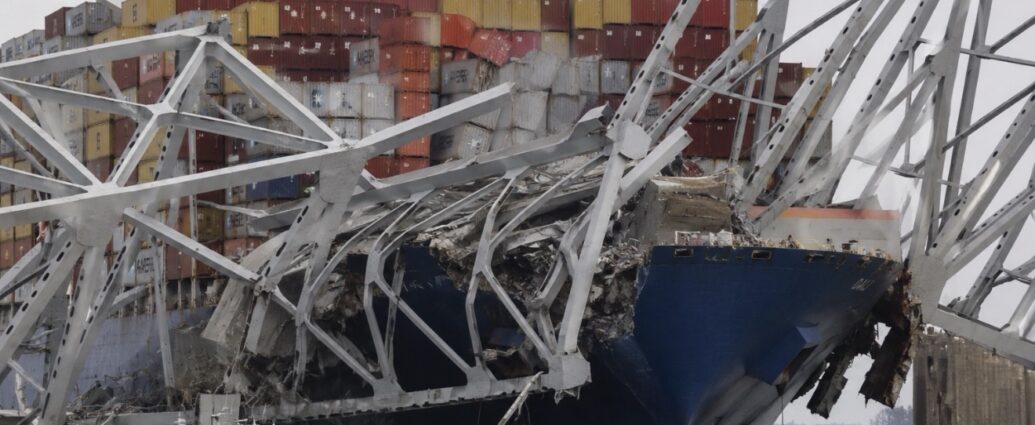
The U.S. Department of Justice filed sweeping federal criminal charges Tuesday against the companies responsible for operating the cargo ship Dali and the vessel’s technical superintendent, accusing them of deliberately ignoring known safety risks, falsifying inspection records, and misleading federal investigators in the catastrophic 2024 collapse of Baltimore’s Francis Scott Key Bridge.
Federal prosecutors say the disaster — which killed six construction workers, shut down one of America’s busiest shipping ports, and caused more than $5 billion in economic and infrastructure damage — was entirely preventable.
The 18-count indictment, unsealed Tuesday morning in federal court in Maryland, charges:
- Synergy Marine Pte Ltd, based in Singapore,
- Synergy Maritime Pte Ltd, based in Chennai, India,
- and Radhakrishnan Karthik Nair, the Dali’s technical superintendent.
The defendants face charges including:
- conspiracy to defraud the United States,
- obstruction of federal investigators,
- false statements,
- and failure to report hazardous conditions to the U.S. Coast Guard.
The two corporate entities were also charged with environmental violations tied to pollution released into the Patapsco River following the collapse.
“The collapse of the Francis Scott Key Bridge was a preventable tragedy of enormous consequence,” said Acting Attorney General Todd Blanche. “Six construction workers lost their lives, critical infrastructure was destroyed, pollutants were released into the Patapsco River and Chesapeake Bay, and the economic damage now exceeds five billion dollars.”
According to prosecutors, the heart of the case centers on deliberate decisions involving the Dali’s electrical and fuel systems before the ship departed Baltimore Harbor in the early morning hours of March 26, 2024.
Federal investigators allege that a loose wire inside a high-voltage switchboard triggered the vessel’s initial power failure as the nearly 1,000-foot cargo ship navigated outbound toward Sri Lanka.
But prosecutors say the more devastating failure came seconds later.
The indictment alleges the ship’s operators had improperly modified the vessel’s fuel configuration, relying on a “flushing pump” system not designed to automatically restart after power outages.
When the Dali lost power the first time, the flushing pump reportedly failed to reactivate, starving the ship’s generators of fuel and triggering a second catastrophic blackout moments before impact.
“After that first blackout, the ship’s generators became starved of fuel, causing a second blackout,” said U.S. Attorney Kelly Hayes for the District of Maryland.
The powerless vessel then slammed directly into one of the bridge’s primary support columns at approximately 1:30 a.m., causing the massive steel structure to collapse into the river within seconds.
Federal prosecutors allege the companies knew the flushing-pump configuration violated international maritime safety standards and failed to properly disclose or correct the issue despite repeated warnings and internal knowledge of the risks.
Investigators also claim similar unsafe configurations were found on multiple other vessels operated by the companies.
The indictment further accuses executives and managers of falsifying safety certifications and lying to federal investigators after the collapse.
“Those responsible for the ship’s operation deliberately cut corners to the expense of safety,” said Jimmy Paul, Special Agent in Charge of the FBI Baltimore Field Office. “They forged safety inspections and certifications. They falsely claimed the ship was in good working order and then lied to investigators.”
The collapse triggered one of the largest infrastructure and maritime disruptions in recent U.S. history.
The Port of Baltimore, one of the nation’s most important shipping hubs for automobiles, agricultural equipment, and container traffic, remained largely shut down for nearly two months while the U.S. Army Corps of Engineers cleared wreckage from the shipping channel.
Maryland officials estimate the broader economic impact rippled through thousands of jobs tied to logistics, trucking, shipping, construction, and port operations.
The replacement bridge is now projected to cost between $4.3 billion and $5.2 billion, with completion not expected until approximately 2030.
The original bridge opened in 1977 after five years of construction and stretched roughly 1.6 miles across Baltimore Harbor.
The six workers killed in the collapse were part of an overnight road maintenance crew repairing potholes on the bridge when the Dali struck the structure.
The victims were identified as:
- Dorlian Ronial Castillo Cabrera
- Carlos Daniel Hernandez Estrella
- Alejandro Hernandez Fuentes
- Jose Mynor Lopez
- Miguel Angel Luna
- Maynor Yasir Suazo Sandoval
A seventh worker survived with serious injuries after being thrown into the river.
The criminal case now becomes one of the most consequential maritime prosecutions in decades, raising broader questions about global shipping oversight, vessel maintenance standards, and corporate accountability inside the international cargo industry.
Federal investigators say the evidence suggests the disaster was not the result of an unforeseeable accident — but rather a chain of ignored warnings, improper modifications, and systemic failures that prosecutors argue ultimately cost six people their lives.
JBizNews Desk
© JBizNews.com. All rights reserved.