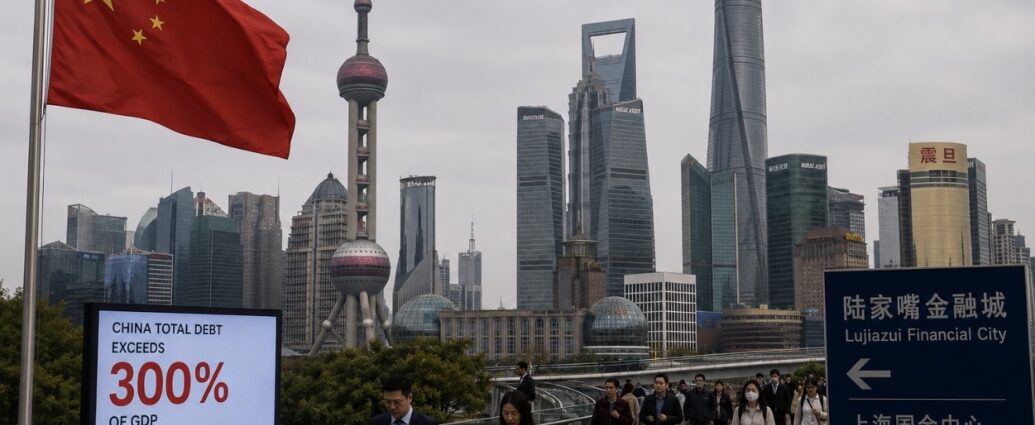
China‘s total debt-to-GDP ratio, excluding the financial sector, has more than doubled since 2010 and now exceeds 300% — a level that Capital Economics Chief Asia Economist Mark Williams describes as putting China “in a league of its own” among major global economies, with the trajectory deteriorating faster than the United States’ federal debt picture and raising fresh structural questions just as President Trump departed Tuesday evening for his Beijing state visit with President Xi Jinping on a trip framed around technology, trade, and rare-earth access.
Williams, in a late-April research note that has now circulated through global fixed-income desks ahead of the Trump-Xi meeting, calculated that China’s aggregate debt across households, non-financial corporations, and central and local governments has risen by more than 120% of GDP over the past 15 years — an expansion that surpasses the United States, the eurozone, the United Kingdom, and the broader emerging-markets aggregate. Only Japan carries more total debt as a share of GDP, and Japan’s position reflects decades of below-trend nominal growth combined with deep domestic savings and yen-denominated borrowing, a structural posture that China does not share.
The composition of China’s debt expansion is the central concern. Household borrowing has weakened since the 2021–2023 property-market collapse, with Country Garden, Evergrande, and Sunac China Holdings restructurings continuing to weigh on consumer confidence. But corporate and public-sector borrowing have continued to far outpace GDP growth. Nearly 40% of outstanding Chinese debt is now owed by the public sector, including the network of local government financing vehicles (LGFVs) that Beijing has used over the past decade to fund infrastructure and industrial-policy priorities including artificial intelligence, electric vehicles, and robotics.
“China‘s current level of indebtedness puts it in a league of its own,” Williams wrote in the note. He flagged the rate of growth as separately concerning. The ratio’s 120% increase over 15 years is one of the steepest credit expansions in modern macroeconomic history, comparable to U.S. credit expansion before the 2008 financial crisis or Japan’s pre-1989 cycle.
The corporate borrowing trajectory is particularly troubling. Capital Economics data show that Chinese non-financial business debt has roughly doubled since 2019, while corporate revenues have risen only 30% over the same span. The implication is that Chinese firms are increasingly borrowing to refinance existing obligations and fund operating losses rather than to expand productive capacity. Williams estimated that nearly one-third of Chinese companies are losing money, with creditors continuing to roll over loans to keep struggling firms afloat — a dynamic that prevents capital from reaching healthier borrowers, deepens industrial overcapacity, and contributes to the persistent deflationary pressure that has bedeviled the Chinese economy.
The U.S. comparison is sharper than headlines about American federal debt suggest. While the U.S. federal debt has crossed 100% of GDP for the first time since the immediate post-World War II period, total public and private U.S. debt sits at approximately 265% of GDP — a figure that has actually declined from pandemic-era highs as households and businesses deleveraged. Williams’s note frames the contrast as a U.S. picture that “is actually down since 2010” against a Chinese picture that has doubled in the same window. The comparison cuts against the common framing of Chinese strength versus U.S. fiscal weakness that has dominated political discussion of the bilateral relationship.
Beijing is publicly aware of the problem. Over the weekend, Chinese authorities — speaking through China Central Television, as reported by Bloomberg — vowed to ramp up efforts to ease LGFV debt risk through a restructuring program designed to help borrowers meet payments on schedule. Officials also called for preventing new hidden borrowing, strengthening the domestic economy, and advancing infrastructure investment. The People’s Bank of China, under Governor Pan Gongsheng, has cut benchmark lending rates four times in the past 18 months, and the State Council’s Financial Stability and Development Committee has signaled a more aggressive posture toward restructuring stressed local-government debt.
Williams argued that the Chinese government’s outsized role in the financial system reduces the probability of a Lehman Brothers-style cascade.
“The financial system survived a major stress test in the form of the property market crash,” he wrote, citing high domestic savings, strict capital controls, and the state’s dominance over the banking sector. Industrial and Commercial Bank of China, China Construction Bank, Bank of China, and Agricultural Bank of China — the so-called Big Four — all retain effective sovereign backing. The structural risk is therefore not acute crisis but chronic drag.
“The irony is that one driver of both government borrowing and the lax lending standards of state-owned banks is the desire to prop up economic growth and prevent job losses,” Williams said. “But the product of a credit boom that has been underway for 18 years is a banking system propping up unproductive firms, widespread losses across industry, and a deflationary impulse that is now exporting itself globally.”
The timing of the analysis is geopolitically pointed. President Trump departs Washington Tuesday evening for his Beijing state visit, accompanied by a delegation that includes Apple Chief Executive Tim Cook, Tesla Chief Executive Elon Musk, BlackRock Chief Executive Larry Fink, Boeing Chief Executive Kelly Ortberg, and Goldman Sachs Chief Executive David Solomon. The visit is expected to focus on technology export controls, rare-earth access, the unresolved tariff structure imposed during 2025, and bilateral cooperation on industrial policy. The Capital Economics debt analysis arrives at a moment when the U.S. business community is being asked to invest more aggressively in China at exactly the point when the country’s domestic credit cycle is showing the most strain in two decades.
For global investors, the Williams note reframes the debate. The default question of recent years has been when the U.S. fiscal trajectory becomes unsustainable. The Capital Economics data point suggests the analogous question for China — whether the debt accumulation produces a slow-grinding drag on growth, a sharper structural break, or a managed unwind through state-led restructuring — is now the more immediate macroeconomic issue. The answer will shape the trajectory of Chinese demand for U.S. exports, the country’s continued willingness to fund overcapacity in steel, solar, and EV production, and the political bandwidth Beijing has to negotiate trade and security with the Trump administration over the coming year.
JBizNews Desk
© JBizNews.com. All rights reserved. This article is original reporting by JBizNews Desk. Unauthorized reproduction or redistribution is strictly prohibited.