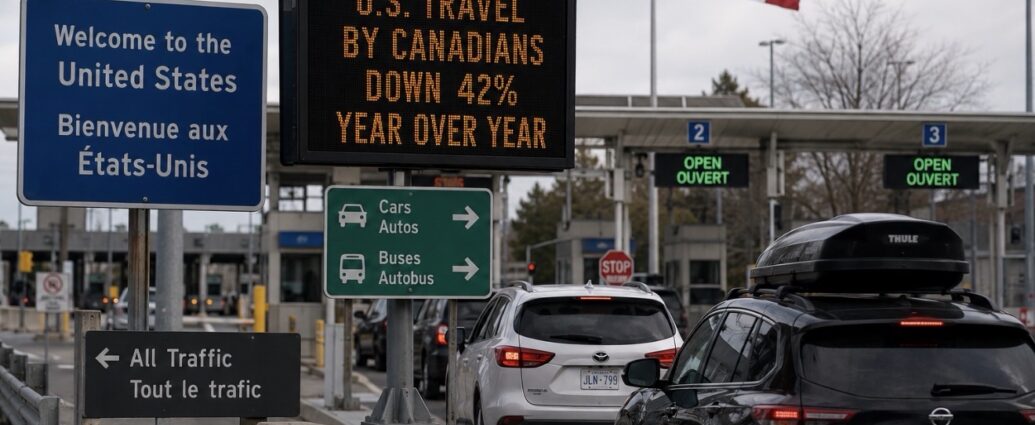
Canadian visits to U.S. cities have fallen 42% year over year through March 2026, a sharper contraction than any official measure has captured to date, according to a cellphone-tracking analysis released this week by the University of Toronto’s School of Cities — research that contradicts the narrower 25% decline shown in Statistics Canada border-crossing data and reveals that financial centers, automotive hubs, and conference cities have absorbed business-travel losses materially larger than tourism-focused destinations.
The study, authored by Karen Chapple, Yihoi Jung, and Jeff Allen at the School of Cities, was released as part of the school’s “Mapping Tariffs” project. The researchers analyzed cellphone activity from Canadian devices between April 2024 and March 2026, requiring each tracked trip to register a stop in Canada, a stop in the U.S., and a return stop in Canada. Of 267 U.S. cities included in the analysis, only three saw increased Canadian visits over the period. Myrtle Beach, South Carolina showed the largest decline at 65.4%; Yuma, Arizona declined 62%. Major financial and industrial hubs including Dallas, Grand Rapids, Michigan, New York, San Francisco, Los Angeles, and Houston also showed substantial declines.
“This means that border crossing data is not capturing the full drop in Canadian business and trade-related travel, and when Canadians travel to the U.S., they are visiting fewer locations and staying for less time than they used to,” Chapple, Jung, and Allen wrote in the study’s findings.
CBS News separately reported Tuesday that Statistics Canada estimates U.S. residents visiting Canada dropped 75% in 2025 — a parallel collapse in cross-border travel.
The financial-center detail is the most consequential finding for U.S. corporate strategy.
Dallas has emerged as one of the largest U.S. operating hubs for Canadian financial institutions, with Scotiabank opening a regional headquarters in the city in early 2026 joining Royal Bank of Canada, Bank of Montreal, and Canadian Imperial Bank of Commerce. The Canadian-bank corridor between Toronto and Dallas has expanded sharply over the past three years as the institutions positioned for the U.S. infrastructure, energy-transition, and private-credit cycle.
Grand Rapids, named Vaughan, Ontario as a sister city earlier this month, sits at the center of cross-border auto-industry supply chains anchored by Ford Motor Company, General Motors, and Stellantis plants in Detroit and southern Ontario.
The financial impact is concentrated because of how business travel sits in the U.S. travel economy. The U.S. Travel Association estimates business travel represents approximately 20% of total travel to the U.S. but accounts for roughly 60% of air and lodging revenue, reflecting higher hotel and conference-center spend, more dining out, and premium-cabin air bookings.
Chapple told Fortune that the loss of business travelers is more costly than the tourism decline because of the revenue mix.
Air Canada, Delta Air Lines, and United Airlines all operate substantial cross-border premium-cabin networks on routes between Toronto, Montreal, Calgary, Vancouver, and U.S. financial and technology centers.
The employment data confirm the macroeconomic transmission.
Center for Economic and Policy Research analysis found that by mid-2025, U.S. establishments with the highest share of Canadian visitors had approximately 6% fewer employees than establishments in less Canada-exposed markets — a loss of between 14,000 and 42,000 jobs across affected markets. The job-loss range exceeds anything captured in standard tourism-employment statistics because the CEPR methodology isolates Canadian-traffic exposure rather than total establishment employment.
For investors, the sectoral exposure runs across hotels, airlines, gaming, and conference operators.
MGM Resorts International, Caesars Entertainment, and Wynn Resorts in Las Vegas carry direct exposure to leisure-tourism declines. Walt Disney Company’s Orlando parks, Hard Rock International’s Florida operations, and Myrtle Beach hospitality operators face the deepest leisure-side hits.
On the business-travel side, Marriott International, Hilton Worldwide, and Hyatt Hotels carry exposure across all the affected financial and convention centers. The American Hotel & Lodging Association has consistently identified business and group travel as central to weekday occupancy and revenue-per-available-room — exactly the segment now compressing.
The airlines face the most asymmetric exposure.
Delta Air Lines Chief Executive Ed Bastian has spent the past three years positioning Delta as a premium-service operator, with the highest mix of business and corporate revenue in the U.S. domestic majors. United Airlines Chief Executive Scott Kirby has similarly leaned into cross-border corporate flying. American Airlines Chief Executive Robert Isom runs a more balanced mix. Air Canada Chief Executive Michael Rousseau sits at the center of the cross-border network on the Canadian side.
Sell-side coverage from Conor Cunningham at Melius Research, Helane Becker at TD Cowen, Sheila Kahyaoglu at Jefferies, and Andrew Didora at Bank of America has tracked the cross-border business-travel softness through Q1 2026, but the University of Toronto data point materially exceeds anything in the sell-side analyst base cases.
The political backdrop adds to the friction.
The Trump administration imposed sweeping tariffs on Canadian imports in early 2025, including 25% tariffs on steel and aluminum and broader Section 232 measures, while the President has publicly mused about Canada becoming the “51st state.”
Canadian Prime Minister Mark Carney, who succeeded Justin Trudeau in March 2025 and won the April 2025 federal election, has positioned Canada as building economic alternatives to U.S. dependence, with Bank of Canada Governor Tiff Macklem cutting rates four times in the past 18 months to support domestic demand.
The Mapping Tariffs project at the University of Toronto is itself a direct response to the trade-and-political environment.
The cellphone-tracking methodology has limitations. Statistics Canada and the U.S. Census Bureau rely on formal survey and administrative data, while device-based analysis captures physical movement but not spending. The researchers acknowledged that the data may include Canadians who were previously living in the U.S. and have since returned home — a population that would compound the headline number but not represent active travel demand.
Even with those caveats, the 42% figure is consistent with anecdotal reporting from cross-border hotel operators, convention managers, and airline operations groups dating back to the second quarter of 2025.
The findings dovetail with the broader macroeconomic picture today’s data have produced.
April CPI released Tuesday at 3.8% confirmed inflation reacceleration. The National Federation of Independent Business Small Business Optimism Index, also released Tuesday, came in at 95.9, the second consecutive month below the 52-year average. The National Bureau of Economic Research working paper from Chloe East at the University of Colorado Boulder and Elizabeth Cox found this week that ICE enforcement has reduced employment for U.S.-born workers in construction, agriculture, and hospitality — sectors that overlap with the Canadian-traffic exposure the University of Toronto data now quantify.
The combined picture is a U.S. economy absorbing the second-order effects of trade and immigration policy across multiple channels simultaneously. Tariffs raise input costs and shift supplier behavior. Border and visa policies reduce cross-border business travel. ICE activity contracts labor supply in construction and hospitality. Energy disruption from the Iran war raises shipping and freight costs. Each channel by itself would be material; in combination, they constitute a coordinated headwind on the discretionary-services and cross-border-commerce segments of the U.S. economy.
The next data point on the trajectory is the U.S. Department of Commerce International Trade Administration’s next quarterly inbound-tourism release, due in late June, which should begin to reflect the cellphone-data gap with official statistics. Whether Carney’s May meeting with Trump scheduled for next month produces a tariff de-escalation, and whether the Iran war ceasefire holds — both still in flux — will shape the trajectory of cross-border travel through the summer.
The University of Toronto data suggest the recovery, when it comes, will start from a deeper hole than border-crossing data have signaled.
JBizNews Desk
© JBizNews.com. All rights reserved. This article is original reporting by JBizNews Desk. Unauthorized reproduction or redistribution is strictly prohibited.