A new emergency trade architecture is rapidly reshaping the Middle East and global commodity markets as Gulf nations scramble to bypass the closed Strait of Hormuz, one of the world’s most critical maritime chokepoints. Eleven weeks after the United States and Israel launched airstrikes against Iran on Feb. 28 — and Tehran retaliated by effectively shutting the strait — Saudi Arabia, the United Arab Emirates and neighboring Gulf states have begun constructing an improvised overland economic corridor to keep oil, fertilizer, food and consumer goods moving.
At the center of that effort is a massive Saudi trucking operation unlike anything seen in the kingdom’s modern industrial history.
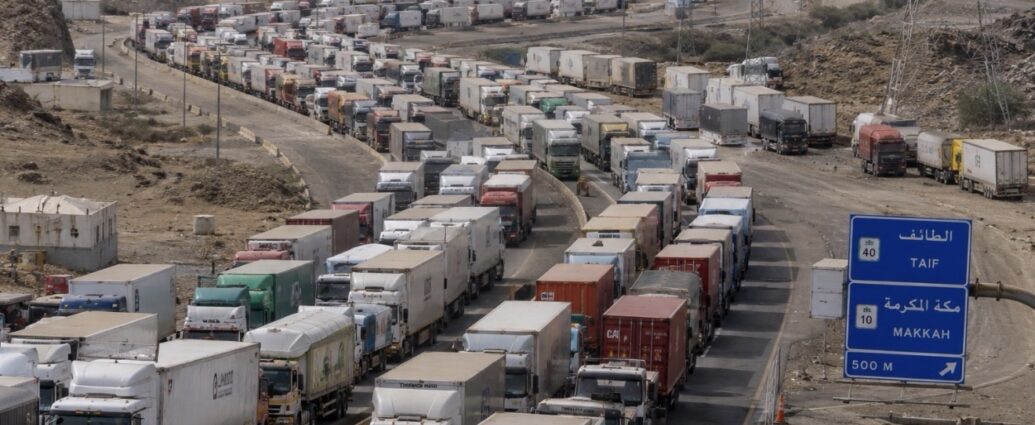
According to reporting from The Wall Street Journal, Saudi state mining giant Maaden has expanded its emergency logistics fleet to approximately 3,500 trucks, hauling phosphate fertilizer across more than 1,300 kilometers of desert from its Persian Gulf production hub at Ras Al-Khair to the Red Sea export terminal at Yanbu. The convoy system was created after tanker exports through Hormuz became effectively impossible following the outbreak of the regional war.
The scale of the disruption is staggering. Before the conflict, roughly 20 million barrels of oil per day and nearly one-third of global seaborne fertilizer trade passed through the Strait of Hormuz. According to shipping analytics firm Kpler, only 191 vessels crossed the waterway during April compared with a normal monthly average near 3,000 ships, leaving Gulf maritime traffic operating at roughly 5% of normal commercial throughput.
The result has been one of the fastest supply-chain restructurings in modern energy-market history.
Saudi Arabia’s rerouted fertilizer exports are now flowing west through the Red Sea rather than east through the Persian Gulf. According to Argus Media, Maaden has already shipped approximately 15,000 tons of MAP fertilizer to South America from Yanbu and sold another 50,000 tons of DAP fertilizer to Ethiopia through Djibouti. April export lineups from Yanbu reportedly reached roughly 105,000 tons.
The workaround matters far beyond the Gulf itself.
Saudi Arabia accounted for approximately 19% of global DAP and MAP fertilizer exports in 2025, while the broader Gulf region produces nearly half of the world’s urea supply and roughly 30% of global ammonia production. Fertilizer markets have already reacted violently to the crisis, with urea prices climbing roughly 50% since the war began, according to industry data cited by The Fertilizer Institute.
The agricultural consequences are increasingly alarming.
The United Nations has established an emergency task force led by Jorge Moreira da Silva, Executive Director of the UN Office for Project Services, to coordinate humanitarian fertilizer shipments amid fears that supply shortages could trigger severe food insecurity across parts of Africa, Asia and Latin America. The World Food Programme warned this week that as many as 45 million people could face hunger or starvation in coming months if fertilizer supply chains remain disrupted.
Meanwhile, the United Arab Emirates has emerged as the second critical pillar of the Gulf’s improvised bypass network.
The UAE’s eastern port of Khor Fakkan, located outside the Strait of Hormuz on the Gulf of Oman, has become one of the region’s most strategically important logistics hubs almost overnight. According to Reuters, weekly container traffic through the port has surged to roughly 50,000 containers from a pre-war baseline near 2,000, while daily truck movements exploded to approximately 7,000 per day from barely 100 daily movements before the war.
“This has become a critical national gateway,” Farid Belbouab, Chief Executive of terminal operator Gulftainer, told Reuters.
To manage the surge, Gulftainer hired approximately 900 workers within the first weeks of the conflict and is now planning a logistics and dry-port expansion project reportedly exceeding $100 million inland at Al Dhaid, connected to Khor Fakkan through road and future rail infrastructure.
The neighboring UAE oil hub at Fujairah has also become indispensable to global energy markets.
Crude shipments from Fujairah have risen approximately 38% since late February, pushing the Abu Dhabi Crude Oil Pipeline, operated by ADNOC, near its maximum capacity of 1.8 million barrels per day. At the same time, Saudi Arabia’s East-West pipeline to Yanbu is reportedly operating at full capacity near 7 million barrels daily.
Combined, these emergency bypass systems are now rerouting roughly 9 million barrels of oil per day around Hormuz — still less than half the strait’s normal flow but enough to prevent a complete collapse in global energy markets.
The International Energy Agency has responded by coordinating the release of approximately 400 million barrels from strategic petroleum reserves among member nations, the largest emergency reserve deployment in the agency’s history.
Yet despite the massive logistical response, the workaround remains deeply vulnerable.
The Wall Street Journal reported Monday that the UAE secretly conducted military strikes inside Iran during the conflict, including an alleged attack on Iran’s Lavan Island refinery earlier this spring. In response, Iran’s Revolutionary Guards Navy has published maps asserting military control over waters surrounding both Khor Fakkan and Fujairah, while drone strikes earlier this week hit the Fujairah Oil Industry Zone, injuring workers and igniting fires near storage facilities.
Saudi Aramco Chief Executive Amin Nasser warned over the weekend that even if the Strait of Hormuz reopened immediately, disruptions to oil, fertilizer and shipping markets could continue well into 2027.
For several Gulf nations, the situation is even more precarious.
Qatar, Kuwait, and Bahrain lack meaningful overland export alternatives and remain heavily dependent on rerouted cargo flows through UAE infrastructure and Saudi trucking corridors. Goods are now increasingly unloaded at Khor Fakkan and transported overland across Saudi Arabia back toward Gulf markets — a fragile and expensive system built almost entirely under wartime pressure.
The result is a dramatically altered map of global trade.
What began as a regional military conflict has rapidly evolved into one of the largest emergency supply-chain reorganizations in modern history, reshaping energy flows, agricultural markets and global shipping patterns in real time. And with the Strait of Hormuz still effectively shut, the world economy is now relying on a handful of vulnerable roads, pipelines and ports to keep critical commodities moving.
— JBizNews Desk
© JBizNews.com. All rights reserved. This article is original reporting by JBizNews Desk. Unauthorized reproduction or redistribution is strictly prohibited.