Wall Street heads into Wednesday facing another potentially volatile session as investors brace for fresh inflation data, a historic Federal Reserve leadership transition, and one of the technology sector’s most closely watched earnings reports — all against a backdrop of surging oil prices, rising Treasury yields and renewed fears that the market’s AI-fueled rally may be colliding with a worsening inflation cycle.
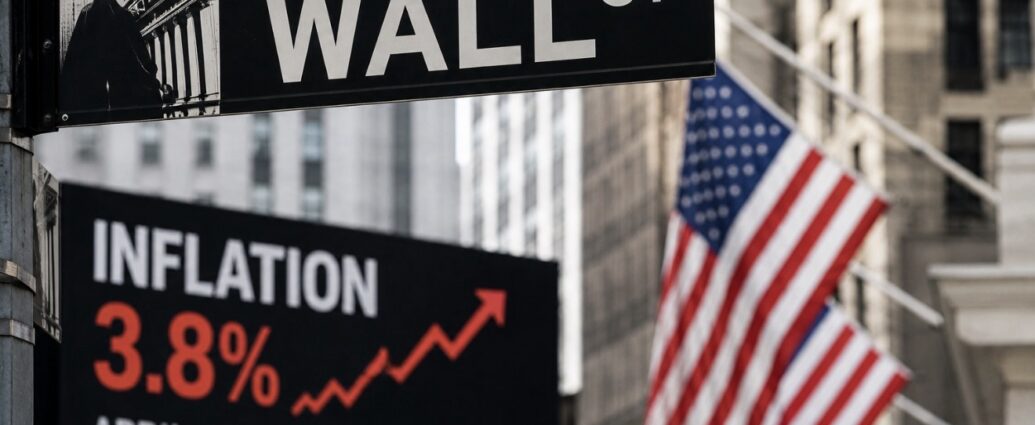
The day’s biggest catalyst arrives at 8:30 a.m. ET, when the Bureau of Labor Statistics releases the April Producer Price Index, the wholesale inflation report that follows Tuesday’s scorching 3.8% Consumer Price Index print that rattled markets and effectively erased what remained of Wall Street’s rate-cut expectations for 2026.
Investors are now watching closely to see whether wholesale inflation confirms that pricing pressures are spreading deeper into the economy — particularly across energy, industrial goods and supply chains increasingly strained by the ongoing Middle East conflict and continued disruption around the Strait of Hormuz.
Overnight futures already reflected growing anxiety.
Early Wednesday trading showed Nasdaq 100 futures falling roughly 0.85%, while S&P 500 futures dropped approximately 0.37% as investors continued pulling back from high-growth technology shares following Tuesday’s sharp semiconductor selloff. The CBOE Volatility Index (VIX) climbed toward 18.75, signaling a rebuilding of hedges after months of unusually calm trading conditions during the spring AI rally.
Commodity markets remained equally tense.
WTI crude oil surged another 3.4%, climbing above $101 per barrel, amid reports that the Trump administration is reconsidering military operations involving Iran and growing concern that energy disruptions tied to Hormuz could persist well into next year. Gold held near record highs above $4,700, while bitcoin slipped toward $80,700 as traders reduced exposure to risk assets.
The inflation report itself may ultimately determine the direction of the entire trading session.
March’s Producer Price Index showed wholesale inflation accelerating 0.5% month-over-month and 4.0% year-over-year, driven heavily by energy costs including a nearly 16% jump in gasoline prices. Economists now warn that another strong PPI reading Wednesday could cement fears that inflation is becoming embedded again throughout the broader economy.
“It’s becoming increasingly difficult to justify any near-term rate cuts,” Chris Zaccarelli, Chief Investment Officer at Northlight Asset Management, warned Tuesday after the CPI release.
Markets are already rapidly adjusting.
According to CME Group FedWatch data, traders now assign growing odds that the Federal Reserve could actually raise rates again before the end of 2026 — a dramatic reversal from earlier expectations that the central bank would deliver multiple cuts this year.
At the same time, Washington is preparing for one of the most consequential Federal Reserve leadership transitions in years.
The U.S. Senate is expected to vote Wednesday on confirming former Fed governor Kevin Warsh to a concurrent four-year term as Federal Reserve chairman, replacing Jerome Powell, whose term officially ends Friday. The Senate advanced Warsh Tuesday after clearing his appointment to the Fed Board of Governors by a 51-45 margin.
Warsh would immediately inherit one of the most complicated economic environments of the post-pandemic era: stubborn inflation, negative real wage growth, elevated Treasury yields, slowing consumer spending and increasingly fragile financial markets.
Investors remain divided over how independent Warsh would operate from the White House.
A recent CNBC Fed Survey found only about half of respondents believe Warsh would conduct monetary policy mostly independently from President Donald Trump, whose administration continues pushing for lower rates even as inflation pressures intensify.
Markets are now looking toward the Federal Reserve’s June 16-17 FOMC meeting as the likely first major test of Warsh’s leadership approach.
Corporate earnings could provide the market’s only meaningful positive catalyst Wednesday evening.
Cisco Systems Inc. reports fiscal third-quarter results after the close in what many analysts view as a critical test of whether the AI infrastructure spending boom remains intact following Tuesday’s market shock.
Options markets are pricing in nearly a 10% move in Cisco shares after earnings, according to TipRanks data — an unusually large expected swing that reflects investor uncertainty surrounding enterprise technology demand and AI-related capital spending.
Cisco has guided quarterly revenue between $15.4 billion and $15.6 billion and recently raised its full-year AI infrastructure order forecast above $5 billion after reporting approximately $2.1 billion in AI-related orders during the previous quarter alone.
Shares of Cisco are already up roughly 28% year-to-date as investors increasingly view the company as a major beneficiary of exploding AI data-center demand.
Analysts across Wall Street are expected to closely examine Cisco’s commentary surrounding cloud infrastructure spending, hyperscaler demand and corporate technology budgets heading into NVIDIA Corp.’s highly anticipated earnings release next week.
Meanwhile, several major Chinese technology companies are also reporting Wednesday, adding another layer of global significance to the session.
Alibaba Group Holding Ltd. and Tencent Holdings Ltd. both release earnings as investors monitor Chinese consumer demand, cloud-computing growth and artificial-intelligence spending trends amid ongoing U.S.-China trade tensions.
Geopolitical risks continue hovering over all of it.
President Donald Trump is preparing for a major diplomatic trip to China focused on tariffs, trade normalization and artificial-intelligence cooperation with President Xi Jinping, while Middle East instability continues driving energy-market volatility.
The Wall Street Journal reported earlier this week that the United Arab Emirates secretly conducted military strikes inside Iran during the recent conflict, including attacks targeting Iranian refinery infrastructure. Saudi Aramco Chief Executive Amin Nasser warned over the weekend that even a full reopening of the Strait of Hormuz would not normalize global energy markets before 2027.
That warning now hangs over every inflation report, every Treasury auction and every Federal Reserve decision.
For Wall Street, Wednesday increasingly looks like another high-stakes stress test for a market trying to determine whether the AI boom can continue outrunning a rapidly worsening macroeconomic backdrop.
A softer-than-expected PPI reading could spark a relief rally across semiconductors and megacap technology shares battered during Tuesday’s selloff. But another inflation surprise — combined with elevated oil prices and rising bond yields — could extend the market’s sharp reversal deeper into the broader economy and force investors to confront a reality many hoped had already passed: the inflation fight may be far from over.
— JBizNews Desk
© JBizNews.com. All rights reserved. This article is original reporting by JBizNews Desk. Unauthorized reproduction or redistribution is strictly prohibited.