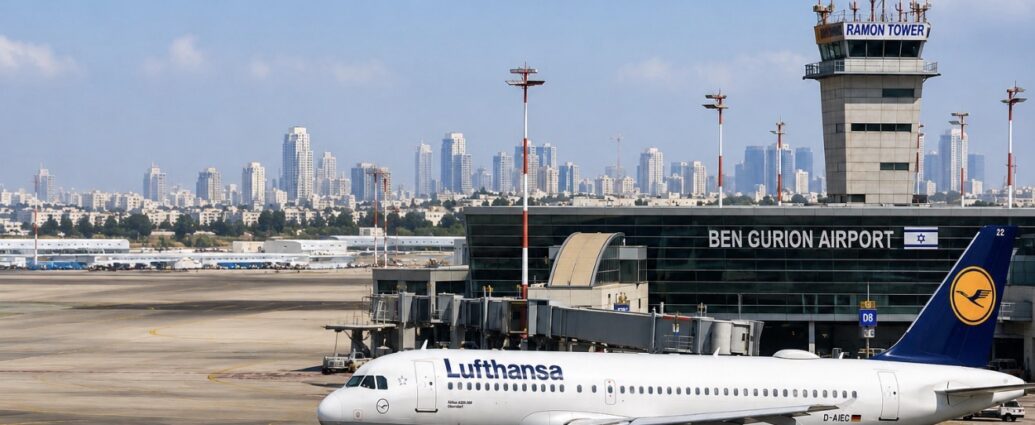
The European Union Aviation Safety Agency on Tuesday extended its conflict-zone advisory over Israeli and broader Middle Eastern airspace until May 27, while simultaneously softening the language European carriers have relied on for more than two months to justify suspending service to Tel Aviv — a move aviation officials say inches Europe closer toward restoring flights to Israel without yet delivering the full green light airlines have been waiting for.
In its updated Conflict Zone Information Bulletin issued May 12, EASA replaced earlier language advising airlines to avoid operating in the region with guidance urging carriers to “exercise caution and take potential risks into account” when flying through the airspace of Israel, Bahrain, Jordan, Saudi Arabia, Qatar, Kuwait, Oman, and the United Arab Emirates. The agency maintained stricter warnings against operations at any altitude over Iran, Iraq, and Lebanon.
The extension itself also stood out. Instead of continuing the rolling five- to seven-day renewals that had characterized the advisory throughout April, the European regulator issued a broader 15-day extension — a signal aviation analysts interpreted as evidence that regulators believe the immediate threat environment has stabilized following the April 8 U.S.-Iran ceasefire and its subsequent April 21 extension.
Still, EASA cautioned that the ceasefire’s durability remains uncertain.
“While the overall level of risk has decreased in the region, the sustainability of the ceasefire remains uncertain in the longer term, with a possibility of rapid escalation,” the agency said in its statement, adding that operators should continue conducting enhanced threat monitoring and maintain contingency procedures.
The wording shift matters enormously for Europe’s airline industry because the EASA bulletin has effectively served as the regulatory trigger behind the near-collapse of commercial European aviation into Israel since the February 28 U.S.-Israeli strikes on Iranian nuclear and military infrastructure and Iran’s retaliatory missile and drone attacks throughout the region.
Major carriers including Lufthansa Group, Air France, KLM, British Airways, Wizz Air, and Air Europa have tied their Israel suspensions directly to EASA’s guidance, with war-risk insurers and airline safety committees treating the bulletin as the benchmark for operational decisions.
The softer language now gives airlines more flexibility to restart flights — but it does not force them to do so.
Several carriers that had initially targeted late-May resumptions are now expected to reassess their schedules again following the advisory’s extension. Wizz Air, Air France, KLM, and Air Europa had all previously indicated possible returns before the end of May, though industry officials now expect some of those timelines to slip further into June.
Lufthansa Group has already formally suspended Tel Aviv service through June 30, while British Airways is targeting a tentative July 1 return with one daily flight, contingent on additional easing or removal of the advisory altogether. Air India said Tuesday it would also extend cancellations into early July.
Even if regulators lifted the bulletin entirely on May 27, operational realities would still delay a meaningful European return.
Executives at Wizz Air, historically Israel’s largest European low-cost carrier by passenger volume, have reportedly told Israeli aviation officials that the airline requires approximately two weeks of preparation before resuming Tel Aviv service. That process includes crew scheduling, aircraft positioning, slot coordination, war-risk insurance renewals, and restoration of local ground-handling operations.
As a result, industry analysts say a substantial return of European service to Ben Gurion Airport before mid-June remains unlikely even under an optimistic scenario.
The prolonged aviation disruption has dealt a heavy blow to Israel’s tourism and business sectors.
Since late February, Ben Gurion Airport has operated with only limited international connectivity, relying heavily on Israeli carriers including El Al, Arkia, and Israir to maintain repatriation flights and scaled-back commercial operations. European business travel, conferences, and inbound tourism have all sharply contracted, while Israeli outbound travelers have faced soaring fares and lengthy rerouting through hubs including Athens, Larnaca, and Istanbul.
The insurance market remains another major obstacle.
According to aviation-industry estimates, war-risk insurance premiums for aircraft operating in or near Israeli airspace remain between 50 percent and 500 percent above pre-war levels. Several underwriters continue using EASA’s advisory status as a core pricing benchmark when determining coverage costs and operational restrictions.
Analysts say normalization of insurance pricing will likely require both a fully lifted advisory and a prolonged period without missile launches, drone activity, or broader regional escalation.
For now, European regulators appear to be attempting a careful balancing act: acknowledging that the immediate threat environment has improved while stopping well short of declaring the region stable.
EASA said it will continue coordinating with the European Commission and member-state aviation authorities and plans to issue another update before the May 27 expiration date. The agency also instructed operators to maintain active risk assessments and prepare for rapid operational changes if regional conditions deteriorate — a reminder that despite the softer language, caution remains the dominant posture across European aviation.
© JBizNews.com. All rights reserved.