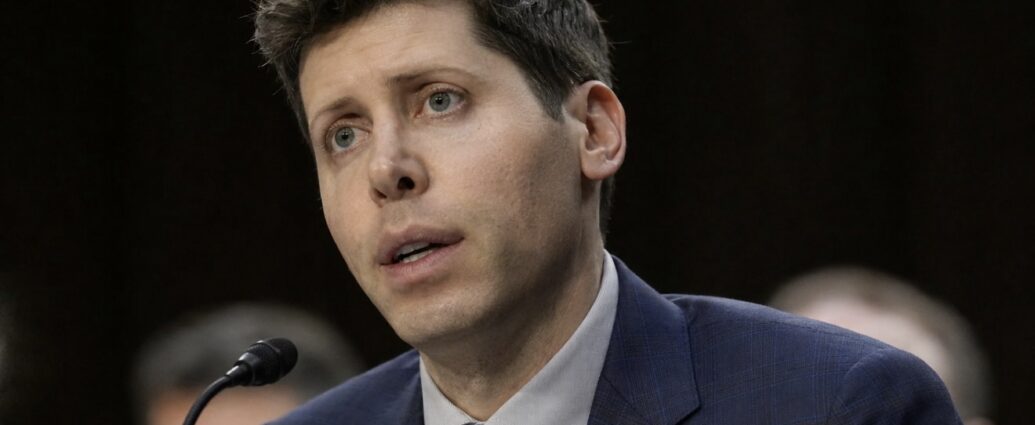
OpenAI Chief Executive Sam Altman wrapped roughly four hours of testimony in federal court in Oakland on Tuesday, telling jurors he made no commitments to Elon Musk about the company’s corporate structure and rejecting the central allegation of the lawsuit that has consumed Silicon Valley for the past three weeks and that could result in a $150 billion disgorgement order against the world’s most prominent artificial-intelligence company.
The trial, Musk v. Altman, is unfolding before Judge Yvonne Gonzalez Rogers in U.S. District Court for the Northern District of California. Musk sued OpenAI, Altman and president Greg Brockman in 2024, alleging they went back on their vow to keep the artificial-intelligence company a nonprofit and to follow its charitable mission. Microsoft Corp. is named as a co-defendant and is accused of aiding and abetting the alleged breach of charitable trust. Closing arguments are scheduled for Thursday, with proceedings expected to run through May 21 and an advisory-jury verdict and ruling possible the following week.
Altman testified about his role in founding the company in 2015, his relationship with Musk, OpenAI’s corporate structure and the chaotic few days in 2023 when he was briefly ousted as chief executive. “I had poured the last years of my life into this,” Altman said of his removal. “I was watching it about to be destroyed.”
On the central question of whether he ever promised Musk that OpenAI would remain a nonprofit, Altman was direct: he said from the stand that he had made no commitments to Musk about the company’s corporate structure. Musk’s complaint contends that the roughly $38 million he donated to the company between 2016 and 2020 was used for unauthorized commercial purposes, but OpenAI’s lawyers have countered with text messages and emails suggesting Musk himself initially pushed for the creation of a for-profit entity — including a proposed merger with Tesla Inc. that the other founders rejected.
Altman’s demeanor was calm through direct examination and only slightly nervous as cross-examination got underway, a marked contrast to Musk’s own appearance on the stand during the trial’s first week, when the Tesla and SpaceX chief executive repeatedly and openly clashed with OpenAI lawyer William Savitt. Musk’s lead attorney Steven Molo opened his cross of Altman with a single question — “Are you completely trustworthy?” — to which Altman replied, “I believe so.” Molo then walked through earlier testimony from former chief scientist Ilya Sutskever, former chief technology officer Mira Murati, and former board members Helen Toner and Tasha McCauley, each of whom had told the court that Altman had at various points lied to or misled them. Altman said he was not aware of the specific accusations and did not agree with them. “I am an honest and trustworthy businessperson,” he said.
Altman told the court that Musk’s February 2018 departure from the OpenAI board had been “a morale boost” for some employees, citing what he described as a management style that “demotivated” some of the company’s researchers. “I don’t think Mr. Musk understood how to run a good research lab,” Altman testified. Brockman told the court earlier in the trial that Musk had once belittled an OpenAI researcher to the point that the person nearly left the field; that researcher later became a central figure behind ChatGPT.
The financial stakes for Microsoft loom over the case. In testimony Monday, Microsoft Chief Executive Satya Nadella told the jury he had feared his company would become “the next IBM” if it did not lock down a deep partnership with OpenAI, an admission drawn from an April 2022 internal email entered into evidence by Molo. A January 2023 memo from Microsoft President Brad Smith projected a $92 billion return on the company’s cumulative $13 billion OpenAI investment — $1 billion in 2019, $2 billion in 2021 and $10 billion in 2023. Under last year’s restructured agreement, Microsoft’s return caps were removed entirely and its IP license was converted to non-exclusive through 2032. The Information has reported that revenue-sharing payments under the new structure are capped at $38 billion.
Nadella also acknowledged under cross-examination that he was not aware of any full-time employees at the OpenAI nonprofit before March 2026 and could not identify grants, research or open-sourced technology the nonprofit had produced — testimony Musk’s team has used to argue that the charitable entity functioned as a shell.
Other witnesses have filled in the personal dimensions of the dispute. Shivon Zilis, a former OpenAI board member who has four children with Musk, testified last week that Musk had offered Altman a Tesla board seat as part of a proposed merger and had asked researcher Andrej Karpathy to compile a list of top OpenAI researchers to poach — activity that took place while Musk still sat on the OpenAI board. Sutskever testified that Alphabet Inc.’s Google had offered to pay him as much as $6 million a year to keep him from joining OpenAI in the company’s early days.
Musk ultimately founded the competing AI venture xAI in 2023, which he merged with SpaceX earlier this year and now refers to as SpacexAI. Altman told the court that Musk “did try to kill” OpenAI, citing the xAI launch, talent poaching and other actions he described as business interference. OpenAI’s lawyers have also countered with Musk’s $97.4 billion bid earlier this year for the company’s assets — a figure they have used to argue that his interest is less charitable than competitive.
Board chair Bret Taylor testified earlier that the nonprofit, renamed the OpenAI Foundation, still owns the for-profit entity, now valued at roughly $852 billion, and that the restructuring was a condition of investments by SoftBank Group Corp. and Thrive Capital. A ruling in Musk’s favor could scramble plans for a public-market listing later this year and require the company to redirect tens of billions in assets back to the nonprofit. A ruling for Altman, Brockman and Microsoft would clear the runway for what bankers expect to be one of the largest IPOs in history.
JBizNews Desk
© JBizNews.com. All rights reserved. This article is original reporting by JBizNews Desk. Unauthorized reproduction or redistribution is strictly prohibited.