The largest sporting event ever staged across North America is now just weeks away, yet much of the U.S. hotel industry is preparing for something closer to a normal summer than the tourism windfall many executives once anticipated.
A new report from the American Hotel & Lodging Association found that roughly 80% of hotel operators across the 2026 FIFA World Cup’s 11 U.S. host cities say bookings are running below expectations, with many describing the tournament as effectively a “non-event” for their properties.
The findings sharply undercut earlier projections from FIFA, which repeatedly promoted the tournament as a potential $30.5 billion economic boom and compared the expanded 2026 World Cup to “104 Super Bowls.”
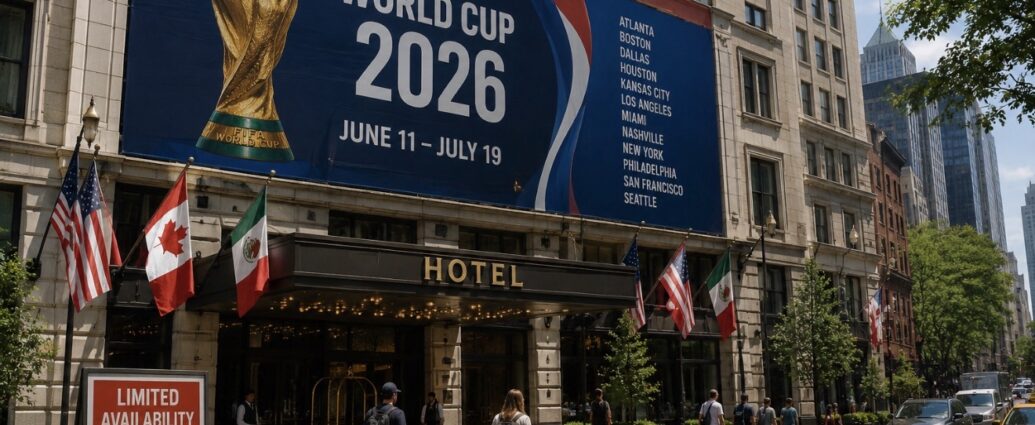
The tournament, running from June 11 through July 19, will be the first FIFA World Cup jointly hosted across the United States, Canada and Mexico, and the first to feature an expanded 48-team field.
The 11 U.S. host markets include New York/New Jersey, Los Angeles, Boston, Seattle, San Francisco, Houston, Dallas, Miami, Philadelphia, Atlanta and Kansas City.
According to the AHLA survey, several of those cities are now seeing significantly weaker-than-expected hotel demand.
Kansas City appears to be the weakest-performing host market, with roughly 85% to 90% of hotel operators reporting booking activity below both original World Cup expectations and even typical summer occupancy levels.
Hotels in Boston, Philadelphia, San Francisco and Seattle similarly reported widespread disappointment, while markets including Dallas, Houston and Los Angeles are tracking roughly in line with ordinary seasonal demand rather than the massive tourism surge many investors anticipated.
Only Miami and Atlanta appear to be outperforming broader expectations, supported partly by stronger leisure demand and the presence of team training bases.
The reasons for the slowdown are increasingly geopolitical as much as economic.
Between 65% and 70% of hotel operators surveyed identified visa-processing delays, broader geopolitical instability and concerns surrounding U.S. entry procedures as major drags on international travel demand.
The strong U.S. dollar has further increased costs for foreign visitors, while ongoing conflict in the Middle East and uncertainty tied to trade policy have weakened global travel sentiment more broadly.
FIFA itself is also facing criticism from hotel operators.
According to the AHLA report, FIFA negotiated large room-block agreements with hotels across host cities before later exercising opt-out clauses and releasing thousands of unsold rooms back into the market after initial demand assumptions failed to materialize.
The association described the process as creating an “artificial early demand signal” that distorted pricing and inventory expectations throughout many host markets.
A FIFA spokesperson defended the organization’s approach, saying accommodations teams worked closely with hotels and released unused inventory within contractually agreed timelines.
Publicly traded hospitality companies are now watching the situation closely.
Major hotel operators with exposure to host cities include Marriott International, Hilton Worldwide, Hyatt Hotels and Choice Hotels International, while booking platforms including Booking Holdings, Expedia Group and Airbnb are also directly tied to World Cup-related travel demand.
Marriott Chief Executive Anthony Capuano recently acknowledged softer inbound international travel trends broadly, though he stopped short of directly criticizing World Cup demand.
Some economists argue the disappointment reflects structural realities surrounding mega-events more than any single geopolitical issue.
Lisa Delpy Neirotti, director of the Sports Management Program at George Washington University, told Fortune that high travel and ticket prices are likely suppressing attendance more than politics alone.
Meanwhile, sports economist Andrew Zimbalist has long argued that major international sporting events often displace ordinary tourism rather than meaningfully increase total visitor activity, as regular travelers avoid congestion, security restrictions and inflated pricing.
The implications could prove especially painful for smaller host markets.
Cities including Kansas City invested heavily in stadium upgrades, transportation improvements and hospitality expansion under the assumption that the World Cup would generate lasting tourism momentum and economic spillover.
If attendance and travel demand underperform expectations, many of those investments could face increasing scrutiny from local taxpayers and municipal officials.
The broader hospitality industry is also entering a more fragile economic period.
After outperforming major gateway cities through much of 2024 and early 2025, smaller and mid-sized U.S. hotel markets are now facing signs of softening discretionary travel demand as inflation, airfare costs and geopolitical uncertainty weigh on consumers.
For investors, the AHLA report represents one of the clearest indications yet that Wall Street’s World Cup tourism narrative may have become significantly overpriced.
The tournament itself is still expected to draw enormous television audiences and global attention. But for many American hotel owners, the economic reality increasingly appears far less transformational than the hype that preceded it.
JBizNews Desk
© JBizNews.com. All rights reserved. This article is original reporting by JBizNews Desk. Unauthorized reproduction or redistribution is strictly prohibited.