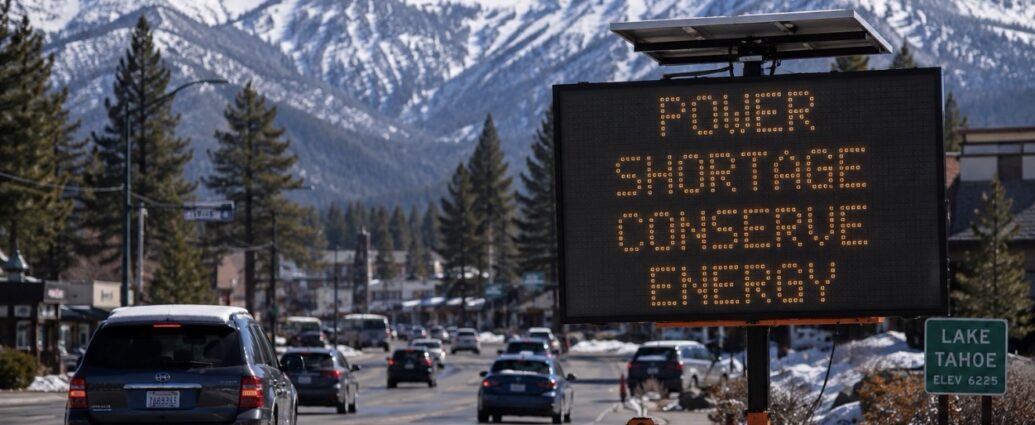
The artificial-intelligence infrastructure boom is beginning to reshape the American power grid in real time, and residents around Lake Tahoe are now confronting one of the clearest examples yet of how the race to build AI data centers is colliding with residential electricity demand.
Liberty Utilities, which serves roughly 49,000 customers on the California side of Lake Tahoe, disclosed this week that longtime supplier NV Energy will cut approximately 75% of the utility’s wholesale electricity supply by May 2027, with the redirected power flowing instead toward a rapidly expanding corridor of AI-focused data centers in northern Nevada.
The decision effectively places one of America’s most iconic residential and tourism regions into direct competition with the enormous energy appetite of companies including Google, Microsoft and Apple.
The scale of the imbalance is staggering.
NV Energy, owned by Berkshire Hathaway Energy, has supplied most of the Tahoe region’s electricity for decades through transmission lines crossing the Sierra Nevada from Nevada into California. Because the South Lake Tahoe region lacks direct transmission links into California’s broader grid system, Liberty Utilities has very limited alternatives for replacing the lost power.
Roughly 25% of Liberty’s electricity currently comes from company-owned solar assets located in Nevada. The remaining 75% has historically come from NV Energy — the portion now being redirected toward AI infrastructure projects clustered around the Tahoe-Reno Industrial Center east of Reno.
According to analysis from the Desert Research Institute, the 12 major data-center developments currently planned across northern Nevada could generate approximately 5,900 megawatts of new electricity demand by 2033.
For comparison, the entire Lake Tahoe service territory peaks at well under 200 megawatts.
In effect, the region is being displaced by a wave of industrial-scale AI infrastructure demand roughly thirty times larger than the electricity needs of the communities now losing supply access.
Residents and local officials are openly warning about reliability risks and future electricity costs.
“It’s like we don’t exist,” Tahoe resident Danielle Hughes told Fortune, describing growing frustration among homeowners and businesses watching AI infrastructure receive grid priority over long-established communities.
Hughes warned that Liberty Utilities may soon be forced into the broader Western electricity market, where the small utility would compete against far larger buyers including Pacific Gas & Electric, Southern California Edison, industrial lithium-mining operations and the same hyperscale data centers that displaced it in the first place.
“We’re 49,000 customers. We have no leverage,” she said.
Political and regulatory pressure is already building.
South Lake Tahoe Mayor Cody Bass wrote to the California Public Utilities Commission earlier this year warning of “a great deal of concern” among residents regarding reliability and long-term affordability.
Environmental and consumer groups are also challenging the speed of the procurement process.
Sierra Club Vice Chair Tobi Tyler urged regulators to open a broader formal review of the situation rather than allowing fast-tracked approvals, while local advocacy organization Tahoe Spark argued that California lacks a dedicated demand forecast for the Tahoe region despite growing wildfire and climate-related grid risks.
Residents have also pointed to rapidly rising utility bills, with electricity prices in portions of the region reportedly climbing roughly 77% since late 2022, according to Bloomberg reporting.
The Tahoe dispute, while unusually visible, is far from isolated.
Utilities across the United States are increasingly warning regulators that AI data centers are overwhelming existing grid assumptions.
In Northern Virginia, the largest data-center market in the world, Dominion Energy has projected that demand tied solely to data centers could require the equivalent of roughly 15 major new power plants over the next decade.
American Electric Power has issued similar warnings in Ohio, while Duke Energy continues confronting surging AI-driven demand growth throughout the Carolinas.
The underlying economics driving the squeeze are enormous.
Wall Street estimates that Alphabet, Amazon, Microsoft and Meta Platforms will collectively spend roughly $725 billion on capital expenditures in 2026, up dramatically from already-record spending levels last year.
The overwhelming majority of that investment is flowing into AI infrastructure — data centers, networking systems, cooling facilities and electricity procurement.
Meanwhile, OpenAI and SoftBank continue building the massive Stargate AI campus in Texas, while Elon Musk’s xAI expands its own high-density computing facilities in Tennessee.
The cumulative effect is beginning to transform electricity itself into one of the most strategically constrained resources in the modern economy.
For homeowners and small businesses caught in the middle, rooftop solar and battery systems are increasingly becoming defensive necessities rather than environmental preferences.
Companies including Tesla Energy, Sunrun, Enphase Energy and SolarEdge Technologies are positioned directly at the center of that shift as consumers seek protection against rising rates and future reliability risks.
For regulators, however, the questions are becoming far larger.
The traditional legal framework governing American utilities — including the longstanding “duty to serve” principle requiring power providers to supply all customers within their territories — was never designed for a world in which a single AI data center can consume as much electricity as an entire mid-sized city.
Lake Tahoe residents now have less than two years to secure alternative supply arrangements.
The broader American grid may have even less time than that to determine how it intends to balance the exploding electricity demands of artificial intelligence against the needs of the communities already connected to the system.
JBizNews Desk
© JBizNews.com. All rights reserved. This article is original reporting by JBizNews Desk. Unauthorized reproduction or redistribution is strictly prohibited.