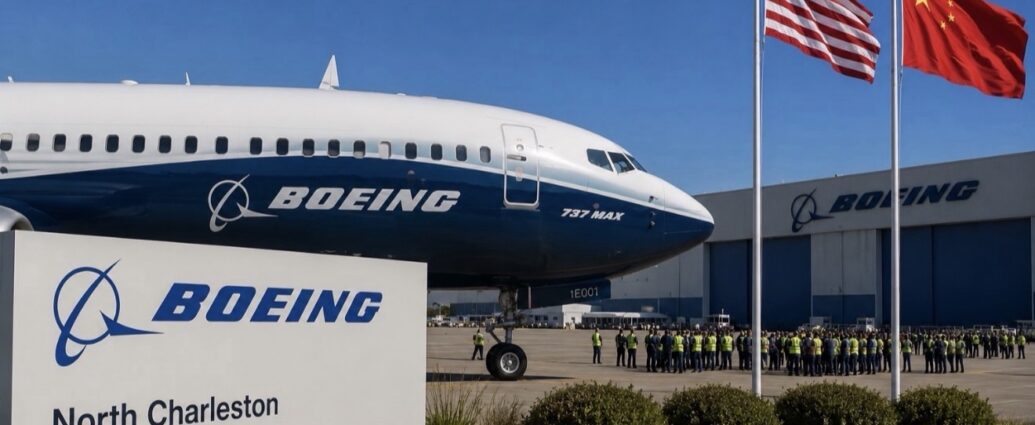
Boeing Chief Executive Kelly Ortberg arrived in Beijing Wednesday as part of the U.S. business delegation accompanying President Donald Trump for a two-day summit with Chinese President Xi Jinping, with negotiations reportedly nearing completion on what could become one of the largest aircraft orders in aviation history.
According to reporting from Bloomberg News and CNBC, discussions now center on a package that could include as many as 500 Boeing 737 MAX jets alongside roughly 100 widebody aircraft, potentially reopening China’s market to Boeing after nearly a decade of frozen large-scale orders.
The proposed agreement would represent China’s first major Boeing purchase since Trump’s 2017 Beijing state visit, which produced commitments for roughly 300 aircraft valued at more than $37 billion at the time.
At current pricing levels — even after standard industry discounts — analysts estimate a 600-aircraft package could exceed $100 billion in total value, instantly becoming one of Boeing’s most important commercial victories in years.
The majority of the order is expected to focus on the 737 MAX 8 and MAX 10 models, aircraft heavily used by Chinese airlines for high-density domestic routes.
Carriers expected to participate include Air China, China Eastern Airlines, China Southern Airlines and Hainan Airlines, all of which face rising fleet-renewal needs as Chinese domestic air travel continues recovering.
For Boeing, the stakes extend far beyond headline optics.
The company has spent the last several years rebuilding operational credibility following the prolonged 737 MAX crisis and the 2024 Alaska Airlines door-plug incident that triggered renewed scrutiny from the Federal Aviation Administration.
Ortberg, who succeeded former CEO Dave Calhoun in August 2024, has focused heavily on stabilizing production quality while gradually increasing monthly MAX output under FAA-imposed caps.
China’s absence from Boeing’s order pipeline has remained one of the largest holes in the company’s global backlog.
A deal of this size would likely fill production slots well into the next decade and dramatically improve long-term visibility for Boeing’s narrow-body manufacturing operations.
Bank of America aerospace analyst Ronald Epstein previously described the potential package as “a near-decade of lost Chinese market share returning in one announcement.”
The geopolitical backdrop is also unusually favorable for a transaction of this scale.
Trade relations between Washington and Beijing deteriorated sharply throughout 2025 after both sides escalated tariffs across key sectors. China raised retaliatory tariffs on U.S. imports to 125% after the Trump administration increased duties on Chinese goods to 145%, effectively freezing many aircraft deliveries.
The partial thaw emerged following the Busan APEC truce reached in late 2025, which reduced certain tariffs and paused expanded Chinese restrictions on rare-earth exports.
Both governments are now under pressure to produce tangible commercial wins before the current trade truce expires later this year.
For China, aircraft procurement also intersects directly with broader economic and energy-security concerns.
The country remains heavily dependent on energy shipments transiting through the Strait of Hormuz, where ongoing instability tied to the Iran conflict has created growing pressure on shipping and commodity markets.
Stabilizing trade ties with Washington while securing access to critical industrial supply chains has increasingly become a strategic priority for Beijing.
The Boeing negotiations are unfolding alongside broader commodity and trade discussions.
Cargill Chief Executive Brian Sikes, also traveling with the delegation, is reportedly working to finalize a multiyear Chinese commitment to purchase approximately 25 million metric tons of U.S. soybeans annually, alongside expanded imports of American beef, poultry and energy products.
The broader U.S. delegation reflects the scale of the summit’s economic ambitions.
Executives traveling with Trump include Apple CEO Tim Cook, Tesla CEO Elon Musk, Nvidia CEO Jensen Huang, BlackRock CEO Larry Fink, Blackstone Chairman Stephen Schwarzman and Citigroup CEO Jane Fraser.
The summit is widely viewed as an effort to stabilize corporate ties between the world’s two largest economies following several years of rising geopolitical confrontation.
For Boeing’s competitors, the implications are substantial.
Airbus has spent the past several years steadily increasing dominance within the Chinese aviation market while Boeing remained sidelined. The European manufacturer recently expanded its Tianjin assembly operations and secured multiple major Chinese carrier orders during Boeing’s absence.
Meanwhile, China’s state-backed aerospace manufacturer COMAC continues expanding deployment of its domestically built C919 narrow-body aircraft, though industry analysts still view the jet as years behind the Boeing 737 MAX and Airbus A320neo in terms of range, payload efficiency and international certification.
A Boeing return to China at scale would complicate Beijing’s long-term ambitions for aerospace self-sufficiency while slowing COMAC’s market-share expansion.
Investors are already partially pricing in a positive outcome.
Boeing shares have climbed meaningfully from their March lows as optimism surrounding the Beijing summit intensified.
Whether the order ultimately materializes — and on what financing and delivery terms — may determine not only Boeing’s production outlook for the next decade, but also the broader trajectory of U.S.-China commercial relations heading into 2027.
JBizNews Desk
© JBizNews.com. All rights reserved. This article is original reporting by JBizNews Desk. Unauthorized reproduction or redistribution is strictly prohibited