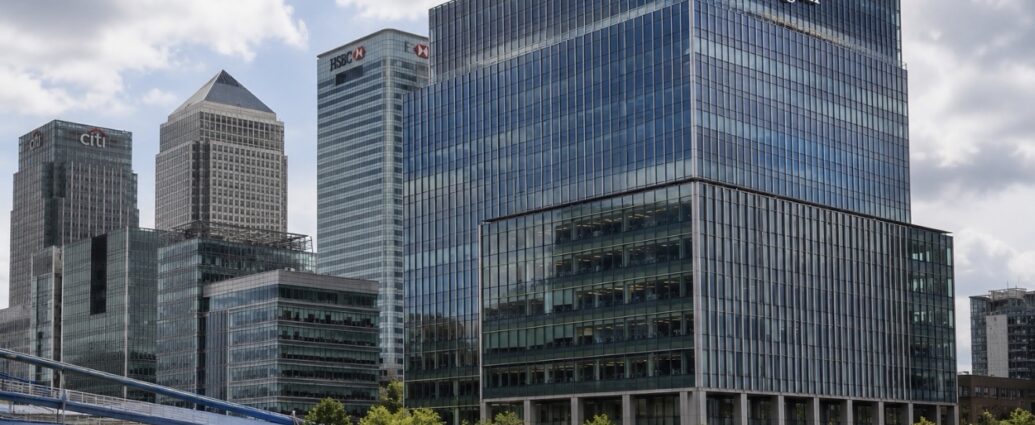
JPMorgan Chase Chairman and Chief Executive Jamie Dimon warned that the bank could reconsider its planned multibillion-dollar London headquarters if the United Kingdom moves toward higher taxes on banks, delivering one of the sharpest public warnings yet from a major U.S. financial executive about the risks of political instability and anti-bank policy in Britain.
Speaking in a Bloomberg interview in Paris, Dimon said JPMorgan’s proposed new tower in Canary Wharf remains conditional on the U.K. maintaining a competitive and predictable financial-services environment.
The warning comes at a politically volatile moment for Prime Minister Keir Starmer, whose Labour Party suffered heavy losses in recent local elections and is now facing pressure from both the left and right.
The immediate concern for banks is a proposal backed by U.K. trade unions to raise the bank-profit tax surcharge from 3% to 8% on profits above £100 million.
That proposal has intensified fears across the City of London that a weakened Labour government — or a successor leadership more hostile to financial services — could shift sharply toward higher levies on banks.
Dimon framed the issue in unusually direct terms.
“I’ve always objected to the fact — we didn’t damage the U.K. in any way — we paid probably $10 billion back in extra taxes by now,” Dimon told Bloomberg’s Francine Lacqua. “I don’t think that’s right or fair. If that happens too much, we will reconsider.”
Dimon praised Starmer as “very smart” and offered qualified support for both the prime minister and Chancellor Rachel Reeves, who have largely pursued a market-friendly fiscal approach since taking office.
But his warning was clear: JPMorgan’s investment commitment depends on Britain not becoming hostile to banks.
The stakes for Canary Wharf are substantial.
JPMorgan announced last year that it planned to build a new 3 million-square-foot office tower in the London financial district, designed to house as many as 12,000 employees and serve as the bank’s U.K. headquarters.
The project is one of the largest single corporate real-estate commitments in Canary Wharf in more than a decade and was widely interpreted as a vote of confidence in London’s post-Brexit financial future.
A cancellation or delay would land hard across the U.K. property market, construction sector and broader financial-services industry.
The political backdrop has become increasingly unstable.
Starmer’s Labour Party has faced mounting internal dissent after local-election losses to Reform UK on the right and the Green Party on the left. Some Labour members of Parliament have publicly questioned Starmer’s leadership, while Health Secretary Wes Streeting has been widely discussed as a potential future challenger.
Bond markets have responded cautiously.
U.K. gilts sold off during the height of the political turbulence, pushing the 10-year yield higher, before stabilizing as Starmer signaled he intended to remain in office.
Investors have generally viewed the Starmer-Reeves leadership team as more fiscally disciplined than several possible alternatives, making Dimon’s warning politically useful for the current government as it resists pressure from Labour’s left flank.
The episode is part of a broader global pattern.
Major financial firms are increasingly warning cities and governments that high taxes, populist rhetoric and regulatory hostility can redirect investment elsewhere.
In the United States, Citadel founder Ken Griffin has made similar arguments while weighing real-estate and expansion decisions in New York amid disputes with city leaders over tax policy and political rhetoric.
Cities including Miami, Dallas, Charlotte, Nashville, Singapore, Dubai and Frankfurt have all benefited in recent years from concerns about taxes and regulation in traditional financial hubs such as New York and London.
JPMorgan’s Canary Wharf commitment had been a powerful counter-signal that London remained capable of attracting blue-chip financial investment even after Brexit.
Dimon’s latest comments now make that confidence explicitly conditional.
For investors, the warning adds another layer of risk to U.K. financial assets.
Shares of major British banks including HSBC, Barclays, Lloyds Banking Group and NatWest have already been trading with elevated political-risk premiums. Any concrete move toward higher bank taxes could weigh further on valuations and potentially accelerate capital allocation away from London.
For Starmer and Reeves, the message from Wall Street’s most influential banking executive is blunt but useful: Britain can either protect its financial-services competitiveness or risk watching some of the world’s largest banks redirect capital, jobs and real-estate commitments elsewhere.
JBizNews Desk
© JBizNews.com. All rights reserved. This article is original reporting by JBizNews Desk. Unauthorized reproduction or redistribution is strictly prohibited