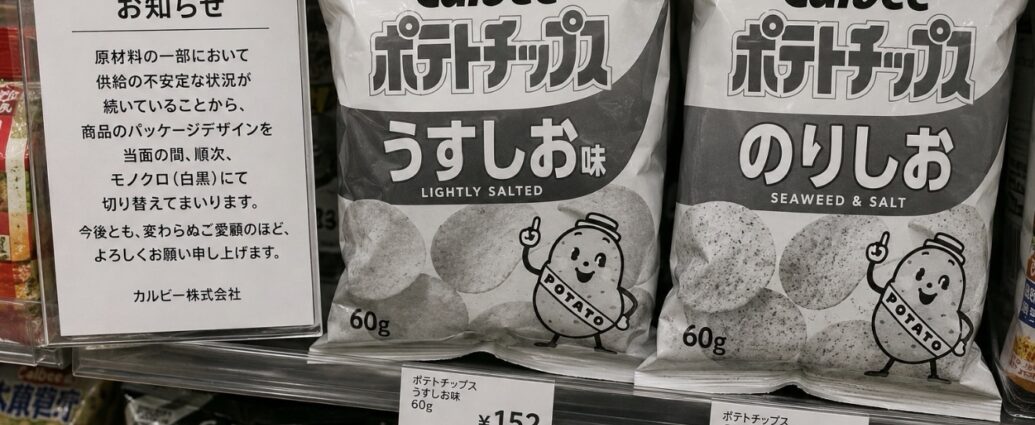
One of Japan’s largest snack-food companies is now stripping color from its packaging because of supply-chain disruptions tied directly to the ongoing Iran conflict, offering one of the clearest consumer-level examples yet of how the war is rippling through everyday global commerce.
Calbee Inc., the Tokyo-based snack giant behind some of Japan’s best-known potato chips and cereal products, announced Tuesday that it will temporarily shift portions of its packaging lineup to monochrome black-and-white designs beginning later this month after shortages emerged in petroleum-derived materials used to manufacture colored printing inks.
The move affects 14 products, including several of the company’s flagship snack brands.
Calbee said the decision was necessary because of “supply instability affecting certain raw materials amid ongoing tensions in the Middle East,” directly linking the packaging changes to disruptions tied to the near-closure of the Strait of Hormuz since the Iran conflict intensified earlier this year.
The supply-chain mechanics behind the problem are rooted in petrochemicals.
Modern packaging inks rely heavily on naphtha, a petroleum derivative used to manufacture pigments, solvents and industrial resins necessary for bright, high-volume food packaging.
Japan imports a substantial share of its naphtha from the Middle East, with much of that supply historically transiting through Hormuz.
As shipping flows through the region slowed sharply following the outbreak of conflict, Japanese refiners and manufacturers began drawing down reserves and scrambling for replacement supply from alternative markets.
The shortages are now beginning to surface in highly specific industrial categories — including food-packaging inks.
Calbee executives emphasized that product quality and recipes themselves will remain unchanged.
The company described the move as a temporary measure designed to maintain stable product availability while reducing pressure on constrained supply chains.
Images released by Calbee show simplified grayscale packaging replacing the colorful designs Japanese consumers traditionally associate with specific flavors and product lines.
The shift is more disruptive in Japan than it might initially appear.
Japanese consumers often rely heavily on packaging colors to quickly identify flavors and product variants — particularly in crowded convenience stores and supermarkets where visual branding plays an outsized role in purchasing behavior.
Calbee’s iconic brightly colored snack bags are deeply familiar across Japan, making the monochrome transition visually striking for consumers.
The company is not alone.
Executives across Japan’s consumer-products industry are increasingly warning about similar shortages and production adjustments.
Itoham Yonekyu, a major processed-meat producer, has reportedly begun evaluating monochrome packaging options as well because of ink shortages.
Meanwhile, cosmetics giant Shiseido is exploring shifts toward plant-based material alternatives as petrochemical costs rise and supply reliability weakens.
Other Japanese manufacturers are facing disruptions tied to fuel, plastics and chemical feedstocks.
Snack producer Yamayoshi Seika recently suspended production of one product line because of heavy-fuel shortages, while food manufacturer Mizkan Holdings has halted certain products and raised prices because of rising packaging and petrochemical costs.
The implications extend well beyond Japan.
Major global consumer-packaged-goods companies including Procter & Gamble, Unilever, Nestlé, PepsiCo and Coca-Cola all depend on highly concentrated global packaging and industrial-ink supply chains.
Trade publications across Europe and Asia have already reported spot shortages in certain pigments and specialty inks since March, particularly bright reds and yellows that rely on specific petrochemical formulations.
The Calbee announcement effectively confirms that those shortages are no longer theoretical.
The broader Japanese economy is already feeling pressure from the conflict.
The Bank of Japan’s latest manufacturing surveys showed weakening industrial sentiment, while automakers including Toyota, Honda and Nissan have all warned about rising input costs and energy-related pressures.
Japan remains one of the world’s most energy-import-dependent advanced economies, making it particularly vulnerable to prolonged instability in Middle Eastern shipping routes.
For consumers outside Japan, the changes may soon become visible as well.
Calbee products sold through international retailers including Costco, H Mart and specialty Asian grocery chains are expected to begin appearing in simplified monochrome packaging later this summer.
The snacks themselves will taste exactly the same.
But the bags holding them now serve as an unexpectedly vivid reminder of how a geopolitical conflict thousands of miles away is quietly reshaping ordinary consumer life across the global economy.
JBizNews Desk
© JBizNews.com. All rights reserved. This article is original reporting by JBizNews Desk. Unauthorized reproduction or redistribution is strictly prohibited.