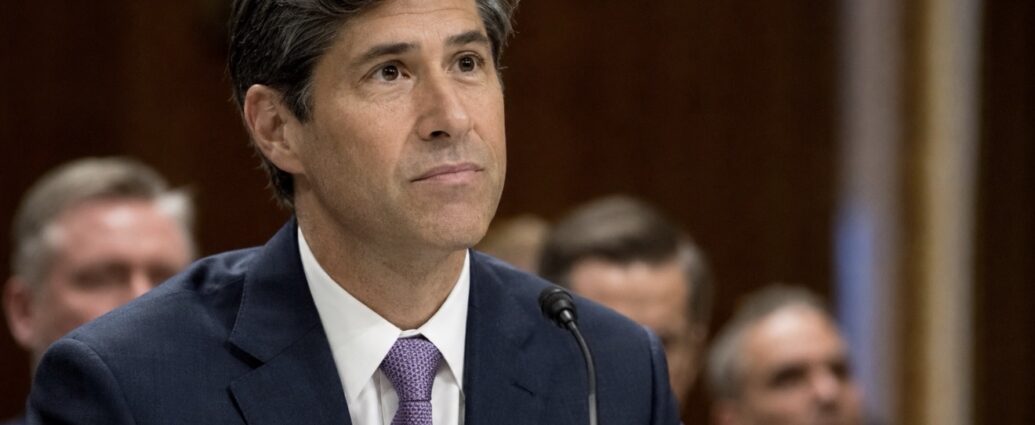
WASHINGTON — The U.S. Senate voted at Wednesday Afternoon to confirm Kevin Warsh as the next chairman of the Federal Reserve in a razor-thin 54-45 vote, marking the closest confirmation margin for a Fed chair in the modern era and handing President Donald Trump the central-bank leader he has openly pushed for while immediately reigniting debate over the future independence of the U.S. central bank.
Warsh, 56, will replace Jerome Powell, whose term leading the Federal Reserve expires Friday after serving as chair since 2018. The Senate vote broke almost entirely along party lines, with Sen. John Fetterman (D-Pa.) emerging as the lone Democrat to support the nomination.
The confirmation concludes one of the most politically charged Federal Reserve battles in years. Just one day earlier, the Senate approved Warsh separately for a 14-year term on the Federal Reserve Board of Governors in a 51-45 vote after a dramatic reversal by Sen. Thom Tillis (R-N.C.), who withdrew his opposition following reports that a Justice Department criminal probe involving the Federal Reserve would no longer proceed.
Opposition Democrats, led by Sen. Elizabeth Warren (D-Mass.), argued that Warsh could become too closely aligned with White House priorities after repeated public pressure from Trump for lower interest rates. Warren accused Warsh during hearings of potentially acting as the president’s “sock puppet,” a characterization Warsh forcefully rejected while pledging to act independently if confirmed.
Warsh returns to the Eccles Building with deep institutional history and equally deep controversy. Appointed to the Federal Reserve Board in 2006 by President George W. Bush at just 35 years old, he became the youngest governor in modern Fed history and served through the collapse of the housing market and the 2008 global financial crisis.
During that period, the Federal Reserve initially underestimated the risks posed by the subprime mortgage market before launching unprecedented emergency interventions, including massive liquidity programs and bond-buying campaigns that reshaped modern monetary policy. Warsh later resigned in 2011 in protest over the Fed’s second round of quantitative easing — a $600 billion Treasury bond-buying program known as QE2 — arguing the central bank had become too dependent on extraordinary intervention.
Since leaving government, Warsh has become one of the most outspoken critics of post-crisis monetary policy, repeatedly warning that prolonged ultra-low interest rates and aggressive balance-sheet expansion distorted markets and fueled inflationary risk. In a widely discussed CNBC interview last year, he openly called for “regime change” at the Federal Reserve, comments that immediately resurfaced during the confirmation process.
The White House celebrated Wednesday’s outcome as a turning point in economic policy.
“The Senate’s confirmation of Kevin Warsh as the next Chairman of the Federal Reserve is a welcome step towards finally restoring accountability, competence, and confidence in Fed decision-making,” White House spokesman Kush Desai said following the vote.
Rep. French Hill (R-Ark.), chairman of the House Financial Services Committee, similarly praised Warsh’s record, saying his “commitment to disciplined monetary policy will help restore confidence in our economy and support long-term prosperity.”
Financial markets have already begun recalibrating around the leadership transition. The U.S. dollar strengthened, while longer-dated Treasury yields climbed in recent sessions as investors weighed whether a Federal Reserve perceived as more politically exposed might face credibility pressures in bond markets.
Trump has repeatedly demanded lower interest rates publicly, especially after recent signs of slowing growth in parts of the economy. But Warsh signaled during his Senate Banking Committee hearing that he does not intend to serve as a political extension of the White House.
“I will be an independent actor if confirmed as chair of the Federal Reserve,” Warsh told senators during testimony in April.
His first meeting leading the Federal Open Market Committee (FOMC) is scheduled for June 16-17, where markets currently expect policymakers to leave rates unchanged. However, this week’s stronger-than-expected inflation reports — including elevated CPI and PPI readings — have complicated expectations for rate cuts and even revived some speculation about possible future tightening if inflation pressures continue accelerating.
Warsh enters office closely aligned philosophically with Treasury Secretary Scott Bessent, with both men advocating for a smaller Federal Reserve balance sheet, tighter constraints on emergency interventions, and a narrower interpretation of the central bank’s mandate. Their approach signals a potentially major shift away from the intervention-heavy policies associated with the Bernanke, Yellen, and Powell eras.
That change could carry enormous implications during any future economic downturn. Investors and economists increasingly believe a Warsh-led Federal Reserve may prove far less willing to launch large-scale rescue programs such as quantitative easing or aggressive bond purchases during periods of market stress.
The transition also introduces an unusual power dynamic inside the central bank itself. Jerome Powell plans to remain on the Federal Reserve Board after stepping down as chair — an extraordinarily rare arrangement not seen in roughly 80 years. Powell has indicated he intends to stay until a federal inquiry involving the Federal Reserve’s headquarters renovation project concludes, meaning he will continue voting on monetary policy decisions even after Warsh assumes leadership.
The leadership overlap effectively creates two major centers of influence within the Federal Reserve during Warsh’s opening months as chairman.
Warsh will also enter office under heightened scrutiny over personal finances. With assets reportedly exceeding $100 million, he becomes the wealthiest Federal Reserve chair in history and is expected to divest substantial holdings under strengthened ethics rules governing financial activity by senior Fed officials.
He additionally brings unusually direct exposure to digital-asset policy debates. Past investments in crypto and blockchain firms — many of which he has pledged to divest — position him as one of the first Federal Reserve leaders with extensive familiarity with digital-asset markets at a time when regulators are actively debating stablecoins, crypto custody rules, and the future architecture of digital payments.
For households and businesses, the immediate practical impact is likely limited. Mortgage rates remain tied more closely to long-term Treasury yields than directly to Fed leadership changes, while auto loans, credit-card interest rates, and small-business borrowing costs remain anchored to the current federal funds rate environment.
Still, Wall Street increasingly views the confirmation as potentially marking the beginning of a materially different era for U.S. monetary policy — one defined by a Federal Reserve that may become more politically scrutinized, more inflation-focused, less interventionist, and more cautious about using extraordinary tools to stabilize markets.
JBizNews Desk
© JBizNews.com. All rights reserved. This article is original reporting by JBizNews Desk. Unauthorized reproduction or redistribution is strictly prohibited.