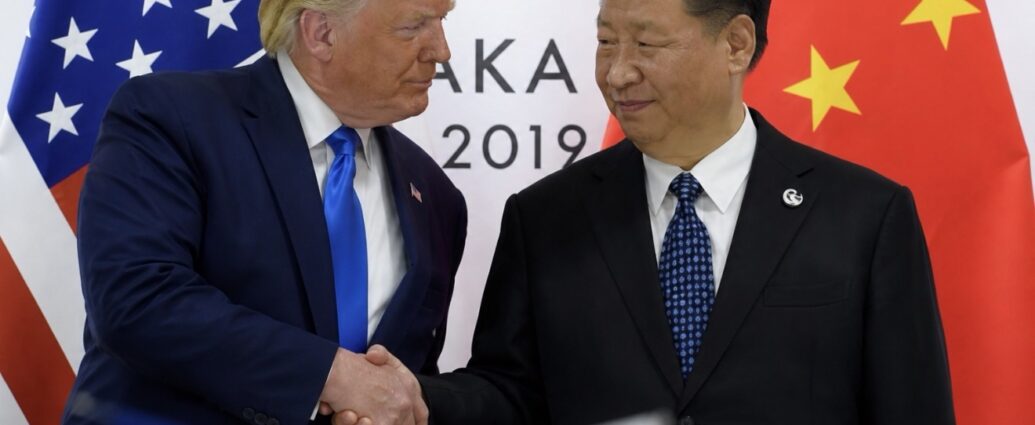
The single biggest variable hanging over the Trump–Xi summit in Beijing this week is no longer tariffs, Taiwan, or even the war with Iran — it is China’s near-monopoly on the rare earth elements that power American factories, weapons systems, electric vehicles, and advanced artificial-intelligence infrastructure. As President Donald Trump opened a 36-hour summit with President Xi Jinping on Wednesday, business leaders and national-security officials increasingly viewed access to critical minerals as the real strategic centerpiece of the talks.
REalloys Chief Executive Officer Lipi Sternheim told Bloomberg on Wednesday that Trump must use the summit to secure near-term rare earth supply agreements because rebuilding independent North American production capacity “won’t happen overnight.” Her warning reflects a growing reality confronting both Washington and Wall Street: the United States remains deeply dependent on China for materials that sit at the core of nearly every advanced industrial sector.
According to a separate S&P Global factbox published Wednesday, rare earth access is now expected to dominate the formal May 14–15 negotiations between Trump and Xi. Heidi E. Crebo-Rediker, senior fellow at the Council on Foreign Relations Center for Geoeconomic Studies, summarized the strategic shift in a paper published May 10, writing that “the center of gravity moved away from tariffs — long seen by Trump as the decisive lever — and toward something more structural: China’s control over critical minerals, rare earths, and the magnet supply chains that underpin modern military capability and advanced manufacturing.”
The numbers explain the urgency. According to the International Energy Agency, China controlled 61% of global mined rare earth production in 2024 and an overwhelming 91% of global refining and processing capacity. While many countries mine small amounts of rare earth material, China dominates the technically complex refining process required to turn raw minerals into usable metals and magnets.
That leverage became painfully visible after Beijing imposed export licensing restrictions in April 2025. According to industry data cited by Foreign Policy, rare earth magnet shipments from China to the United States collapsed 93% year over year the following month, forcing temporary shutdowns at several automotive plants in both the United States and Europe. Prices for key heavy rare earths including dysprosium and terbium — essential components in electric motors, fighter jets, missile systems, and advanced semiconductors — surged to as much as six times Chinese domestic pricing levels.
Although the Busan trade truce later eased some restrictions, export volumes remain roughly 50% below pre-restriction levels. The situation worsened further after China’s Ministry of Commerce announced a second wave of controls on October 9, 2025, expanding the restricted list to include samarium, gadolinium, lutetium, europium, and ytterbium while also broadening rules to cover foreign-made products containing Chinese-sourced materials or Chinese manufacturing technology.
Those restrictions were temporarily suspended until November 10, 2026, under the Busan agreement — effectively placing Trump under a six-month negotiating deadline controlled almost entirely by Beijing.
Sternheim’s company, REalloys (NASDAQ: ALOY), has emerged as one of the few North American firms attempting to rebuild domestic heavy rare earth processing capability. The company operates the continent’s only facility capable of converting heavy rare earths into commercial-scale metals and alloys. Initial production at its Saskatchewan Research Council–linked facility is targeted for 2027, while downstream magnet operations are based in Euclid, Ohio.
REalloys recently secured a $200 million letter of interest from the U.S. Export-Import Bank along with a $1.7 million Defense Logistics Agency engineering contract tied to a planned 300-ton-per-year production facility. But executives openly acknowledge that scaling enough independent capacity to meaningfully reduce Chinese dependence will likely take years.
The Trump administration has spent much of the past year aggressively building a strategic response. The White House launched plans for a critical-minerals reserve known as “Project Vault,” pursued equity stakes in mining and refining companies, signed mineral agreements with allied governments, and proposed a global critical-minerals trading bloc designed to reduce China’s dominance.
Private-sector efforts have accelerated as well. USA Rare Earth announced plans last month to acquire Brazil’s Serra Verde Group, one of the world’s few meaningful heavy rare earth sources outside China. Yet analysts warn that mines, refineries, and magnet facilities cannot be built quickly enough to fully shield American industry in the near term.
“The U.S. still has to tread carefully in its relationship with China to avoid those disruptions,” Gracelin Baskaran, director of the Critical Minerals Security Program at the Center for Strategic and International Studies, told Foreign Policy.
The makeup of Trump’s Beijing delegation underscores how central the issue has become. The president arrived alongside major American executives including Apple CEO Tim Cook, Tesla and SpaceX CEO Elon Musk, and Nvidia CEO Jensen Huang, who joined the trip at the last minute after media attention focused on his earlier absence. Huang reportedly boarded Air Force One during a refueling stop in Anchorage.
Their presence highlights how deeply intertwined rare earths have become with artificial intelligence, semiconductors, electric vehicles, and defense technology. Advanced data centers, AI networking systems, electric motors, robotics, smartphones, missile guidance systems, and radar equipment all depend heavily on rare-earth-based magnets and specialized materials.
For U.S. manufacturers, the stakes are immediate and tangible. Automakers including General Motors, Ford, and Stellantis rely heavily on rare-earth magnets for electric drive systems. Defense contractors including Lockheed Martin, RTX, and Northrop Grumman depend on the same supply chains for missile systems, stealth technologies, radar, sonar, and precision-guided weapons.
Industry executives have warned privately that even modest delays in Chinese export-license approvals during or after the summit could disrupt summer production schedules across multiple industries.
For Xi, rare earth supply remains one of the strongest strategic tools Beijing holds over Washington. For Trump, the objective is to secure enough stability in the supply chain to buy time for companies including REalloys, USA Rare Earth, and MP Materials to scale domestic production capacity.
How those competing priorities are negotiated in Beijing may ultimately shape not only the next phase of U.S.–China economic relations, but the future supply chain architecture of the global industrial economy itself.
JBizNews Desk
© JBizNews.com. All rights reserved. This article is original reporting by JBizNews Desk. Unauthorized reproduction or redistribution is strictly prohibited.