The rapid adoption of ChatGPT and other generative artificial-intelligence tools is accelerating grade inflation across American colleges and universities, pushing A grades to historic highs and increasingly weakening the value of GPAs as a reliable hiring signal for employers. A Wall Street Journal report published Wednesday, citing new academic studies and employer surveys, found that transcripts at many universities have become so compressed that companies are increasingly abandoning grade-based screening altogether.
An A is now the most commonly awarded grade across the U.S. four-year college system, according to the Journal. At elite universities, roughly two-thirds of all grades now fall in the A range, a dramatic shift from historical norms that many employers say makes it nearly impossible to distinguish among candidates entering the workforce.
The trend has accelerated sharply since the release of OpenAI’s ChatGPT in late 2022. A peer-reviewed study published last year in the Centre for Economic Policy Research examined student performance at an Israeli university before and after ChatGPT became widely available. Researchers found that AI tools significantly boosted grades, particularly among lower-performing students, while compressing the overall distribution of academic performance and “eroding the signal value of grades for employers.”
A separate February 2026 study presented at the Harvard Graduate School of Education reached even harsher conclusions. The paper, led by University of Texas at Austin economist Jeffrey Denning alongside researchers from RAND, the University of Maryland, and the University of Georgia, found that students exposed to lenient grading were less likely to succeed in subsequent coursework, scored lower on standardized tests, and earned materially less over their careers.
Denning estimated that a single graduating class affected by grade inflation could collectively lose roughly $160,000 in lifetime earnings because inflated transcripts distort both learning outcomes and employer evaluation systems.
The numbers emerging from elite universities illustrate the scale of the shift. At Harvard University, where administrators launched a formal review of grading practices last year, approximately 60% of all undergraduate grades during the 2024–2025 academic year were A’s — more than double the level recorded in 2006. More than 50 members of Harvard’s graduating class of 2025 reportedly earned perfect GPAs.
At Yale University, 79% of students received grades in the A or A-minus range during the 2022–2023 academic year, up from roughly 40% in 2010.
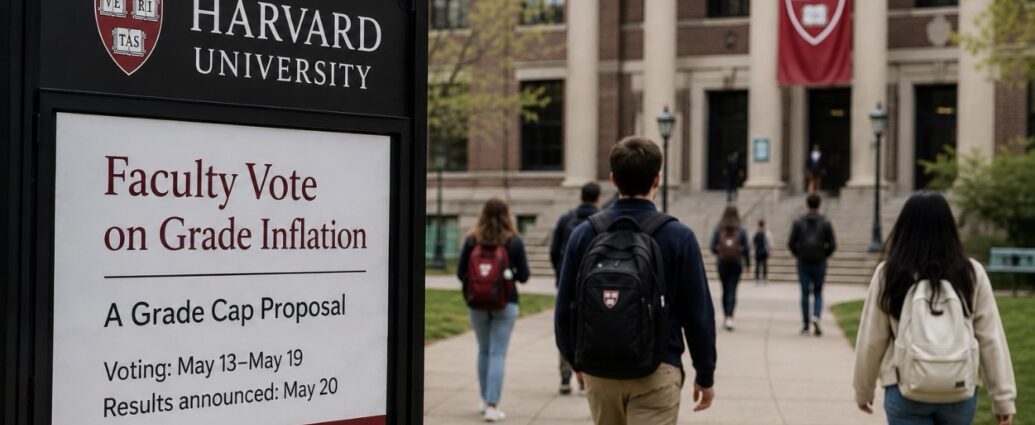
The issue has now become serious enough that Harvard’s Faculty of Arts and Sciences began voting Tuesday on a proposal that would sharply limit the number of top grades instructors can award. Under the proposal, A grades would be capped at 20% of students in each course, with limited flexibility for a handful of additional A’s. Voting closes May 19, with results expected May 20. If approved, the policy would take effect in fall 2027.
Stuart Shieber, chair of Harvard’s Computer Science department and head of the faculty grading subcommittee, described the problem as a systemic coordination failure, comparing it to a prisoner’s dilemma where individual professors feel pressured not to grade more harshly than peers.
Joshua D. Greene, the Harvard psychology professor who helped draft the proposal, told the Boston Globe: “The way things are now, it’s like every student starts college with a shiny new car.”
For employers, the consequences are already reshaping hiring practices. According to the National Association of Colleges and Employers, only 40% of recruiters still use GPA screening for new graduates, down sharply from 70% just seven years ago. Separate employer surveys found that 60% of hiring managers now question whether recent graduates are workforce-ready, while roughly 30% say they no longer trust GPAs at all.
Industries that historically relied heavily on academic credentials — including consulting, banking, accounting, and technology — are increasingly replacing transcript-based filters with technical assessments, structured interviews, case-study exercises, and internship pipelines.
At the same time, AI itself is changing the applicant pool. Tools including ChatGPT, Anthropic’s Claude, Google Gemini, and Microsoft Copilot now allow students and job seekers to generate polished résumés, cover letters, coding samples, and written assignments at unprecedented scale. Research cited earlier this year by The Atlantic found that AI-assisted applications have made writing quality — once considered one of the strongest predictors of hiring success — far less useful as a screening metric.
The broader labor-market backdrop adds further pressure. Earlier this year, the Federal Reserve Bank of New York reported that unemployment among recent college graduates had climbed above the national unemployment rate — a rare reversal of the traditional economic advantage associated with a college degree.
At the same time, many of the entry-level tasks historically assigned to new graduates — including writing, summarizing, coding assistance, research, and basic analytical work — are increasingly being automated by the very AI systems students are using in school.
Some large employers are adapting aggressively. Consulting firms including McKinsey, Bain, and Boston Consulting Group have publicly emphasized skills-based hiring and expanded assessment testing while continuing to recruit heavily from universities. Other firms, particularly on Wall Street and within major accounting networks, have quietly reduced entry-level hiring and leaned more heavily on internship conversion programs that allow companies to evaluate candidates directly over longer periods.
Whether universities ultimately succeed in restoring the value of academic transcripts remains uncertain. Harvard’s pending vote may become a test case for whether elite institutions are willing to reverse years of grade inflation even at the risk of student backlash and competitive disadvantage.
But according to the growing body of research, one reality is already becoming difficult for both universities and employers to ignore: the American GPA is no longer functioning the way the labor market once expected it to.
JBizNews Desk
© JBizNews.com. All rights reserved. This article is original reporting by JBizNews Desk. Unauthorized reproduction or redistribution is strictly prohibited.