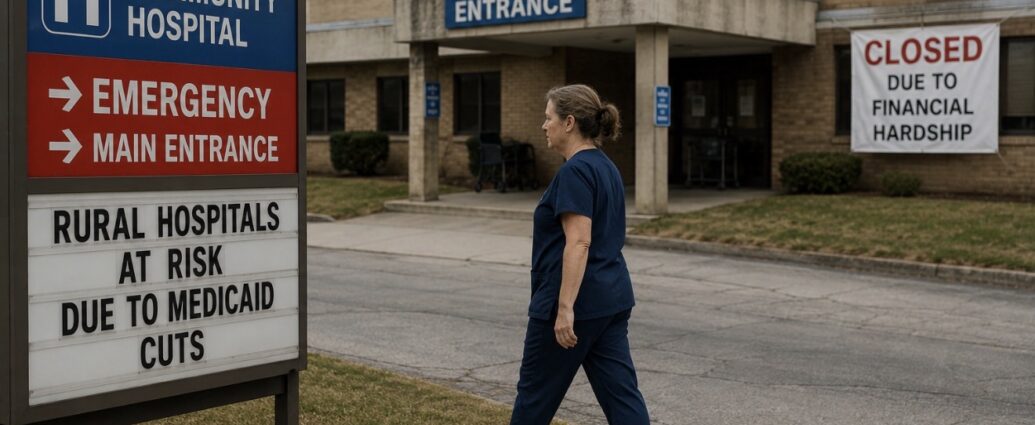
New federal Medicaid work requirements scheduled to take effect on December 31, 2026 are projected to strip health coverage from millions of Americans and place hundreds of rural hospitals at heightened risk of closure, according to new research published by the Urban Institute, the American Hospital Association, and several healthcare policy groups this spring.
The law, signed last year by President Donald Trump, requires most working-age Medicaid expansion recipients to document at least 80 hours per month of work, job training, or qualifying volunteer activity to maintain eligibility. States must also conduct eligibility redeterminations every six months rather than annually, dramatically increasing administrative requirements for both recipients and state Medicaid systems.
Researchers estimate the impact could be severe. The Urban Institute projects between 4.9 million and 10.1 million Americans could lose Medicaid coverage by 2028 depending on how aggressively states implement the requirements and how effectively they automate verification systems.
The financial burden is expected to fall especially heavily on rural healthcare providers already operating on thin margins. The Commonwealth Fund projected earlier this year that Medicaid spending in rural America could decline by roughly $137 billion over the next decade. Rural hospital Medicaid revenue is forecast to fall by as much as 9.6% on average, while uncompensated care costs are expected to surge more than 35%.
According to the Center for Healthcare Quality and Payment Reform, approximately 190 rural inpatient hospitals across 34 Medicaid expansion states are already considered at immediate risk of closure. In states including Pennsylvania and Virginia, roughly one-quarter of rural inpatient hospitals face elevated financial distress. In Oklahoma and New York, the share approaches one in three.
Warning signs are already emerging. John Fitzgibbon Memorial Hospital in Missouri and Mizell Memorial Hospital in Alabama recently filed for Chapter 11 bankruptcy protection, citing expected Medicaid-related revenue losses as a major contributing factor.
Nebraska, which plans one of the earliest implementations of the work requirements, has become an early testing ground for the policy’s practical challenges. The Nebraska Hospital Association warned in April that the state’s July 31 rollout could trigger sudden coverage losses and substantial administrative complications.
Governor Jim Pillen has defended the rules as promoting long-term independence from government assistance, but critics argue the burden will fall heavily on low-income workers who already meet work requirements but struggle with documentation systems.
“Even under the most generous assumptions, many working people are still projected to lose coverage simply because they cannot navigate the paperwork,” researchers led by Urban Institute senior fellow Matthew Buettgens wrote in their analysis.
The report found that even among Medicaid recipients who already work, between 19% and 37% could still lose coverage due to documentation failures, reporting delays, or system errors. Self-employed workers, adults between ages 50 and 64, caregivers, students, and individuals with chronic illnesses appear especially vulnerable to erroneous disenrollment.
The pressure extends beyond hospitals themselves. Separate analysis from the Commonwealth Fund and Capital Link estimated nearly 5.6 million community health center patients in expansion states could lose Medicaid coverage within five years of implementation, reducing health-center revenue by roughly $32 billion.
Community health centers rely on Medicaid for approximately 43% of average operating revenue and disproportionately serve low-income, rural, elderly, and chronically ill populations.
The broader fiscal picture is increasingly concerning for healthcare executives. The think tank Third Way estimates hospitals nationwide could absorb roughly $661 billion in cumulative cuts over the next decade from the Medicaid changes, expiring Affordable Care Act subsidies, and potential Medicare sequestration tied to rising federal deficits.
Of that total, rural hospitals alone are projected to absorb approximately $125 billion.
Congress included a Rural Health Transformation Program within the same legislation allocating $10 billion annually through 2030 to help offset some financial losses. But the Centers for Medicare & Medicaid Services later stipulated that no more than 15% of those funds may be used directly for hospital operations or patient care, limiting the program’s practical impact.
Healthcare executives are now preparing for what many describe as one of the most difficult operational planning cycles in years. William Schpero, assistant professor of population health sciences at Weill Cornell Medicine, warned that providers serving low-income populations already face elevated financial fragility even before implementation begins.
“Projected coverage losses under the work requirements will have severe effects on safety-net providers in both rural and urban areas,” Schpero told the American Journal of Managed Care.
Large Medicaid-focused insurers and hospital systems including Centene, Molina Healthcare, HCA Healthcare, and Tenet Healthcare are also expected to face increasing pressure on margins and payer mix assumptions over the next 18 months.
For many healthcare economists, the most consequential aspect of the policy may ultimately prove administrative rather than ideological. States must now build systems capable of verifying employment status, exemptions, and ongoing eligibility every six months — infrastructure many states are not expected to fully complete before implementation begins.
Researchers warn that the result may be widespread coverage losses driven not by true ineligibility, but by paperwork friction and bureaucratic breakdowns.
For low-income Americans, that can translate directly into delayed treatment, missed prescriptions, postponed surgeries, and untreated chronic illness. For the rural hospitals serving those communities, the larger question is becoming increasingly existential: whether they will still be open to provide care at all.
JBizNews Desk
© JBizNews.com. All rights reserved. This article is original reporting by JBizNews Desk. Unauthorized reproduction or redistribution is strictly prohibited.