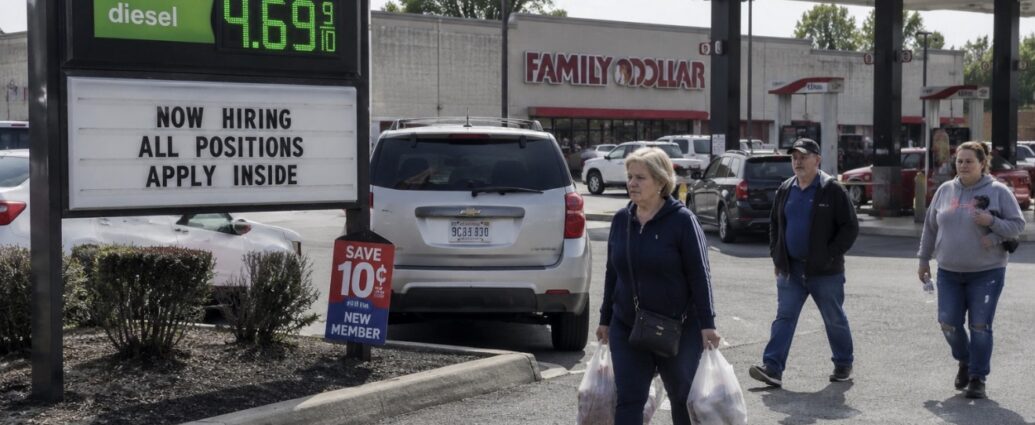
American consumers tightened their grip on discretionary spending in April and a fresh batch of layoffs pushed jobless claims to a five-week high, according to two government reports released Thursday morning that together paint the clearest picture yet of an economy buckling under the weight of Iran-driven energy costs.
The Commerce Department said retail sales rose 0.5% in April from the prior month, a sharp deceleration from a revised 1.6% surge in March that had marked the largest one-month gain in more than three years. Strip out gasoline stations, and sales were up just 0.3% — a sign that higher pump prices, rather than genuine consumer strength, were doing much of the work in the headline figure.
Separately, the Labor Department reported that initial applications for unemployment insurance climbed to 211,000 in the week ending May 9, an increase of 12,000 from the prior week’s revised level and well above the 205,000 figure forecast by economists polled by Dow Jones. Continuing claims, which measure Americans still drawing benefits and lag the initial filings by a week, rose by 24,000 to 1.78 million.
The two reports landed roughly an hour apart and reinforce a single theme: the cost of the U.S.-Israeli war with Iran is now flowing directly into American kitchens, gas tanks, and household budgets. Crude prices have climbed more than 30% since the conflict erupted in late February, and the Energy Information Administration has reported retail gasoline prices well above $4 a gallon nationally — pressure that economists at the Stanford Institute for Economic Policy Research estimate has added roughly $857 to the average American driver’s annual fuel bill.
Inside the retail report, the squeeze on nonessentials was unmistakable. Department stores saw sales fall 3.2%, the steepest one-month drop in over a year, while furniture and home furnishings stores slipped 2%. Online retailers eked out a 1.1% gain, suggesting consumers are still spending but increasingly hunting for deals on price comparison engines rather than walking into malls. Gas station receipts continued to balloon, but those dollars do not reflect demand — they reflect cost.
“Households remain resilient for now, potentially leaning on tax refunds and broader savings to keep on spending in the face of the latest price squeeze,” said James McCann, senior economist for investment strategy at Edward Jones, in a research note circulated earlier this week. Tax refunds have run roughly $350 above last year’s pace, according to Internal Revenue Service data, providing a temporary cushion that economists warn is running thin.
The jobless claims report adds a fresh wrinkle. While initial filings remain low by historical standards — the labor market spent much of the spring near multi-decade lows — the 12,000 jump and the rise in continuing claims suggest the long-running “low-firing” environment may finally be cracking. Wall Street has watched a steady cadence of corporate layoff announcements from large employers in recent weeks, including roughly 4,000 jobs at Cisco Systems announced after Wednesday’s closing bell, with notifications beginning Thursday.
The combined readings carry direct implications for monetary policy. Kevin Warsh, confirmed Wednesday in a 54-45 Senate vote as the next chairman of the Federal Reserve, takes the helm at the central bank on Friday inheriting an inflation problem made worse by the Iran war and a labor market that, while still tight, is no longer unambiguously strong. Markets had been pricing in only a single quarter-point cut from the Federal Open Market Committee this year, with the benchmark rate currently held in the 3.50% to 3.75% range. Thursday’s data — softer real consumer spending, a tick higher in layoffs, and a fresh import-price report showing the steepest 12-month gain since October 2022 — gives Warsh little room to maneuver as he balances the White House’s calls for cheaper borrowing costs against the inflation flowing through the gas pump.
For Main Street, the picture is more immediate. The National Retail Federation said earlier this week that household spending priorities have shifted toward groceries, fuel, and essential services, with discretionary categories such as furniture and electronics absorbing the cutbacks. Matthew Shay, president and chief executive of the NRF, said in a statement that consumers are “mindful on costs” while retailers work to “keep everyday goods affordable for American families.”
The next major reads on the American consumer arrive May 21, when Walmart reports fiscal first-quarter results, and again on May 30, when the Bureau of Economic Analysis publishes April personal income and spending data. Until then, Thursday’s twin reports — softer spending and a creeping rise in layoffs — stand as the clearest sign that the Iran war is no longer a Wall Street headline. It is a kitchen-table reality.
JBizNews Desk
© JBizNews.com. All rights reserved. This article is original reporting by JBizNews Desk. Unauthorized reproduction or redistribution is strictly prohibited.