Cuba has completely exhausted its reserves of diesel and fuel oil, the country’s energy minister announced on state television Wednesday night, triggering overnight protests across Havana and pushing the island’s collapsing electrical grid into what officials described as a “critical” condition.
The blackout crisis — the worst Cuba has faced since the collapse of the Soviet Union more than three decades ago — now sits at the center of an escalating economic confrontation between the Trump administration and the communist government just 90 miles off the Florida coast.
“We have absolutely no fuel oil, and absolutely no diesel. We have no reserves,” Vicente de la O Levy, Cuba’s minister of energy and mines, said during remarks carried on state-run television.
According to the minister, the only fuel still feeding portions of the national grid is limited domestic natural gas production alongside small amounts of locally extracted crude oil and renewable energy generation — together covering only a fraction of national electricity demand.
In Havana, a city of more than two million residents, rolling blackouts have stretched between 20 and 22 hours per day in some neighborhoods. Power outages have spread even deeper into Cuba’s interior provinces, where infrastructure conditions are often worse.
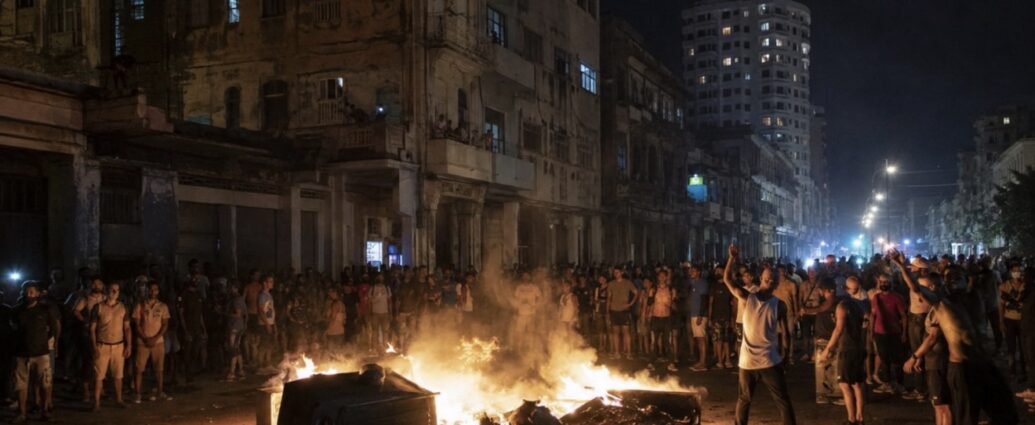
The deteriorating conditions spilled into the streets overnight Wednesday into Thursday.
Residents in Havana neighborhoods including Lawton and Dolores blocked roads with burning trash, banged pots and pans from balconies and intersections, and chanted “turn on the lights,” according to videos circulating widely on social media and eyewitness reporting from Reuters journalists inside the capital.
The demonstrations mark the largest visible unrest in Havana since the historic July 2021 anti-government protests and present a direct challenge to the administration of Cuban President Miguel Díaz-Canel.
In a statement posted on X, Díaz-Canel described the situation as “particularly tense” and blamed what he called the “genocidal U.S. blockade” for worsening the island’s economic collapse.
The immediate cause of the crisis traces directly to tightening U.S. policy.
In late January, President Donald Trump signed an executive order declaring Cuba an “extraordinary threat” to the United States and warning that countries shipping fuel to the island could face tariffs and secondary sanctions.
Within weeks, Mexico and Venezuela — historically Cuba’s primary fuel suppliers — sharply reduced or halted shipments.
Cuba’s position worsened further after the collapse of Venezuelan support infrastructure earlier this year. Following the removal of Venezuelan President Nicolás Maduro in January, the long-standing Caracas-Havana energy pipeline that had sustained Cuba’s grid through years of economic decline effectively collapsed.
Since December, only one major tanker — the Russian-flagged Anatoly Kolodkin — has reportedly delivered crude oil to Cuba, offering only temporary relief.
The humanitarian and economic fallout is now accelerating rapidly.
Tourism, Cuba’s largest source of foreign currency, has deteriorated sharply as airlines cancel flights over fuel shortages and hotels struggle to maintain basic operations across Havana, Varadero, and Cayo Coco.
Hospitals have postponed surgeries due to electricity shortages and limited backup fuel. Food distribution systems have broken down in parts of the country. Garbage collection has reportedly stopped in several districts, while schools and public transportation networks face growing disruptions.
Reuters correspondents described long lines outside the few remaining operational gas stations alongside an expanding diesel black market where prices have surged beyond what many Cuban households can afford.
The Trump administration has framed the crisis as an opportunity for political change rather than immediate sanctions relief.
The U.S. State Department announced Wednesday it was renewing an offer of roughly $100 million in humanitarian aid but tied the package to what officials called “meaningful reforms to Cuba’s communist system.”
In a statement, Washington said Cuban authorities must now decide whether to “accept our offer of assistance or deny critical life-saving aid.”
The United Nations last week criticized the tightening U.S. energy embargo, arguing that it risks obstructing Cubans’ “rights to food, education, health, water and sanitation.”
The crisis is also creating ripple effects inside the United States.
Florida’s large Cuban-American community has reportedly accelerated remittance transfers to relatives on the island while humanitarian organizations and shipping groups have urged Washington to permit limited fuel deliveries tied specifically to hospitals, food logistics, and medical infrastructure.
Immigration officials are also monitoring concerns that worsening conditions could trigger a new migration wave toward South Florida at a time when U.S. border enforcement resources remain heavily strained.
Geopolitically, the situation signals a broader strategic shift.
The Trump administration has increasingly indicated that following the stabilization of Middle East tensions, Cuba and Venezuela may become primary focuses of a renewed Western Hemisphere pressure campaign.
Secretary of State Marco Rubio, a longtime advocate of tougher policies toward Havana and Caracas, said earlier this month that Cuba’s collapse stems from “decades of communist mismanagement” rather than sanctions alone — remarks Cuban officials dismissed as “lies.”
High-level discussions between U.S. and Cuban officials took place in Havana on April 10 but produced no public breakthrough.
Whether the latest protests represent the beginning of a larger political rupture remains uncertain.
Historically, Cuban authorities have responded to unrest through mass arrests, internet shutdowns, and the deployment of paramilitary “rapid response brigades.” Reports Thursday suggested internet access had already been throttled in several Havana neighborhoods overnight.
The next major test may arrive over the coming weekend, as temperatures climb into the 90s across much of the island while millions of Cubans remain trapped inside a collapsing electrical grid with little access to refrigeration, ventilation, or air conditioning.
JBizNews Desk
© JBizNews.com. All rights reserved. This article is original reporting by JBizNews Desk. Unauthorized reproduction or redistribution is strictly prohibited.