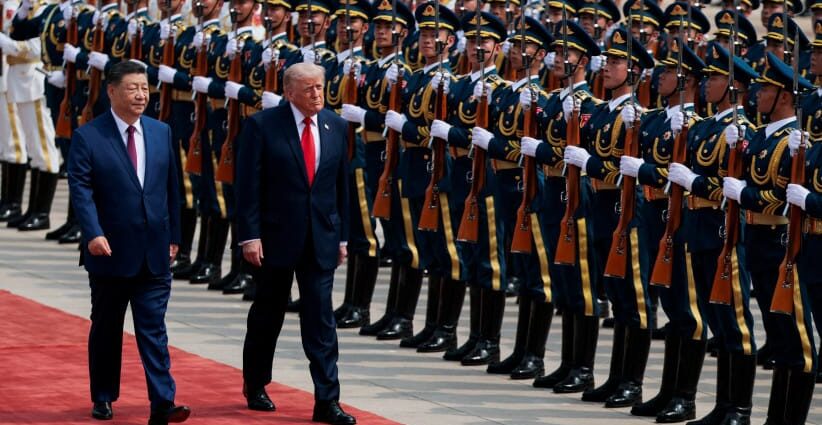
US President Donald Trump is on a historic visit to China. This could potentially have major ramifications for the world order. China and the US are signaling they want to seek accommodations on certain policies. The goal is to avoid a clash and possible conflict. China is a rising power. Some analysts believe the US is a declining power. As such, there is a chance that, in terms of global affairs, this will naturally lead to clashes. On the other hand, it might be that neither the US nor China will rise or fall in a predictable way. The meetings in China, therefore, have a lot of impact on the Middle East.
China is an emerging power in the Middle East. Beijing has been treading carefully in the region. It doesn’t want to be involved in conflict. Let’s examine five reasons the US-China meetings matter for the region:
China’s emerging role in the Middle East
China has been playing a greater role in the region. It has been doing this incrementally. For instance, it has sent its navy to the region in recent years. It has also been involved in aiding talks between Iran and Saudi Arabia in recent years. That means it has sought to bring stability to the region. China was wary of conflict zones, such as Syria. However, it has been more deeply involved in the Gulf, seeking out partnerships and investments.
China’s role is ambiguous at the moment. Is it only about investment, or will there be a military component? China, for many years, has been increasing its relationship with Israel. This included investments in Israel as well. However, the US viewed this with concern. In recent years, Beijing has been much more critical of Jerusalem. This means that it appears now that Israel’s attempt to work more closely with Russia and China, at the expense of working with the West, has shifted.
As China shifts gears in the region, it wants to extend economic partnerships with non-Western groups such as BRICS and the SCO. His ties are with the China-Russia partnership. As such, in the geopolitical space, China is a rising power in the region, and it has close ties with countries like Pakistan. It will likely have closer ties with Saudi Arabia, Syria, and other countries in the future.
China’s role in mediation with Iran
China has had increasingly close ties with Iran over the last decade. This included a 25-year deal intended to foster Iran-China partnerships. Most of this deal was unrealized. It appears that Beijing was cautious and concerned about Iran’s potential to destabilize the region. China doesn’t want to be dragged into conflict. Beijing has been critical of the US and Israeli attack on Iran. As such, China’s leader, Xi Jinping, has a chance to work with President Donald Trump on Iran deals. The deals reportedly include China agreeing that Iran should not have a nuclear weapon and that the Strait of Hormuz should remain open, according to the White House. Arab News reported this, citing a White House statement, the report said.
“Xi Jinping said earlier that trade talks were making progress at the start of a two-day summit but warned that disagreement over Taiwan could send relations down a dangerous path,” the report noted. China could become a major peacemaker. China could be playing the role that the US played in the early 20th century. The Treaty of Portsmouth formally ended the 1904–1905 Russo-Japanese War, and it was brokered with US support. It was signed on September 5, 1905. This could be China’s model now.
China-Israel relations in the spotlight
When the war in Iran began on February 28, there were articles examining how it might affect China. A quick defeat of Iran would show that Israel and the US were dominant powers in the region. Countries in the region, particularly Saudi Arabia, appear concerned at this outcome. Iran has not folded. This enables China to wait and see what comes next. China once had better ties to Israel. Those ties began to get worse around 2021. It was in those years that China also pivoted to helping Saudi-Iranian ties.
China is nonplussed with Israel. On May 12, Ynet noted that “Chinese Foreign Ministry spokesman Guo Jiakun on Tuesday rejected Prime Minister Benjamin Netanyahu’s claims that China aided Iran’s missile program.” The report added that “Guo was asked about Netanyahu’s remarks in an interview with CBS’ ‘60 Minutes,’ in which he said China had provided Iran with “a certain amount of support and certain components for missile production,” adding that he ‘didn’t like it.’ Netanyahu declined to elaborate ahead of the planned summit between President Donald Trump and Chinese President Xi Jinping.”
This means that China is watching Israel closely. It likely views Israel through the same lens it uses for the US. It knows Israel and the US have increasingly close military ties. It also knows that Israel had sought out closer ties to non-Western powers between 2015 and 2023. However, October 7 has changed many things. Israel has close ties with India, which is often seen as a rival to China. Israel has close ties with South Korea and Singapore. Israel historically has ties in Asia with Western allies, but has also worked on ties with countries such as Vietnam and those in Central Asia. China watches Israel’s moves closely, and Beijing is likely impressed with Israel’s technology advances.
China-Gulf influence
As the Iran conflict continues, China will benefit from ties with the Gulf. This is particularly true of ties with Saudi Arabia. China is seen as a rising power and one that can bring stability and investment. There is concern in the region that the US war with Iran has spread chaos and instability. Countries like Saudi Arabia want to hedge now on what comes next in the world. Saudi Arabia has been a close US friend since the 1930s. However, it now understands that this century will bring new challenges.
Gulf media is watching developments surrounding the Trump visit. One report says that the conflict is “fast tracking” China’s influence in the Gulf and the region. Meanwhile, an Associated Press report noted that “Kuwait said on Tuesday that Iran launched a failed attack earlier this month on an island where China is helping build a port in the Gulf Arab country. The accusation came just hours before Trump was to depart for Beijing on a high-stakes visit over the Iran war and other issues.” This is important. Countries want to make it clear to China that Iran’s actions are also a threat to stability. Iran will want to try to smooth things out and emerge as the responsible power.
China may benefit from trade deals and munitions
An article in the South China Morning Post on the eve of the Trump visit noted that “US missile shortages could strengthen China’s hand during Trump visit.” This messaging is clear. The messaging is that the US has wasted a lot of munitions in the war on Iran. China has watched closely. If the US had landed a knockout blow, China might feel it should be worried. The US’s presence in Iran can benefit China.
On the other hand, China wants to secure trade and oil deliveries. As such, China may be concerned that the continued US blockade of Iran and the Iranian blockade of the Strait of Hormuz could affect China’s dominance and its need for oil and other trade passing through the Strait of Hormuz. Iran will also feel that if it can’t secure trade routes, its future may be in jeopardy.
China historically was not a major naval power. It is primarily a land power. However, over the last few decades, it has invested heavily in shipbuilding and naval power. Iran does not have good land infrastructure links with its neighbors. This is partly due to geography. Building land links to Central Asia is difficult. Also, its neighbors in that area are mostly poorer and less developed. As such, Iran has to search for maritime trade to secure its future. The Gulf is important for this. The disruptions in recent years in the Red Sea and now in the Strait of Hormuz have led China to rethink its role in the world.