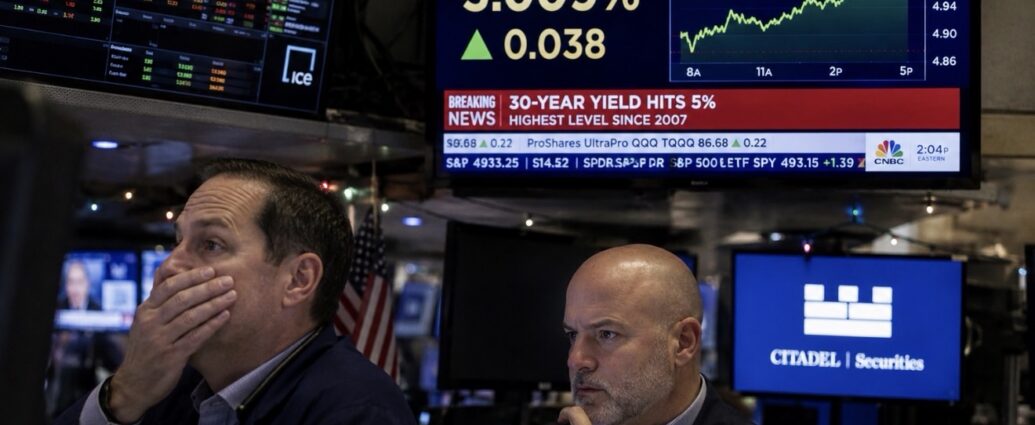
The U.S. bond market delivered its clearest warning yet to the Federal Reserve this week as the 30-year Treasury yield surged above 5% for the first time at a regularly scheduled Treasury auction since 2007, underscoring mounting investor fears that inflation tied to the Iran conflict is becoming deeply embedded across the economy.
The benchmark 30-year Treasury bond traded as high as 5.05% Wednesday following a hotter-than-expected inflation report from the Bureau of Labor Statistics, marking its highest intraday level since July and reviving Wall Street fears of a prolonged era of elevated borrowing costs.
The move came after the U.S. Treasury Department auctioned $25 billion in new 30-year bonds at a yield of 5.046%, slightly above prevailing market levels immediately before the bidding closed — a sign investors demanded higher compensation to absorb long-term U.S. government debt.
The weak reception followed similarly soft demand earlier this week for new 3-year and 10-year Treasury offerings, reinforcing concern that investors are increasingly questioning whether inflation will return to the Federal Reserve’s long-standing 2% target anytime soon.
“Wednesday’s PPI was strikingly elevated as producers are feeling the ripple effects of $100 per barrel oil,” said Clark Bellin, president and chief investment officer at Bellwether Wealth. Bellin warned the Federal Reserve now faces “an inflation problem on its hands at a time when the labor market has slowed down.”
The rise in yields reflects growing anxiety across global financial markets over the economic consequences of the expanding U.S.-Israel conflict with Iran.
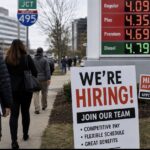
The effective closure and disruption of shipping through the Strait of Hormuz — through which roughly one-fifth of the world’s seaborne crude oil moves — has pushed oil prices above $100 per barrel and gasoline prices above $4 per gallon in many parts of the United States.
The shock has spread rapidly through industrial supply chains, lifting costs for fertilizers, petrochemicals, diesel fuel, aluminum, plastics, aviation fuel and transportation services.
Those pressures became unmistakable Wednesday after the Producer Price Index surged 1.4% in April, nearly triple economist expectations and the largest monthly increase in four years. On an annual basis, producer inflation accelerated to 6.0%, its highest level since December 2022.
Core producer inflation — which excludes food and energy — climbed 1.0% for the month, also sharply above forecasts.
The inflation shock followed Tuesday’s Consumer Price Index report showing headline inflation rising 3.8% year over year, the highest reading since May 2023.
“Today’s inflation report is certainly another nail in the coffin of the idea Fed officials have to welcome the new Fed Chair with an interest rate cut this year,” said Chris Rupkey, chief economist at FWDBONDS.
Markets are now beginning to price in the possibility that the Federal Reserve’s next move could eventually be another rate increase rather than the cuts investors had expected earlier this year.
According to the CME FedWatch Tool, traders now assign roughly a 25% probability to an additional quarter-point Fed rate hike by year-end, up notably from earlier this week.
The Federal Open Market Committee has kept its benchmark overnight rate in a range of 3.50% to 3.75% since December, but internal divisions inside the Fed have become increasingly visible.
Three voting members dissented at the Fed’s late-April meeting against language implying the next move would likely be a cut.
The hawkish shift intensified Wednesday after Boston Federal Reserve President Susan Collins told the Boston Economic Club that she could now envision a scenario requiring additional monetary tightening if inflation pressures fail to ease.
Hours later, the Senate confirmed Kevin Warsh as the next Federal Reserve chair in a party-line vote, replacing Jerome Powell. Warsh, nominated by President Donald Trump, has publicly advocated for a “new inflation framework” and is widely viewed by markets as more hawkish than Powell.
For households and businesses, the jump in long-term Treasury yields carries immediate real-world consequences.
The 30-year Treasury yield heavily influences mortgage financing costs, and Freddie Mac reported last week that the average 30-year fixed mortgage rate was already approaching 7.4%.
Auto loans, credit-card interest rates, student loans and small-business financing costs also track broader Treasury-market movements, meaning persistently higher yields could tighten financial conditions throughout 2026 even without additional Federal Reserve action.
Commercial real estate markets remain particularly vulnerable as billions of dollars in office, multifamily and retail property loans approach refinancing in a much higher-rate environment.
Despite the bond market’s warning signals, equity investors have so far remained remarkably resilient.
The S&P 500 closed Wednesday at a record 7,444.25, while the Nasdaq Composite climbed 1.20% to another all-time high, driven largely by enthusiasm surrounding artificial-intelligence megacap technology companies.
“In the face of continued hot inflation data, technology remains resilient,” said Ryan Detrick, chief market strategist at Carson Group.
Still, the rally’s narrowness has become increasingly noticeable. Roughly two-thirds of S&P 500 companies finished lower Wednesday even as the index itself reached a new record high.
That disconnect between equity optimism and bond-market caution is drawing growing scrutiny across Wall Street.
Morgan Stanley raised its year-end 2026 S&P 500 target to 8,000 from 7,800, citing strong AI-driven earnings growth, but simultaneously warned that renewed Federal Reserve tightening now represents the primary risk to its bullish outlook.
Meanwhile, Jim Baird, chief investment officer at Plante Moran Financial Advisors, said the latest inflation data “reinforces the inflation risk narrative and at least makes the case for a longer pause at the Fed.”
Foreign appetite for U.S. government debt also appears to be softening.
Japanese and European pension funds — historically among the largest buyers of long-dated Treasuries — have gradually reduced purchases as currency-hedged Treasury returns become less attractive and concerns about America’s fiscal outlook intensify.
The Congressional Budget Office projects federal interest payments will exceed $1 trillion during fiscal 2026, surpassing annual defense spending for the first time in modern history.
For markets, the symbolic breach of 5% on the 30-year Treasury marks more than just another milestone.
It represents a reminder that while equity investors remain captivated by the artificial-intelligence boom, the bond market is increasingly preparing for an economic regime in which inflation remains structurally higher — and borrowing costs remain elevated far longer than policymakers or investors once expected.
JBizNews Desk
© JBizNews.com. All rights reserved. This article is original reporting by JBizNews Desk. Unauthorized reproduction or redistribution is strictly prohibited.