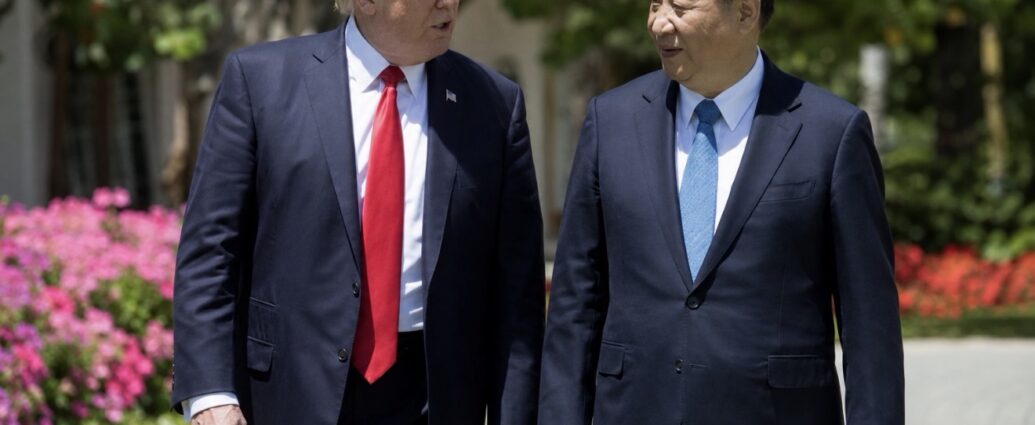
President Donald Trump and Chinese President Xi Jinping concluded the opening day of their Beijing summit Thursday with a joint commitment that Iran must not control or disrupt the Strait of Hormuz, while also advancing a framework for reducing tariffs on roughly $30 billion in trade and moving toward what U.S. officials described as a major pending Boeing aircraft order.
The agreements emerged as the U.S.-led naval blockade of Iran entered its second month and tensions across the Persian Gulf continued threatening global shipping lanes and oil markets.
According to a White House readout, both leaders agreed the Strait of Hormuz must remain open to the free flow of global energy supplies, with Xi Jinping explicitly opposing any Iranian effort to militarize the waterway, interfere with shipping, or impose transit tolls on commercial vessels moving through the strategic chokepoint.
The White House also said both governments agreed Iran must never obtain a nuclear weapon.
President Trump later told Fox News that Xi offered to help mediate an end to the conflict with Iran and assured him China would not provide military support to Tehran.
Markets focused heavily on the summit’s economic deliverables.
Treasury Secretary Scott Bessent, speaking from Beijing, said both sides were working toward an initial tariff-reduction package covering roughly $30 billion in non-critical trade categories, with broader negotiations expected to continue in future rounds.
Bessent also confirmed Boeing was nearing a large commercial aircraft agreement with Chinese carriers. Trump later told reporters the order could involve as many as 200 aircraft, potentially marking China’s largest Boeing purchase in years.
A transaction of that scale would provide a major boost to Boeing’s already massive order backlog, previously estimated near $695 billion.
Industrial and aerospace shares climbed following the announcement, while investors interpreted the summit as a sign of stabilizing commercial ties between Washington and Beijing after years of trade tensions and technology disputes.
Oil markets, however, remained volatile despite the diplomatic progress.
According to testimony Thursday from Admiral Brad Cooper, commander of U.S. Central Command, the 38-day U.S.-Israeli campaign against Iran has significantly weakened Tehran’s military capabilities but has not eliminated its ability to threaten Gulf shipping and regional energy infrastructure.
Cooper told lawmakers that U.S. forces had destroyed roughly 90% of Iran’s naval mine inventory and a comparable share of its defense industrial base during Operation Epic Fury.
At the same time, maritime intelligence firm Windward reported that more than 330 fast boats linked to Iran’s Revolutionary Guard were operating in the Strait of Hormuz this week, underscoring ongoing security concerns.
Additional incidents throughout Thursday highlighted the fragility of the region.
Omani officials confirmed that an Indian-flagged commercial vessel sank after an attack near Oman, though all crew members were rescued. A separate ship was reportedly seized near the United Arab Emirates and redirected toward Iranian waters, according to a British maritime agency.
The Wall Street Journal also reported that Saudi Arabia carried out covert strikes against Iranian targets after attacks on Saudi energy infrastructure and civilian facilities.
The summit also surfaced unresolved geopolitical tensions between Washington and Beijing.
Xi warned Trump that Taiwan remains the most dangerous issue in the U.S.-China relationship and cautioned that mishandling the issue could lead to direct confrontation between the two powers.
The warning carries enormous implications for global semiconductor supply chains given Taiwan’s dominant role in advanced chip manufacturing through Taiwan Semiconductor Manufacturing Co. and key downstream customers including NVIDIA, Apple, and AMD.
Trump said he invited Xi to visit the White House in September, though Chinese officials did not immediately confirm the visit.
Meanwhile, military and diplomatic tensions continued across the broader Middle East.
The State Department confirmed a second round of U.S.-brokered talks between Israel and Lebanon began Thursday as fighting between Israel and Hezbollah intensified.
The Israel Defense Forces said they targeted approximately 65 Hezbollah-related infrastructure sites over the previous 24 hours, while additional projectiles and drone attacks were reported along the Israeli-Lebanese border.
For investors and global markets, the summit’s first day delivered meaningful signals on trade, energy security, and commercial cooperation — but many of the underlying geopolitical risks remain unresolved.
Wall Street largely viewed the tariff rollback framework, Hormuz commitments, and Boeing negotiations as supportive for global growth and industrial trade, though markets remain highly sensitive to developments involving Iran, Taiwan, and global energy flows.
Trump and Xi are scheduled to continue talks Friday during the second and final day of the Beijing summit.
— JBizNews Desk
© JBizNews.com. All rights reserved. This article is original reporting by JBizNews Desk. Unauthorized reproduction or redistribution is strictly prohibited.