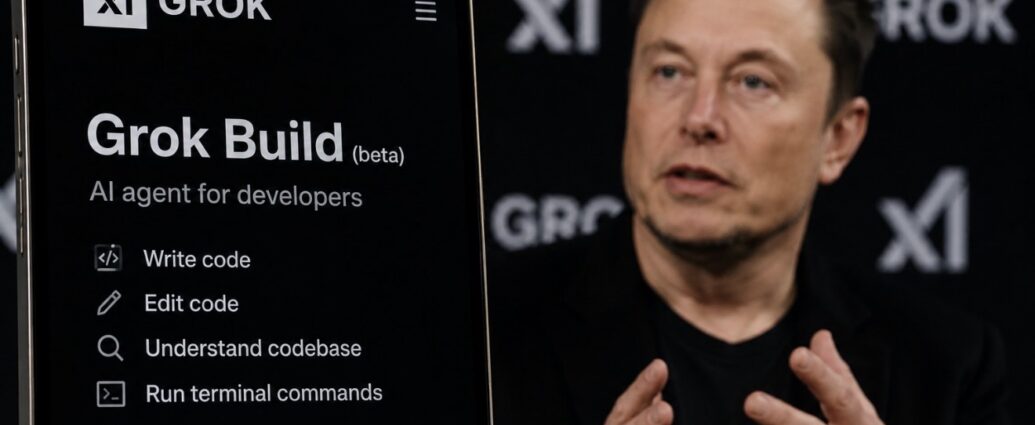
Elon Musk’s xAI launched its first dedicated AI coding agent Thursday, formally entering one of the fastest-growing sectors in artificial intelligence software as competition intensifies between xAI, Anthropic, and OpenAI for dominance in enterprise developer tools.
The new product, called Grok Build, is a desktop and terminal-based coding assistant designed to compete directly with Anthropic’s Claude Code and OpenAI’s Codex, according to an official announcement released by xAI.
The launch marks Musk’s most serious push yet into professional software-development infrastructure and arrives as SpaceX — which absorbed xAI earlier this year — reportedly prepares for a potential public offering that could value the combined AI and aerospace business near $75 billion.
Grok Build Launches for $300-Per-Month Subscribers
Initially, Grok Build is available exclusively to SuperGrok Heavy subscribers, xAI’s highest-tier subscription plan priced at $300 per month.
The platform runs as a native application across macOS, Linux, and Windows systems.
According to xAI, the coding agent is powered by Grok 4.3, the company’s newest frontier AI model, which uses a multi-agent architecture capable of deploying up to eight simultaneous AI workers to analyze codebases, search documentation, plan modifications, and generate software changes in parallel.
xAI said the system includes a massive two-million-token context window, allowing the agent to process and retain large software repositories across complex multi-file coding tasks.
The company also emphasized a “plan mode” feature enabling developers to review, modify, or reject the AI’s strategy before code changes are implemented.
Approved modifications are displayed through human-readable code diffs before execution.
Built Around Emerging Industry Standards
Grok Build supports many of the open standards rapidly becoming common throughout AI-assisted software development.
These include AGENTS.md project structures, plugins, hooks, custom skills, and the Model Context Protocol (MCP) — an interoperability framework originally introduced by Anthropic in 2024 that has since gained broad adoption across AI development platforms.
Developers can currently access the beta version through build.grok.com.
xAI engineer Michael Nicolls is overseeing the early testing and feedback program among high-tier subscribers.
AI Coding Market Becomes Major Battleground
The launch dramatically escalates competition in the emerging AI coding-agent market.
Anthropic, led by Dario Amodei and Daniela Amodei, transformed Claude Code from an experimental product into one of Silicon Valley’s fastest-growing enterprise tools over the past year.
The success helped propel Anthropic into reported valuation discussions approaching $900 billion, up sharply from earlier financing rounds.
Meanwhile, OpenAI’s Codex platform has gained substantial adoption among independent developers and startup engineering teams.
Industry data compiled by analysts at BigGo Finance recently showed Codex generating download activity significantly above Claude Code in certain developer ecosystems.
Amazon has also entered the battle.
Earlier this month, Amazon reportedly opened internal employee access to both Claude Code and Codex after concerns emerged that its internally developed coding assistant, Kiro, had fallen behind competitors.
Musk and Anthropic Shift From Conflict to Partnership
The Grok Build launch comes amid a broader and increasingly complicated rivalry between Musk and major AI firms.
Earlier this year, Anthropic revoked xAI’s access to Claude models after accusing xAI engineers of improperly leveraging Claude capabilities through third-party coding tools in ways that allegedly violated Anthropic’s usage policies.
Despite the tensions, the two companies recently reached a significant infrastructure agreement.
Anthropic signed a major compute deal granting access to xAI’s Colossus 1 data center in Memphis, Tennessee, which provides more than 300 megawatts of AI computing capacity.
Anthropic said the infrastructure is already helping expand compute availability for Claude subscribers.
The agreement also reportedly includes discussions exploring future multi-gigawatt orbital computing infrastructure involving SpaceX.
Musk, who has publicly criticized both Anthropic and OpenAI in recent years while simultaneously pursuing litigation against OpenAI and Chief Executive Sam Altman, recently signaled a softer tone toward Anthropic after meeting with members of the company’s leadership team.
xAI’s Business Model Evolves
The Grok Build rollout also highlights the increasingly unusual economics behind xAI and SpaceX’s AI ambitions.
Musk has publicly stated that xAI currently uses only a small portion of its available computing infrastructure for internal Grok development, leaving substantial unused capacity available for outside clients — including competitors such as Anthropic.
The arrangement effectively positions SpaceXAI as both an AI product developer and a large-scale infrastructure provider to rival AI labs.
Industry analysts increasingly view the strategy as similar to Amazon Web Services’ role in cloud computing: owning the infrastructure layer while simultaneously competing at the application layer.
Can Grok Build Challenge Claude and Codex?
For enterprise customers, Grok Build now emerges as a credible third major option alongside Claude Code and Codex.
Analysts say xAI appears to be positioning Grok Build as a lower-cost alternative to premium offerings from Anthropic and OpenAI while attempting to match competitors on key technical capabilities.
That approach aligns with Musk’s broader strategy across several industries: aggressively scale infrastructure, compete on pricing, and rapidly expand ecosystem integration.
Whether Grok Build can meaningfully challenge Claude Code and Codex over the next year will likely depend on enterprise adoption, reliability, and developer trust as corporations increasingly integrate AI agents directly into software engineering workflows.
For now, the launch signals that the AI coding wars — one of the most commercially important segments of artificial intelligence — are entering a far more competitive phase.
— JBizNews Desk
© JBizNews.com. All rights reserved. This article is original reporting by JBizNews Desk. Unauthorized reproduction or redistribution is strictly prohibited.