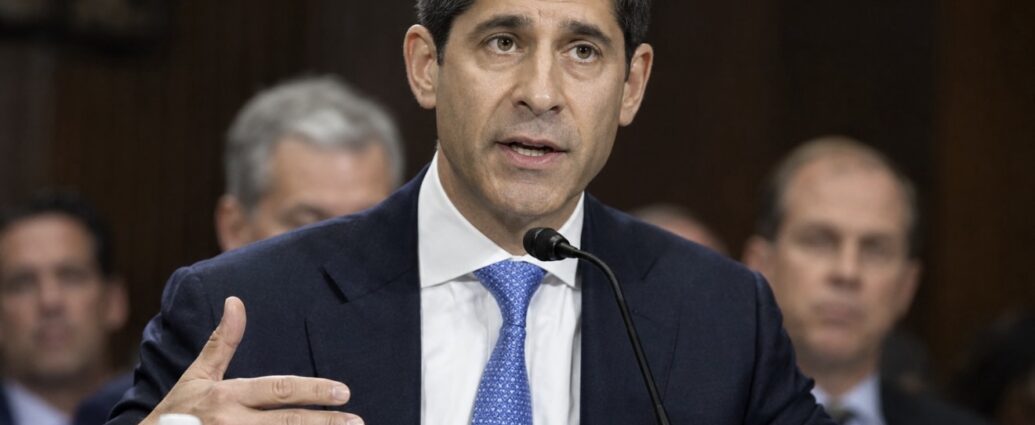
WASHINGTON — The U.S. Senate confirmed Kevin Maxwell Warsh as the 17th chair of the Federal Reserve on a 54-45 vote Wednesday evening, the narrowest margin in the central bank’s 113-year history, capping a four-month nomination fight and clearing the way for Warsh to take office Monday after Jerome Powell’s term as chair expires Friday at midnight. Warsh will serve a four-year term as chair and a 14-year term as a member of the Board of Governors, beginning a tenure that — as Wall Street has been pricing in for weeks — will pivot the central bank toward a more politically aligned policy stance under a chair who turns 56 today and who has spent the last 15 years openly criticizing the post-pandemic monetary regime he is now inheriting. Here is the resume that put him in the seat.
The early life is upstate New York. Warsh was born April 13, 1970 in Albany to Robert Warsh, a manufacturer of school uniforms in Loudonville, and Judith Philipson Warsh, a journalist and freelance writer. He was the youngest of three children, raised in a Jewish family, and attended Shaker High School, where he played tennis and competed in New York State championships. He told SUNY-Albany’s School of Business in 2007 that “I learned much of what I need to know about the real economy in my first eighteen years here.” The education credentials are blue-chip: a bachelor’s in public policy from Stanford University in 1992, a J.D. from Harvard Law School in 1995 with a focus on economics and regulatory policy, and supplementary coursework in market economics at Harvard Business School and the Massachusetts Institute of Technology.
The first chapter of his career was on Wall Street. From 1995 to 2002, Warsh worked in the mergers-and-acquisitions group at Morgan Stanley, eventually rising to vice president and executive director — the operating experience inside the U.S. capital markets system that would later distinguish him from academic economists at the Fed. He left Morgan Stanley in 2002 to join the George W. Bush administration as Special Assistant to the President for Economic Policy and Executive Secretary of the White House National Economic Council. In that role he managed domestic finance, capital markets, and banking policy, served as White House liaison to the Federal Deposit Insurance Corp., Commodity Futures Trading Commission, and the Securities and Exchange Commission, and helped shepherd the administration’s response to the Enron and WorldCom scandals — work that produced the Sarbanes-Oxley Act of 2002.
The first Fed appointment came in 2006. President Bush named Warsh to the Board of Governors at age 35, making him the youngest Fed governor in U.S. history. He served from 2006 to 2011, including throughout the global financial crisis, where he worked closely with then-Fed Chair Ben Bernanke and then-New York Fed President Timothy Geithner. Bernanke later wrote in his memoir that Warsh was “one of my closest advisers and confidants” and credited his “political and markets savvy and many contacts on Wall Street” as “invaluable” during the crisis response, including in negotiating the rescue of his former employer Morgan Stanley in September 2008. Warsh served as the Fed’s representative to the G-20, as the Board’s emissary to Asia, and as Administrative Governor managing the central bank’s operations. He resigned in March 2011 — three years before his term was set to end — in opposition to the Federal Open Market Committee’s second round of quantitative easing, the $600 billion Treasury bond-buying program known as QE2.
The post-Fed years were spent constructing a hybrid policy-and-finance portfolio. Warsh joined the Hoover Institution at Stanford in 2011 as the Shepard Family Distinguished Visiting Fellow in Economics and as a lecturer at Stanford Graduate School of Business, positions he held continuously until his confirmation this week. He became a partner at Duquesne Family Office, the private investment vehicle of legendary hedge-fund manager Stanley Druckenmiller. He joined the board of directors of United Parcel Service Inc., where he served until the Fed nomination. He is a member of the Group of Thirty, the closed-door body of senior central bankers and financiers. In 2017, President Trump considered him for Fed Chair but chose Powell instead — a decision Trump has since publicly called “bad advice.” In 2024, Warsh was the leading candidate for Treasury Secretary until Trump chose Scott Bessent.
The nomination fight that ended this week was unusually difficult. Trump named Warsh as Powell’s successor in January 2026. North Carolina Senator Thom Tillis placed a hold on the nomination until the Department of Justice dropped its investigation of Powell — a probe widely interpreted in Washington as an attempt to force Powell out before his term expired. DOJ dropped the investigation in April. Warsh’s confirmation hearing before the Senate Banking Committee on April 21 was dominated by questions of Fed independence, the Trump administration’s pressure on Powell, and Warsh’s own past criticism of central-bank policy. He told senators that “inflation is a choice, and the Fed must take responsibility for it” and characterized the post-pandemic price surge as “the biggest policy error in 40 or 50 years.” Pennsylvania Democratic Senator John Fetterman crossed over to provide a critical vote. Warsh was confirmed as a Fed governor on May 12 in a 51-45 party-line vote replacing Stephen Miran and as chair on May 13 in the 54-45 vote.
The personal balance sheet is meaningful. Warsh married Jane Lauder in 2002. Jane Lauder is granddaughter of Estée Lauder founder Estée Lauder and daughter of Ronald Lauder — a major Republican donor, billionaire, and current president of the World Jewish Congress. Warsh’s personal net worth, by Senate disclosures, is at least $100 million, with private investments including stakes in prediction-market platform Polymarket and Elon Musk’s SpaceX. Senate Democrats criticized Warsh for declining to disclose the full size of those holdings. He has pledged to divest all such assets within 90 days of being sworn in. Critically for the institutional dynamics inside the Eccles Building, Powell has said he will remain on the Board indefinitely as a governor — his governor term runs through 2028 — citing Trump’s “unprecedented” pressure on the central bank’s independence. Warsh, who prefers trimmed-mean inflation measures over the Fed’s preferred core PCE gauge and who has aligned with the Trump view that artificial intelligence-driven productivity gains can deliver non-inflationary growth, will take the gavel Monday with Powell sitting beside him on the same panel. The next FOMC meeting will be the first real test.
— JBizNews Desk
© JBizNews.com. All rights reserved. This article is original reporting by JBizNews Desk. Unauthorized reproduction or redistribution is strictly prohibited.