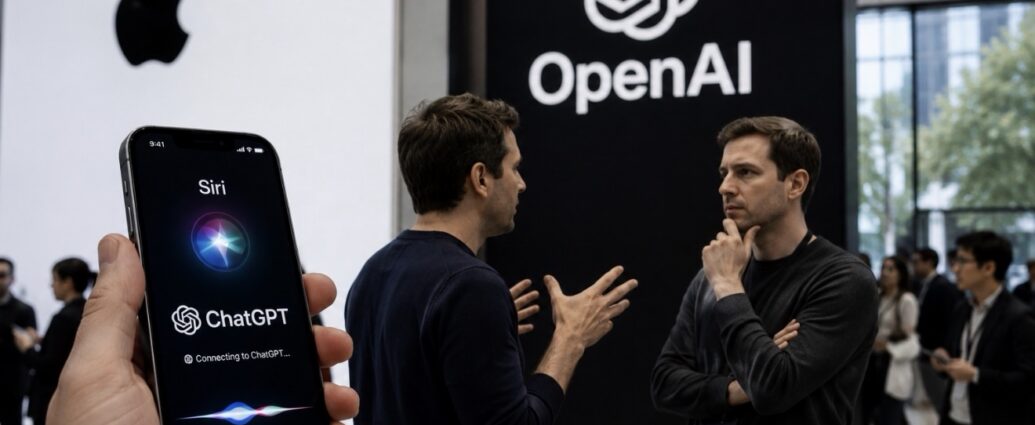
OpenAI is preparing a possible legal challenge against Apple over the companies’ two-year-old Siri-ChatGPT partnership, with lawyers for the artificial intelligence firm exploring options that could include a formal breach-of-contract notice, according to a report Thursday by Bloomberg’s Mark Gurman.
The dispute between two of the most consequential companies in artificial intelligence and consumer technology threatens a partnership that was initially presented as a landmark moment for mainstream AI adoption when it was unveiled at Apple’s Worldwide Developers Conference in 2024.
According to Bloomberg, OpenAI executives have grown increasingly frustrated that Apple’s implementation of ChatGPT inside the iPhone ecosystem has failed to generate the subscription revenue the company expected. Internal forecasts reportedly envisioned billions of dollars in new paid ChatGPT subscriptions driven through Apple devices, but the actual performance has fallen materially short of those projections.
“They haven’t even made an honest effort,” one OpenAI executive told Bloomberg, describing Apple’s implementation as difficult to find, heavily restricted and weakly promoted to users.
Attempts to renegotiate the commercial arrangement have stalled, Bloomberg reported, leading OpenAI and outside counsel to evaluate “a range of options that could be formally executed in the near future,” with a breach-of-contract notice viewed internally as the most immediate possibility.
Such a filing would not necessarily trigger litigation immediately but could serve as leverage in renewed negotiations between the two companies.
The conflict centers largely on how Apple integrated ChatGPT into Siri and the broader iOS ecosystem.
Under the existing arrangement, Siri can transfer more complex user requests to ChatGPT after obtaining user permission, while consumers can subscribe to premium ChatGPT services through Apple’s iOS subscription system, with Apple receiving a percentage of the revenue.
OpenAI had reportedly expected substantially deeper integration across Apple applications and more prominent placement inside Siri itself. Those expectations, according to Bloomberg, were never fully realized.
The tensions arrive as Apple simultaneously broadens its artificial-intelligence relationships elsewhere.
Bloomberg previously reported that Apple struck an agreement estimated at roughly $1 billion annually with Google to incorporate Gemini models into a redesigned Siri experience expected to debut as part of iOS 27 during Apple’s WWDC 2026 keynote on June 8. Apple is also reportedly developing a broader “Extensions” framework that would allow users to connect third-party AI assistants, including Anthropic’s Claude, directly into the operating system.
The company earlier this year also settled a $250 million class-action lawsuit tied to marketing claims surrounding Apple Intelligence features.
The relationship between Apple and OpenAI has become even more complicated as OpenAI expands beyond software into hardware initiatives.
OpenAI’s acquisition of the AI-device startup founded by former Apple design chief Jony Ive has intensified competitive tensions between the companies, while Bloomberg reported that some Apple executives have raised concerns internally about OpenAI’s privacy practices and long-term ambitions.
Meanwhile, Elon Musk’s xAI previously filed litigation against both companies, alleging the original Siri-ChatGPT partnership created anticompetitive dynamics within the AI ecosystem.
The financial and strategic implications are significant for both sides.
For OpenAI, which continues ramping enterprise revenue and consumer subscriptions while positioning itself for a potential future public offering, weaker-than-expected performance from the Apple partnership removes what many internally viewed as a major long-term growth driver.
For Apple, the dispute arrives as the company struggles to convince investors it can remain competitive in consumer artificial intelligence against rivals including Microsoft and Google, both of which have accelerated AI rollouts across their ecosystems.
Apple is also navigating a broader leadership transition. Bloomberg has reported that hardware engineering chief John Ternus is increasingly viewed internally as a potential successor to Chief Executive Tim Cook, with future leadership expected to place greater emphasis on capital deployment, shareholder returns and targeted artificial-intelligence investments.
A prolonged legal conflict with OpenAI would likely become one of the defining strategic issues confronting that next generation of leadership.
Markets reacted only modestly to the report Friday morning, with Apple shares trading little changed as broader weakness across technology stocks tied to the underwhelming Trump-Xi summit overshadowed company-specific developments. Microsoft, OpenAI’s largest commercial backer, also traded roughly flat.
Analysts at Wedbush Securities led by Dan Ives have argued in recent research notes that Apple’s AI strategy requires what they described as a “step-function change” if the company hopes to remain competitive in the next phase of consumer computing.
The dispute also raises broader questions about the economics underpinning the consumer artificial-intelligence industry — particularly whether platform-integration deals controlled by dominant ecosystem owners can generate the subscription growth and monetization AI labs need to finance increasingly expensive computing infrastructure.
OpenAI is not the first company to accuse Apple of limiting commercial opportunity inside the iPhone ecosystem. Spotify, Epic Games and several other firms have raised similar complaints over the years regarding platform control, user friction and subscription economics.
Whether those same tensions now escalate into a legal confrontation with the world’s most recognizable artificial-intelligence company may depend largely on what OpenAI’s lawyers decide to file next.
Both companies declined to comment publicly on Bloomberg’s report.
JBizNews Desk
© JBizNews.com. All rights reserved. This article is original reporting by JBizNews Desk. Unauthorized reproduction or redistribution is strictly prohibited.