The nation’s top economic forecasters have sharply lifted their projection for U.S. inflation in the current quarter, now expecting the Consumer Price Index to climb to a 6% annualized rate in the second quarter — more than double the 2.7% pace they had projected just three months ago, before U.S. and Israeli strikes against Iran sent global oil prices soaring and forced a rapid reassessment of the inflation outlook.
The revision came in the latest Survey of Professional Forecasters, the blue-ribbon panel polled quarterly by the Federal Reserve Bank of Philadelphia and released Friday morning.
The new 6% projection lands well above the 2% pace the Federal Reserve targets and would, if realized, mark the highest quarterly inflation rate since 2022.
For the full year, the panel now sees headline CPI running at 3.5% and core CPI, which excludes food and energy, at 2.9% — both materially higher than what mainstream economists were forecasting at the start of 2026.
The upward revision follows a string of inflation reports that have already shown prices accelerating well above what economists had penciled in just months ago.
The Bureau of Labor Statistics reported Tuesday that headline CPI rose 3.8% in April from a year earlier, the fastest annual pace in nearly three years, with monthly prices up 0.6%.
Energy costs jumped 17.9% on the year — the steepest increase since September 2022 — driven by a 28.4% surge in gasoline and a 54.3% spike in fuel oil.
Wednesday’s Producer Price Index report showed wholesale inflation running at a 6% annual rate in April, the highest reading since December 2022 and a warning that pipeline pressures will continue pushing consumer prices higher in the coming months.
The forecast revision is being driven almost entirely by the energy shock from the Strait of Hormuz closure, which has cut roughly 10 million barrels a day of crude exports from the Persian Gulf since late February.
U.S. national average gasoline prices have climbed nearly 50% since the war with Iran began and have crossed $4 a gallon for the first time in more than three years.
The International Energy Agency has characterized the disruption as the largest in the history of the global oil market by volume.
Even with the United States and China stepping in to plug part of the gap — U.S. exports have surged by roughly 3.5 million barrels a day during the war — Brent crude was trading near $107 a barrel and West Texas Intermediate near $103 on Friday.
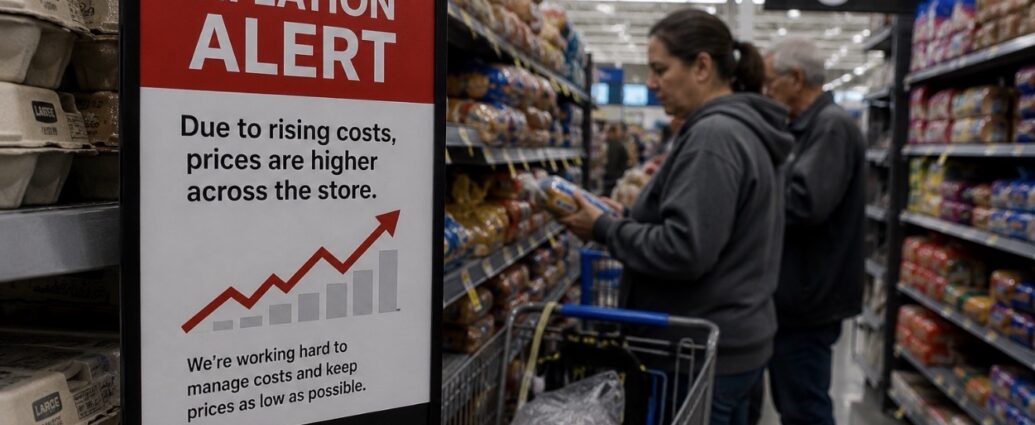
The inflation pickup is feeding directly into household budgets.
Walmart, the country’s largest grocer, has flagged renewed price sensitivity among lower-income shoppers, and Target has said inflation in food, beverage and household essentials is absorbing a larger share of customer budgets.
The University of Michigan’s preliminary May consumer sentiment reading collapsed to 48.2 — the lowest in the survey’s 75-year history — with respondents specifically citing high gas prices and tariffs.
Roughly one-third of consumers surveyed spontaneously mentioned gasoline.
Year-ahead inflation expectations in the Michigan survey held at 4.5%, far above the 3.4% pre-war reading.
The data is colliding with a leadership transition at the Federal Reserve.
Kevin Warsh, President Donald Trump’s nominee to succeed Jerome Powell as Fed chair, has indicated he would like to see lower interest rates, a position aligned with the administration’s growth-first agenda.
But the run of hot inflation data has tied his hands.
The broader Federal Open Market Committee, according to recent statements, is leaning toward keeping rates steady with an open mind toward additional increases if inflation deteriorates further — the opposite of the easing cycle markets had priced in at the start of the year.
Outside the survey, private-sector economists are reaching similar conclusions.
EY chief economist Gregory Daco wrote this week that headline CPI could surpass 4% in May and that core inflation will approach 3%, with risks of “higher and more persistent inflation” remaining salient.
Edward Jones investment strategist James McCann said that while tax refunds and a resilient labor market have buffered the consumer so far, “there are limits to these buffers.”
The Survey of Professional Forecasters panel also lowered its growth outlook, now expecting GDP to rise at a 2.1% annualized rate in the second quarter and 2.2% for the full year — down 0.3 percentage point from the prior estimate.
The longer the Strait of Hormuz remains closed, the more difficult the inflation picture becomes.
President Trump and Chinese President Xi Jinping agreed at this week’s Beijing summit that the waterway “must remain open,” but no timetable was attached to that statement, and major shipping lines remain on hold.
Until the strait reopens at meaningful volume, U.S. consumers can expect higher gasoline, higher airfares, higher diesel-driven trucking costs at the grocery shelf, and higher fertilizer prices feeding into food inflation through the back half of the year.
The 6% forecast is no longer the outlier scenario it would have been three months ago. It is, for now, the consensus.
JBizNews Desk
© JBizNews.com. All rights reserved. This article is original reporting by JBizNews Desk. Unauthorized reproduction or redistribution is strictly prohibited.