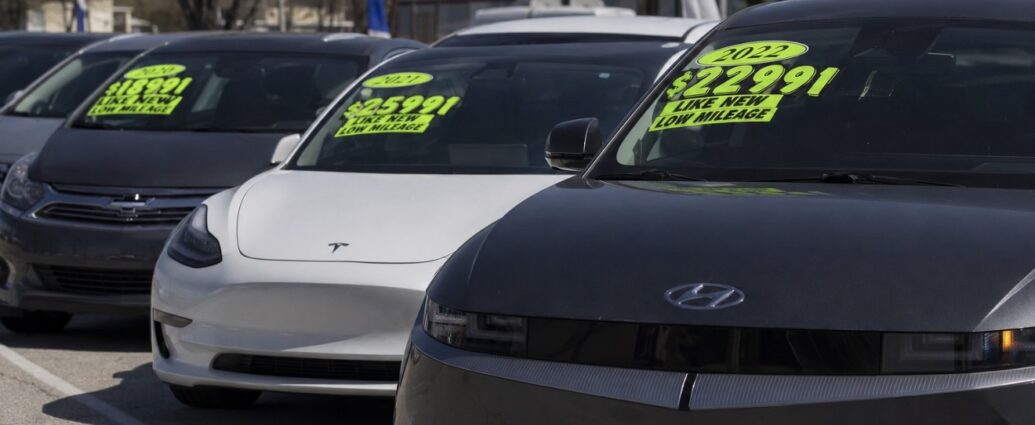
The hot trade on Wall Street this spring — betting that the Strait of Hormuz stays effectively closed — is one ordinary Americans can now place at the dealer’s lot. A wave of off-lease electric vehicles colliding with a national gasoline average above $4.50 a gallon has, almost overnight, made used EVs the cheapest way to drive in the United States.
A new analysis published in the peer-reviewed journal Environmental Research Letters by researchers at the University of Michigan’s Center for Sustainable Systems found that three-year-old used battery-electric vehicles now carry the lowest total cost of ownership of any powertrain across every body style studied.
Compared with buying a new midsize gasoline SUV, choosing the equivalent three-year-old used EV saves an owner roughly $13,000 over the vehicle’s lifetime, while a used gas SUV in the same class saves only about $3,000.
“Transportation is the second-largest portion of the average household’s budget and, in the new vehicle market, EVs are usually more expensive,” said Maxwell Woody, the study’s lead author. “But 70% of all vehicle purchases are used, and used EVs have the lowest cost of ownership across vehicle classes.”
Co-author Greg Keoleian, co-director of the Center for Sustainable Systems, was blunter: “If you’re in the market for a used vehicle, it’s very positive news.”
The math has flipped because two things moved at once.
The first is the pump.
According to AAA, the national average for regular gasoline reached $4.55 a gallon, $1.40 higher than a year earlier, as oil prices held above $100 a barrel.
The U.S. Energy Information Administration said in its May 12 Short-Term Energy Outlook that Iraq, Saudi Arabia, Kuwait, the UAE, Qatar and Bahrain collectively shut in 10.5 million barrels per day of crude oil production in April after the Strait of Hormuz was effectively closed by clashes between the United States and Iran.
The agency expects shipping to begin resuming late this month but said flows are unlikely to reach pre-conflict levels until later this year.
A typical sedan getting 30 miles per gallon now costs roughly 15 cents a mile in fuel; an EV charged at home runs closer to 4 cents — a gap exceeding $1,300 a year for the average driver.
The second is the lot.
Cox Automotive reported that the average used EV sold in March for $34,653, down 6.1% from a year earlier and just $1,102 more than the $33,641 average for a used gasoline car — the narrowest gap on record.
“Price parity is getting close,” said Stephanie Valdez Streaty, director of industry insights at Cox Automotive.
Forty-four percent of used EVs sold for under $25,000 in March, up from 39% in December.
Cox recorded 93,500 used EV transactions in the first quarter, up 12% from the same period in 2025.
CarGurus, the U.S. online auto marketplace, said more than 34% of used EV listings are now priced under $25,000, with the Tesla Model 3, Chevrolet Bolt EV and Nissan Leaf dominating the affordable end of the market.
“Gas prices are the variable to monitor on the powertrain front,” Kevin Roberts, director of economic and market intelligence at CarGurus, wrote in the firm’s most recent intelligence report.
“If they hold above $4, the EV and hybrid interest we saw in March could become a sustained trend rather than a blip. A growing wave of off-lease EVs could add another dimension as more affordable used EV supply hits the market at the same time gas prices are pushing buyers to consider alternatives.”
That off-lease wave is the supply story behind the price story.
J.D. Power projects returning EV lease volume will jump 230% in 2026, reaching about 215,000 vehicles, as a cohort of leases written during the Inflation Reduction Act’s so-called leasing loophole between 2023 and 2025 reaches term.
Edmunds forecasts roughly 400,000 additional lease returns across all powertrains in 2026, with the EV share of lease returns climbing to 8% from 2% a year earlier.
The pressure is amplified by the One Big Beautiful Bill Act, signed last July, which ended the federal tax breaks — worth up to $7,500 for new EVs and up to $4,000 for used EVs — effective at the end of September 2025.
New EV sales fell 28% in the first quarter as a result.
Buying well, however, still requires homework, because in an EV the battery is both the engine and the fuel tank.
Federal rules mandate at least an 8-year or 100,000-mile battery warranty, typically guaranteeing 70% capacity retention, and the warranty almost always transfers to the second owner.
Specialists recommend buyers insist on a written State of Health, or SoH, report before signing.
Industry data compiled by Energy Solutions Intelligence from more than 58,000 used EV listings shows most three-to-four-year-old packs sit between 88% and 94% SoH; for cars under five years old, anything below 85% should trigger either a steep discount or a walk-away.
Buyers should also verify completion of any open recalls through the National Highway Traffic Safety Administration, confirm the warranty transfers, and test the car on a Level 3 fast charger to make sure it pulls expected power and tapers normally past 80% state of charge.
The result is a market that has, almost overnight, reversed a decade of conventional wisdom.
The EV price premium is gone. The fuel-cost advantage has widened sharply. And with off-lease supply set to deepen for the next 18 to 24 months, informed buyers have leverage that did not exist a year ago.
JBizNews Desk
© JBizNews.com. All rights reserved. This article is original reporting by JBizNews Desk. Unauthorized reproduction or redistribution is strictly prohibited.