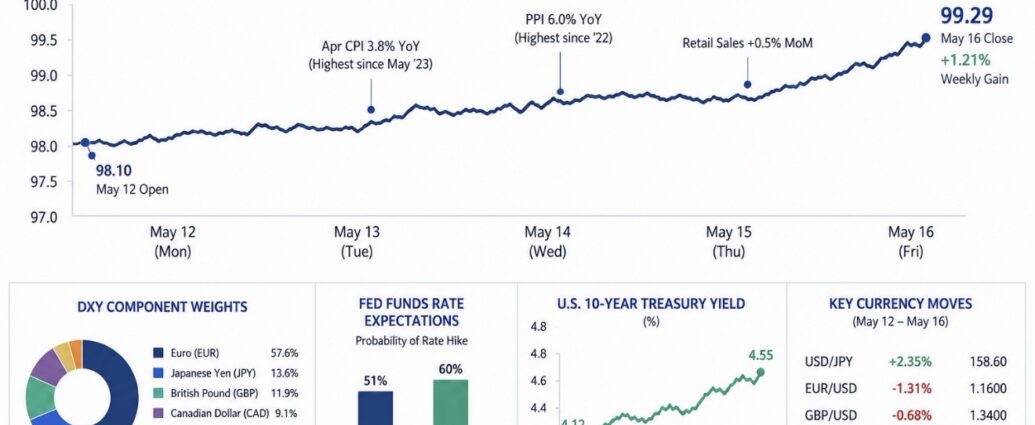
The U.S. Dollar Index climbed for a fifth straight session Friday and was on pace for a weekly gain of more than 1%, its strongest five-day run since the start of March, after April inflation data from the Bureau of Labor Statistics sent traders rushing to price out Federal Reserve rate cuts and increasingly bet on a hike before year-end. Trading Economics data put the DXY at roughly 99.29 in late New York trading, up from a Monday open near 98.10 and trading at its highest level in two weeks. CME FedWatch showed roughly 51% probability of a quarter-point hike at the December FOMC meeting and about 60% odds of a move by January 2027, up from near-zero a month ago.
The repricing was set in motion by the hottest pair of inflation prints in years. April CPI released by the Bureau of Labor Statistics on Tuesday came in at 3.8% year over year, the highest reading since May 2023, while Wednesday’s producer price index report jumped 6% from a year earlier — the hottest pace since 2022 — with headline PPI rising 1.4% month over month against a 0.7% expectation. Energy prices surged 7.8% on the goods side, transportation and warehousing costs rose 5%, and truck freight jumped 8.1%, with core PPI climbing 1% on the month and 5.2% annually. Census Bureau retail sales data Thursday rose 0.5% month over month in April, in line with forecasts but reinforcing the picture of a consumer still spending despite higher prices.
The data overwhelmed what had been a bearish dollar consensus heading into the spring. J.P. Morgan Global Research, which turned bearish on the greenback in March for the first time in four years, had been forecasting EUR/USD at 1.22 by mid-2026. Instead, the euro broke through its May lows and traded toward 1.16 on Friday as the European Central Bank held rates steady and eurozone growth data softened. EUR/USD is the dominant component of the DXY basket at 57.6%, followed by the yen at 13.6%, the pound at 11.9%, the Canadian dollar at 9.1%, the Swedish krona at 4.2% and the Swiss franc at 3.6%.
The biggest single-pair story remained USD/JPY, which traded near 158.60 Friday in its fifth straight winning session as U.S. Treasury yields surged. The 10-year yield jumped roughly nine basis points to 4.55%, a fresh one-year high, widening the rate gap with Japanese government bonds and pulling capital toward dollar assets. The Bank of Japan and Ministry of Finance have intervened repeatedly in recent months to defend the yen, and traders flagged 160 as the level at which fresh action becomes likely. Analysts at National Bank of Canada said wide U.S.-Japan rate differentials “remain the dominant driver” and warned that continued intervention raises spillover risks via potential Japanese sales of U.S. Treasuries.
The hawkish repricing landed on the same week the U.S. Senate narrowly confirmed Kevin Warsh as Federal Reserve chair, replacing Jerome Powell, whose term expired Friday. Warsh, a former Fed governor and longtime critic of post-crisis monetary easing, has publicly questioned the central bank’s tolerance of services inflation. Currency traders are watching closely to see whether the new chair signals an earlier move to tighten, with Adam Button of ForexLive noting that the dollar’s rally “is no longer just about data — it’s about a regime change at the Fed.” Investors are also assessing whether Warsh will maintain the central bank’s institutional independence, a point that drew bipartisan attention during his confirmation hearings.
Geopolitics added a safe-haven bid on top of the rate story. Secretary of State Marco Rubio confirmed that President Donald Trump raised the Iran war and the Strait of Hormuz closure with Chinese President Xi Jinping during their two-day Beijing summit, though no diplomatic breakthrough emerged. WTI crude rose about 4% to near $101 a barrel and Brent climbed 1.5% to $107.30, keeping energy prices in the inflation pipeline and reinforcing the higher-for-longer dollar trade.
Dollar strength is rippling through commodity markets. Gold broke a long winning streak, falling roughly $133 to about $4,551 an ounce as the non-yielding metal lost ground to a higher-yielding greenback. Silver, copper and iron ore also retreated on the day. Strategas Research strategist Ryan Grabinski said in a Friday client note that “the higher-for-longer regime is back, and it’s now visible in every asset priced in dollars — from the euro to copper to a barrel of oil bought by an Indian refiner.” For emerging markets, the move spelled fresh pressure: the Indian rupee, Brazilian real and Turkish lira all weakened, complicating the inflation fight for central banks already squeezed by the Iran energy shock.
— JBizNews Desk
© JBizNews.com. All rights reserved. This article is original reporting by JBizNews Desk. Unauthorized reproduction or redistribution is strictly prohibited.