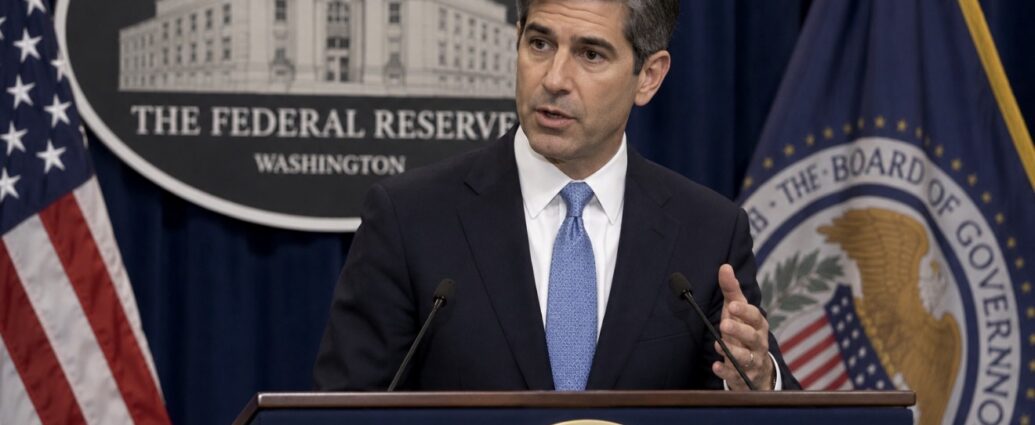
Kevin Warsh begins his first full week as chair of the Federal Reserve with the 10-year Treasury yield at a one-year high of 4.55%, the U.S. Dollar Index at its strongest level since early March, April CPI at 3.8% — the hottest reading since May 2023 — and CME FedWatch odds of a 2026 rate hike at 45%, up from near-zero a month ago, according to data from Trading Economics, the CME Group and the Bureau of Labor Statistics. Warsh, 56, was sworn in Friday after the U.S. Senate narrowly confirmed him Wednesday, replacing Jerome Powell, whose term expired the same day. Wall Street is now waiting on Warsh’s first public communications to gauge whether the new chair will lean rules-based, hawkish, or whether he will, as some critics fear, tilt to accommodate President Donald Trump’s repeated public calls for lower rates.
Warsh’s April 21 confirmation testimony before the Senate Banking Committee offered the clearest signal of his early priorities. He told senators that “the Fed must stay in its lane” and warned that “Fed independence is placed at greatest risk when it strays into fiscal and social policies where it has neither authority nor expertise.” He committed firmly to fighting inflation but, notably, made only one mention of the labor market in his prepared remarks, a tilt that monetary historians read as a return to Paul Volcker-style single-mandate emphasis. Warsh also said publicly elected officials voicing views on rate policy does not, in his view, threaten the Fed’s “operational independence” — a comment that drew applause from the Trump administration but raised eyebrows among economists who argued the standard for political pressure should be higher.
The more consequential policy question is the balance sheet. Warsh has argued for years that the Fed must shrink its footprint in financial markets and rely primarily on the federal-funds rate as its tool, rather than the multi-trillion-dollar System Open Market Account of Treasury and mortgage-backed-securities holdings built up since the 2008 financial crisis. Any signal during his first speech that he intends to accelerate quantitative tightening could send long-end yields higher and pressure mortgage-backed securities and bank stocks. Warsh has also publicly questioned the FOMC’s 2012 decision to formally adopt a 2% inflation target, arguing the figure is “arbitrary.” A move to revise or scrap the target — even rhetorically — would be the biggest framework change since the central bank adopted its flexible average inflation targeting regime in 2020.
The optics are also unusually personal. Warsh is married to Jane Lauder, an Estée Lauder Companies Inc. board member and granddaughter of the cosmetics empire’s founder, putting the new Fed chair in the upper tier of American wealth and giving the Lauder family a direct line to monetary-policy decision-making. He served as a Fed governor from February 2006 to April 2011, dissenting on quantitative easing under chairs Ben Bernanke and Janet Yellen, and built much of his market-facing reputation on his role coordinating the 2008 Troubled Asset Relief Program with then-Treasury Secretary Hank Paulson.
Markets have given Warsh the benefit of the doubt so far. Invesco chief global market strategist Kristina Hooper wrote in a note last month that “longer-term U.S. inflation expectations remain well-contained, suggesting that markets aren’t currently pricing in concerns about political interference in monetary policy.” Five-year breakeven inflation rates have ticked up modestly but remain anchored. Standard Chartered’s Geoffrey Kendrick and Strategas Research’s Don Rissmiller have both flagged that the Warsh regime is most likely to manifest in subtle communication shifts rather than in sudden rate moves, given the FOMC does not meet again until June 16-17.
The calendar this week sharpens the focus. The FOMC minutes from the April 28-29 meeting — the last under Powell — are released Wednesday at 2 p.m. ET, and any contrast between the Powell-era tone and Warsh’s opening remarks will be scrutinized. Fed governors Christopher Waller, Michelle Bowman and Lisa Cook are also scheduled for public remarks during the week, and any divergence on policy could highlight emerging fault lines within the committee. Friday’s final University of Michigan Consumer Sentiment print for May, particularly the five-year inflation expectations component, will be the data Warsh’s team will be watching most closely.
For investors, the practical questions are three: whether Warsh signals an accelerated balance-sheet runoff, whether he hints at a higher tolerance for elevated inflation in service of growth, and whether his rhetoric on Fed independence holds up under the first wave of Trump pressure. The answers will move the U.S. Dollar Index, the 2-year Treasury yield and the S&P 500 in roughly that order of magnitude.
— JBizNews Desk
© JBizNews.com. All rights reserved. This article is original reporting by JBizNews Desk. Unauthorized reproduction or redistribution is strictly prohibited.