By JBizNews Desk | May 18, 2026
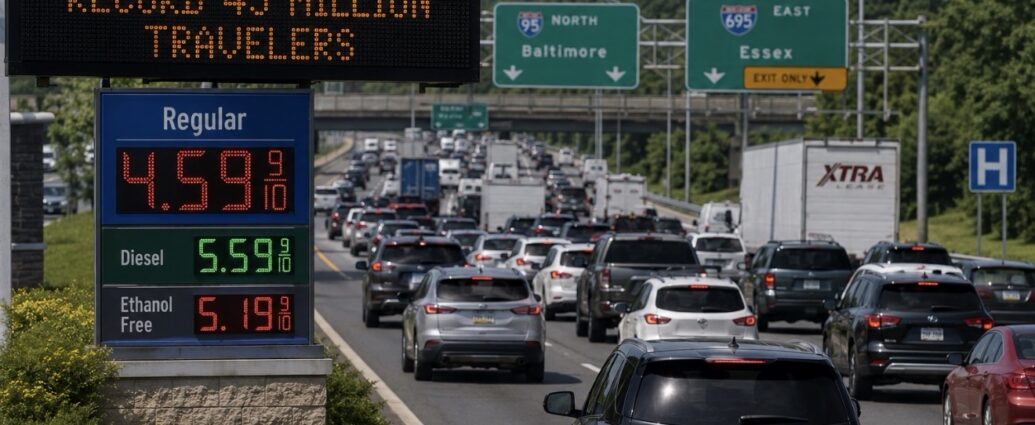
A record 45 million Americans are expected to travel at least 50 miles from home during the Memorial Day holiday weekend despite gasoline prices hovering above $4.50 a gallon, underscoring the remarkable resilience of U.S. consumer travel demand even as inflation, elevated borrowing costs and the Iran-driven energy shock continue squeezing household budgets. The forecast, released Monday by the American Automobile Association, covers travel between Thursday, May 21, and Monday, May 25 and surpasses last year’s 44.8 million travelers, setting a new Memorial Day record.
The surge comes against one of the most difficult fuel-price environments Americans have faced outside the 2022 energy crisis. National average gasoline prices are now roughly $4.50 per gallon, according to AAA data, up sharply from about $3.17 during Memorial Day weekend last year and only modestly below the all-time seasonal highs reached in June 2022. The price increase is being driven largely by the ongoing Iran conflict and the continuing closure of the Strait of Hormuz, which has disrupted global oil flows for more than two months and pushed crude oil back above $100 a barrel.
Despite the pressure, Americans are still traveling. AAA projects 39.1 million people will drive during the holiday period, while 3.66 million are expected to fly and millions more will travel by train, cruise and bus. The scale of the demand has surprised even energy analysts who expected fuel costs to meaningfully suppress discretionary travel this spring.
Patrick De Haan, head of petroleum analysis at GasBuddy, told Bloomberg that holiday travel behavior remains unusually resistant to gasoline-price spikes. “People aren’t going to want to restrict their travel on holidays,” De Haan said. “Even if gas is $6 a gallon, it’s the holidays where people are still going to travel.”
AAA Vice President of Travel Stacey Barber said the organization continues seeing strong leisure demand despite worsening economic pressure. “Travel demand remains strong, and despite higher fuel prices, many people are prioritizing leisure travel during holiday breaks,” Barber said in the agency’s release.
The resilience, however, is not without limits. AAA noted that the growth rate in Memorial Day travel this year is the slowest outside the pandemic period since 2010. Adrienne Woodland, spokeswoman for AAA — The Auto Club Group, said rising fuel prices and persistent inflation are causing many consumers to modify behavior even if they are not canceling trips outright.
“Although travel demand remains strong, higher fuel prices and persistent inflation may cause some travelers to shorten trips, delay plans, or stay closer to home,” Woodland said.
Michigan offers one of the clearest examples of the pressure consumers are absorbing. Average gasoline prices there have climbed to roughly $4.73 per gallon from $3.20 a year earlier. Similar increases are visible across much of the Midwest and Northeast.
Air travel has so far remained comparatively resilient. AAA said average airline ticket prices are still roughly 6% lower for travelers who booked early, though much of that pricing was locked in before the recent surge in jet fuel costs that has rattled airline balance sheets and contributed to the shutdown of Spirit Airlines earlier this month. Car-rental demand is also surging, with Hertz telling AAA that Thursday and Friday are expected to be the busiest pickup days of the weekend.
Among domestic destinations, Orlando, Seattle, New York City, Las Vegas and Miami rank among the most popular travel markets. Internationally, Rome, Paris, London, Athens and Vancouver are seeing strong booking activity as Americans continue prioritizing travel experiences despite broader financial strain.
The transportation system itself is expected to be heavily stressed. Traffic analytics firm INRIX warned that congestion in major metropolitan areas could more than double during peak departure and return windows. Last Memorial Day weekend, AAA roadside assistance crews responded to more than 350,000 emergency calls involving dead batteries, flat tires and empty fuel tanks. Similar or even heavier volumes are expected this year.
Beneath the headline numbers sits a broader economic trend increasingly referred to by economists as the “experience premium.” Consumers appear willing to continue spending aggressively on vacations, dining and entertainment while simultaneously cutting back on large durable purchases such as appliances, furniture and home upgrades.
Recent earnings calls across corporate America reflect the shift. Whirlpool Corp. warned earlier this month that consumers are delaying purchases of refrigerators and washing machines. At the same time, Royal Caribbean Group, Carnival Corp. and Norwegian Cruise Line Holdings all reported record booking trends and particularly strong demand for family and multigenerational vacations.
The political implications are also growing. President Donald Trump publicly voiced support Monday for a temporary federal gasoline tax holiday, targeting the 18.4-cent-per-gallon federal fuel tax that finances the Highway Trust Fund. Analysts at the Tax Foundation estimate the actual savings at the pump would likely be closer to 12 to 15 cents per gallon after accounting for refinery and distribution pricing dynamics, and any change would require congressional approval.
Diesel prices remain another major concern. National diesel averages are hovering within roughly 20 cents of record highs, creating additional inflation pressure across trucking, shipping, food distribution and logistics networks. Meanwhile, rising jet fuel prices have already prompted airlines to cut marginal routes, particularly short-haul regional service.
The broader takeaway for investors and policymakers is increasingly clear: Americans are still traveling, but they are paying substantially more to do it and quietly making trade-offs elsewhere in their budgets to keep those vacations intact.
Whether that resilience survives through the July 4 travel season — traditionally the peak period for summer fuel demand — may become one of the clearest indicators of how much strain the U.S. consumer can ultimately absorb.
— JBizNews Desk
© JBizNews.com. All rights reserved. This article is original reporting by JBizNews Desk. Unauthorized reproduction or redistribution is strictly prohibited.