By JBizNews Desk | May 18, 2026
The United States will need at least another decade — and possibly until the mid-2030s — to break China’s chokehold on the rare earth elements that underpin roughly $1.2 trillion of American economic activity, or about 4% of U.S. GDP, according to a detailed analysis published Friday by Bloomberg’s corporate and economic statecraft reporter Joe Deaux drawing on projections from three independent critical-mineral consultancies. The findings undercut President Donald Trump’s November pledge that the U.S. could end its reliance on Chinese rare earths within 18 months and add hard numbers to a vulnerability that surfaced again this week as the leaders of the world’s two largest economies concluded a closely watched summit in Beijing.
The divide inside the rare-earth market is central to understanding why the timeline is stretching so far into the future. Bloomberg’s analysis suggests the West may gradually loosen China’s dominance over more abundant “light” rare earths by roughly the end of this decade. But the so-called “heavy” rare earths remain the true strategic choke point. Elements such as dysprosium, terbium and samarium are essential to the heat-resistant permanent magnets used in F-35 fighter jets, hypersonic weapons, naval propulsion systems, missile guidance systems, radar arrays and advanced semiconductor manufacturing.
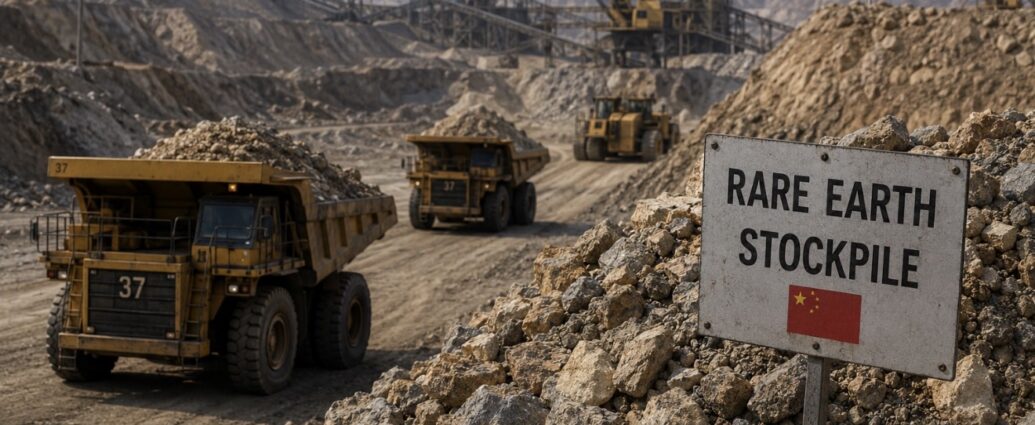
China’s control remains overwhelming. Beijing currently mines roughly 70% of the world’s neodymium-praseodymium supply and controls more than 90% of the downstream refining, metallization and permanent-magnet manufacturing chain. Chinese annual output has expanded rapidly, climbing to roughly 50,000 tons in 2026 from approximately 34,000 tons in 2021, according to Bloomberg’s reporting.
The federal timeline is becoming increasingly urgent. Beginning on Jan. 1, 2027, U.S. law prohibits the use of Chinese-sourced rare earth magnets in American military systems. That restriction affects everything from F-35 Lightning II fighters and Virginia-class submarines to Tomahawk cruise missiles and advanced naval radar systems. The Department of Defense — recently rebranded by the Trump administration as the Department of War — requires roughly 3,000 tons of permanent rare-earth magnets annually.
The United States is nowhere close to producing enough domestic supply to satisfy that demand.
The country’s leading producer, MP Materials Corp., is aggressively expanding operations at its Mountain Pass mine in California and at magnet-manufacturing facilities in Texas. Even so, the company currently expects to produce only around 1,000 tons annually of neodymium-iron-boron magnets by 2028. Heavy rare-earth separation capability at Mountain Pass is expected to begin commissioning only in mid-2026 under a public-private partnership signed last year with the Department of War.
That partnership has become one of Washington’s largest industrial-policy bets. The Pentagon guaranteed MP Materials roughly $140 million in annual EBITDA support tied to its Texas “10X Facility” and committed to purchasing the facility’s entire magnet output. The project also received a $150 million Defense Production Act Title III loan intended to accelerate domestic manufacturing.
Other Western producers are racing to close the gap. Lynas Rare Earths, the Australian-listed producer, signed a $96 million Pentagon-backed contract earlier this year to supply both light and heavy rare-earth oxides from a new Texas processing facility. Once operational, Lynas expects the plant to produce between 1,000 and 1,300 tons annually of NdPr oxide and as much as 3,000 tons of heavy rare-earth oxides.
USA Rare Earth Inc. is advancing the Round Top project in West Texas while pursuing Brazil’s Serra Verde mine, currently the only major producer outside Asia supplying all four critical magnetic rare earths at commercial scale. Additional domestic efforts involve Energy Fuels Inc., operator of Utah’s White Mesa Mill, and Noveon Magnetics, which focuses on rare-earth magnet recycling and domestic production.
Even Saudi Arabia has entered the race. MP Materials recently announced a joint venture with Saudi Arabian Mining Co. (Maaden) and the Department of War aimed at building rare-earth processing infrastructure inside the kingdom, with Maaden holding a controlling stake.
Still, analysts increasingly warn that the largest bottleneck is not mining — it is chemistry and metallurgy. The difficult “oxide-to-metal” conversion process required to transform separated rare-earth oxides into finished alloys and permanent magnets remains overwhelmingly concentrated inside China and, to a lesser extent, Japan.
Without that capability at scale, the United States can mine rare earths domestically but still remain dependent on Chinese industrial processing to turn those materials into defense-grade components.
Japan’s experience demonstrates how difficult diversification can become once China dominates an industrial supply chain. Since the 2010 maritime dispute that triggered Chinese export restrictions, Tokyo has spent more than a decade investing aggressively in alternative sourcing. Yet China still supplies roughly 76% of Japan’s total rare-earth imports, and until recently accounted for nearly 100% of Japan’s heavy rare-earth supply.
The political backdrop remains tense. U.S. Trade Representative Jamieson Greer acknowledged Friday that rare-earth export flows from China are “improving” following the Trump-Xi summit but warned that shipments remain inconsistent and vulnerable to renewed restrictions. Beijing suspended a planned expansion of export controls late last year, but the current reprieve expires in November 2026, and analysts told Bloomberg they do not expect a full rollback.
For Wall Street and defense planners alike, the implications are enormous. Rare-earth-linked equities including MP Materials, Lynas, Energy Fuels and the VanEck Rare Earth ETF (REMX) have become increasingly sensitive to geopolitical headlines and export-policy swings. But the broader takeaway from Bloomberg’s analysis is fundamentally structural rather than political.
Building a fully independent Western rare-earth supply chain is not simply a matter of opening additional mines. It requires constructing an entire industrial ecosystem — from extraction and separation to refining, alloy production and magnet manufacturing — that China spent decades building through state-backed industrial coordination and long-term strategic investment.
The result is that even as Washington pours billions into reshoring critical minerals and defense manufacturing, China’s grip on the rare-earth supply chain is likely to remain one of the defining strategic dependencies of the global economy well into the next decade.
— JBizNews Desk
© JBizNews.com. All rights reserved. This article is original reporting by JBizNews Desk. Unauthorized reproduction or redistribution is strictly prohibited.