For years, Americans were told artificial intelligence would make life cheaper, faster, and more efficient.
Now many are beginning to encounter AI in a very different place: their electricity bill.
Across the country this summer, households are opening utility statements that look noticeably heavier than they did just a few years ago. Air conditioning costs are climbing again. Delivery fees are rising. Utilities are requesting new rate increases almost monthly. And behind much of the pressure sits something most consumers never see directly — giant data centers quietly multiplying across America to power artificial intelligence systems that never sleep.
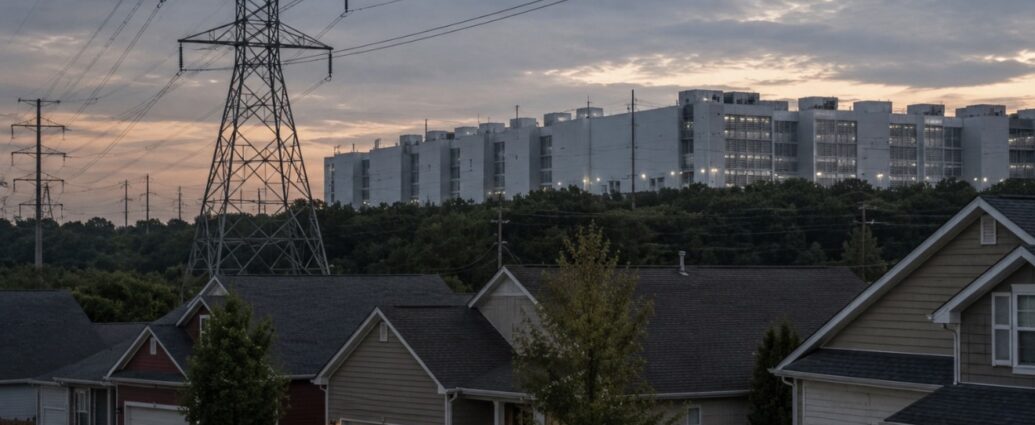
The buildings themselves often look anonymous from the outside. Long gray warehouse-style structures surrounded by fencing, cooling equipment, and endless rows of power lines. But inside, tens of thousands of computer chips run continuously every hour of every day, processing AI searches, generating content, training models, storing cloud data, and powering the digital systems increasingly woven into everyday life.
Each facility consumes staggering amounts of electricity.
And America is suddenly building them everywhere.
The issue moved into sharper focus Friday after reports emerged that NextEra Energy is in talks to acquire Dominion Energy, partly to gain greater access to Northern Virginia — home to the world’s largest concentration of data centers and one of the fastest-growing electricity-demand regions on earth.
To Wall Street, the potential deal is about positioning for the future of AI infrastructure.
To many consumers, however, it raises a much simpler question: who pays for all this power?
Utilities insist ordinary households are not subsidizing the AI boom. Large technology companies including Amazon, Microsoft, Google, and Meta are spending billions expanding infrastructure and signing long-term power agreements. Executives argue those investments eventually strengthen the grid and spread costs across a broader customer base.
But many Americans are struggling to see that benefit right now.
Instead, what they see are utility bills that keep rising faster than expected.
According to the U.S. Energy Information Administration, residential electricity prices have risen more than 31% since 2020, with another increase expected this year. In many regions, consumers are already cutting back elsewhere to absorb higher monthly energy costs alongside elevated insurance, grocery, and housing expenses.
The anxiety becomes more understandable once people realize how much electricity modern AI systems actually consume.
A single large AI-focused data center can use as much power as tens of thousands of homes. Entire clusters of facilities now operate around the clock in places like Northern Virginia, Texas, Arizona, Ohio, and Georgia. Unlike traditional office buildings or factories that may reduce activity overnight, AI infrastructure runs continuously — every search query, chatbot interaction, image generation request, and cloud backup drawing electricity every second.
That nonstop demand is forcing utilities into one of the largest infrastructure expansions in decades.
New transmission lines must be built. Substations upgraded. Backup systems expanded. Renewable-energy projects accelerated. Utilities are also scrambling to add natural-gas generation, battery storage, and nuclear capacity fast enough to prevent shortages as electricity demand surges for the first time in years after decades of relatively flat growth.
Consumers are increasingly caught in the middle.
Inside the utility industry itself, executives are starting to publicly acknowledge the tension. Earlier this month, Eversource Energy CEO Joe Nolan openly questioned whether attracting more data centers actually benefits ordinary households. “It’s only going to drive up the price of energy,” Nolan warned during an earnings call.
That fear is spreading beyond energy executives.
In parts of the country where data-center construction is accelerating fastest, local residents are beginning to push back against massive power usage, water consumption, land acquisition, and the growing visibility of utility infrastructure surrounding these projects.
At the same time, utilities argue they have little choice. America’s economy is rapidly becoming more digital, more electric, and more dependent on AI systems. The power demand is coming whether the grid is ready or not.
That leaves regulators trying to answer an increasingly uncomfortable question: how much of the cost should households absorb while technology companies race to build the next generation of AI infrastructure?
For now, there is no clear answer.
What is clear is that the AI boom is no longer an abstract story about Silicon Valley innovation or futuristic software demonstrations. It is becoming a real-world infrastructure story playing out across suburbs, power grids, utility commissions, and kitchen tables across the country.
For many Americans, artificial intelligence may eventually make work more productive and businesses more efficient.
But before they experience those benefits, they may first experience the cost.
JBizNews Desk
© JBizNews.com. All rights reserved. This article is original reporting by JBizNews Desk. Unauthorized reproduction or redistribution is strictly prohibited.