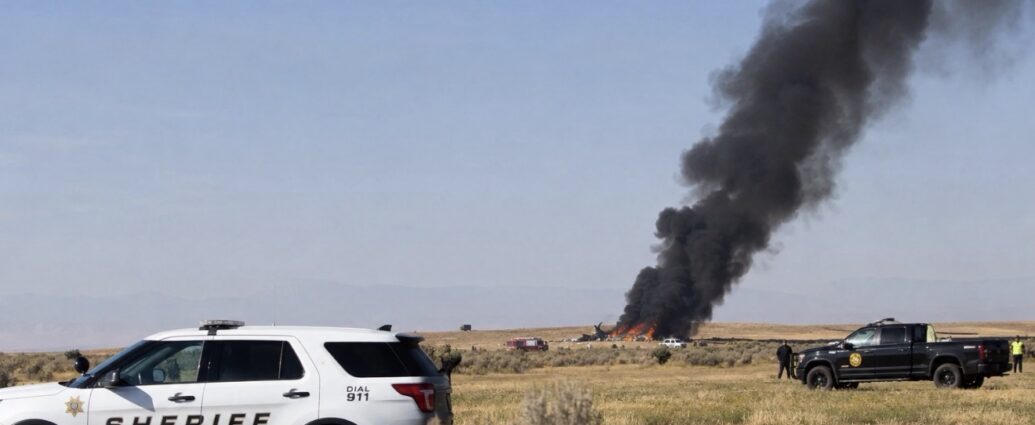
The U.S. Navy confirmed Sunday that two Boeing-built EA-18G Growler electronic-attack jets collided in midair during the Gunfighter Skies Air Show at Mountain Home Air Force Base in western Idaho, with all four aircrew successfully ejecting before the aircraft fell to the ground roughly two miles from the base. Cmdr. Amelia Umayam, a spokesperson for Naval Air Forces, U.S. Pacific Fleet, said the collision occurred at about 12:10 p.m. Mountain time while the aircraft were performing an aerial demonstration. The jets were assigned to Electronic Attack Squadron (VAQ) 129 based at Naval Air Station Whidbey Island in Washington state. All four crew members are being evaluated by medical personnel, and an investigation is under way.
The accident destroyed two of the most expensive tactical aircraft in the Navy’s inventory. According to Naval Air Systems Command, each EA-18G Growler carries a unit cost of roughly $67 million, placing the immediate value of the lost aircraft at approximately $134 million before accounting for the sophisticated electronic-warfare systems mounted aboard each jet. The Growler is the only dedicated airborne electronic-attack platform currently in production in the United States and remains a critical asset for radar jamming, communications disruption, and electronic battlefield operations.
The collision also lands at a sensitive moment for the U.S. defense industrial base and for Boeing, which serves as prime contractor and final assembler of the Growler at its St. Louis facility. The aircraft shares more than 90% commonality with the F/A-18F Super Hornet airframe, allowing Boeing to maintain overlapping sustainment and upgrade operations across both fleets even as new production has slowed sharply in recent years.
Mission-critical systems for the Growler are spread across several major defense contractors. Northrop Grumman supplies the AN/ALQ-218 wideband receiver and helps integrate the aircraft’s electronic-warfare suite, while RTX Corp.’s Raytheon division manufactures the AN/ALQ-99 tactical jamming pods used on the platform. GE Aerospace builds the twin F414-GE-400 turbofan engines powering the aircraft. Together, those programs support a multibillion-dollar sustainment ecosystem expected to continue through at least 2046 under the Navy’s current long-term fleet planning assumptions.
For Boeing’s Defense, Space & Security division, the loss highlights the growing importance of maintenance, modernization, and upgrade contracts as legacy fighter production transitions toward next-generation systems. The Navy is currently pursuing upgrades to the Growler fleet through the Block II modernization package, including the Advanced Cockpit System and integration of the Next Generation Jammer platform led by Raytheon. Each aircraft attrition event tightens the overall fleet count and increases pressure on long-term sustainment and modernization planning.
Beyond the military implications, the crash reverberated through the broader U.S. air show industry, a sector that draws millions of spectators annually and generates substantial tourism, hospitality, and concessions revenue for local communities. John Cudahy, president and chief executive of the International Council of Air Shows, said the industry has averaged roughly one fatality annually over the past decade, down from a historical average closer to two per year. He noted that there were no air show deaths recorded in either 2024 or 2025 and emphasized that no spectator has been killed at a U.S. air show since 1952.
Cudahy described recent years as one of the safest stretches in modern air show history, a trend that has helped sustain corporate sponsorships, municipal investment, and military participation despite rising operational costs and insurance pressures. The Idaho collision, however, arrives as the industry is already facing disruptions tied to global military deployments. According to Cudahy, approximately 10 military air shows have already been canceled in 2026 because flying units were reassigned in connection with the ongoing Iran conflict, removing an important seasonal revenue stream for vendors, hotels, restaurants, and surrounding communities.
The remainder of the Gunfighter Skies Air Show was canceled Sunday afternoon following the collision. The Elmore County Sheriff’s Office closed portions of State Highway 167 from Simco Road to State Highway 67, with the Idaho Transportation Department warning the closure could remain in place for multiple days as investigators secure debris fields and conduct recovery operations. The U.S. Air Force Thunderbirds demonstration squadron had headlined both days of the event.
Investigators are expected to move quickly because both aircrews survived and can provide firsthand accounts of the moments leading up to the collision. The National Weather Service reported good visibility at the time of the accident, though wind gusts reportedly reached nearly 29 miles per hour in the area. The National Transportation Safety Board and Federal Aviation Administration have both been contacted regarding the off-base impact, while the Navy retains primary jurisdiction over the aircraft and squadron operations.
JBizNews Desk
© JBizNews.com. All rights reserved. This article is original reporting by JBizNews Desk. Unauthorized reproduction or redistribution is strictly prohibited.