By Julia Parker — JBizNews Desk
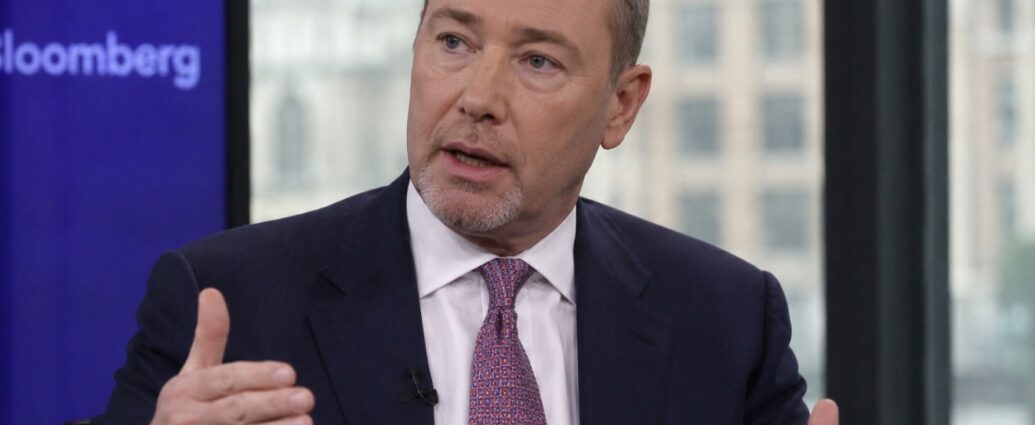
Jeffrey Gundlach, chief executive of DoubleLine Capital, said Sunday that the Federal Reserve cannot cut interest rates with inflation accelerating and bond-market signals turning against easier policy, framing newly installed Fed Chair Kevin Warsh as inheriting the central bank at one of the most difficult moments in years. Speaking during a Sunday morning television interview, Gundlach said the case for rate cuts collapses once the two-year Treasury yield is trading roughly 50 basis points above the federal funds rate, a setup he described as making easing impossible “in my view.”
The warning lands as investors rapidly reassess expectations that the Fed would begin lowering borrowing costs later this year. When short-term Treasury yields trade above the Fed’s own benchmark rate, markets are often signaling that inflation and monetary policy are likely to remain elevated longer than policymakers previously anticipated.
The Federal Open Market Committee voted on April 29 to hold the target range for the federal funds rate at 3.50% to 3.75%, with the effective fed funds rate standing at 3.63% as of May 14, according to Federal Reserve data. While that remains well below the post-pandemic peak above 5%, Gundlach argued that Treasury-market pricing no longer supports the view that the Fed can pivot toward easier policy without reigniting inflation concerns and destabilizing longer-term yields.
The inflation backdrop worsened materially last week. The Bureau of Labor Statistics reported that the April Consumer Price Index climbed 3.8% from a year earlier, marking the fastest pace since May 2023. Wholesale inflation accelerated even more sharply, with producer prices rising 6% annually in April as energy costs surged through the supply chain. Gundlach said DoubleLine’s internal forecasting models suggest the next CPI report could begin “with a four,” a development that would likely force investors to further push back expectations for any policy easing.
Energy markets remain central to the inflation story. The ongoing Iran conflict has driven crude oil prices sharply higher, increasing costs for transportation, refining, manufacturing, and consumer goods across the economy. The five-year breakeven inflation rate — a closely watched market gauge of expected inflation — has climbed to roughly 2.7%, its highest level since the inflation surge of 2022 and 2023, suggesting investors increasingly believe above-target inflation could persist well into the future regardless of central-bank intentions.
That leaves Warsh entering office under immediate pressure. The U.S. Senate voted 54-45 on May 13 to confirm Warsh as the 17th chair of the Federal Reserve, the narrowest confirmation margin ever recorded for the position. Sen. John Fetterman of Pennsylvania was the only Democrat to support President Donald Trump’s nominee. Warsh previously served as a Federal Reserve governor from 2006 through 2011 and now replaces Jerome Powell, whose eight-year term as chair formally ended Friday. In an unusual institutional arrangement, Powell will remain on the Federal Reserve Board of Governors and retain a vote on the 12-member committee responsible for setting interest-rate policy.
Warsh’s first major policy test arrives almost immediately. The Federal Open Market Committee is scheduled to meet June 16 and 17, marking the first gathering chaired by Warsh. Gundlach said he expects no rate cut at that meeting and described the incoming chair as stepping into a “rough time” for monetary policy.
Current market pricing broadly aligns with that view. CME Group’s FedWatch tool shows traders overwhelmingly expecting the Fed to hold rates steady through the remainder of 2026, while probabilities of an additional rate hike later this year have begun to rise modestly as inflation expectations move higher.
The economic realities also place Warsh in direct tension with the political environment surrounding his appointment. Trump has repeatedly and publicly advocated for lower interest rates, arguing that reduced borrowing costs would support economic growth and financial markets. Warsh was viewed by many investors as more open to easing than some other potential candidates, though during his April 21 confirmation hearing before the Senate Banking Committee he pledged to operate as a “strictly independent” chair.
Even so, the Fed chair does not act alone. Several voting members of the Federal Open Market Committee have recently indicated they want clearer evidence that inflation tied to tariffs, energy prices, and geopolitical disruptions is fading before supporting any cuts. That dynamic could significantly constrain how aggressively Warsh is able to shift policy even if economic growth slows later this year.
For investors, Gundlach said the implications extend far beyond the next Fed meeting. Long-term Treasury yields, rising inflation expectations, and heavy federal borrowing needs are all working against the assumption that short-term rates can decline without broader consequences across credit markets and government financing costs.
Gundlach also flagged growing concerns inside the private-credit sector, warning that portions of the market increasingly depend on continuous inflows of new investor capital to maintain liquidity and valuations. He specifically pointed to interval funds and other semi-liquid investment structures whose redemption terms may not properly align with the liquidity profile of their underlying assets — a mismatch that could create stress if market conditions deteriorate further.
The broader message surrounding the start of the Warsh era is that the Federal Reserve may now have significantly less room to maneuver than markets had assumed only months ago. While the central bank still controls short-term interest rates, Gundlach argued that the bond market — through long-term yields, inflation expectations, and credit spreads — ultimately determines whether monetary policy remains credible.
With inflation accelerating again, oil prices climbing, and federal deficits continuing to run deep into the trillions, the Federal Reserve enters its next chapter facing mounting pressure from markets, politics, and geopolitics simultaneously.
JBizNews Desk
© JBizNews.com. All rights reserved. This article is original reporting by JBizNews Desk. Unauthorized reproduction or redistribution is strictly prohibited.