By Julia Parker — JBizNews Desk
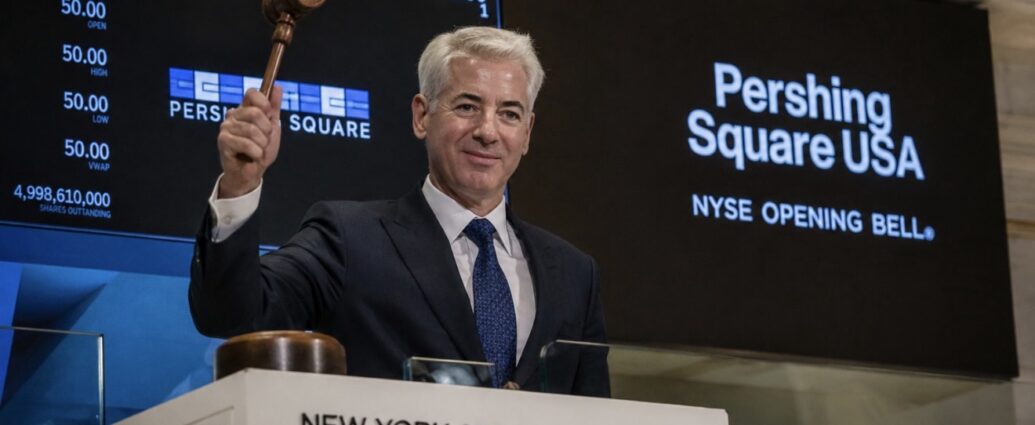
When Bill Ackman rang the New York Stock Exchange opening bell on April 29, the event was about far more than a new stock listing. The launch of Pershing Square USA under the ticker PSUS represented a broader wager that a largely dormant Wall Street structure — the closed-end fund — can be revived into something resembling the permanent-capital engine that allowed Warren Buffett to build Berkshire Hathaway into one of the most powerful investment vehicles in financial history.
Pershing Square USA raised roughly $5 billion at $50 per share, instantly becoming one of the largest closed-end fund launches in years. But the core attraction for Ackman is not merely the size of the raise. It is the permanence of the capital. Unlike traditional mutual funds or exchange-traded funds, investors in a closed-end structure cannot redeem shares directly from the fund at net asset value. They can only sell shares on the open market, insulating the portfolio manager from the redemption pressures that often force hedge funds and open-end vehicles to liquidate positions during market stress.
That permanence has long fascinated Ackman, who has repeatedly pointed to Berkshire Hathaway as proof that permanent capital allows concentrated, long-duration investment strategies to survive volatility and compound over decades. Pershing Square USA is explicitly designed around that logic. The vehicle plans to hold approximately 12 to 15 large-cap North American investments, broadly mirroring the strategy already run inside Pershing Square Capital Management, while charging a 2% annual management fee and no performance fee.
The structure also reflects lessons from Ackman’s earlier failed attempt to bring the concept to market. In 2024, Pershing Square abandoned plans for what had initially been envisioned as a $25 billion launch after institutional demand weakened and investors balked at the size and valuation dynamics of the offering. The final version that came public this spring was dramatically smaller — roughly one-fifth the original target — and included an important concession to market skepticism.
For every five PSUS shares purchased in the IPO, investors also received one free share of Pershing Square Inc., the separately listed management company trading under the ticker PS. The arrangement effectively bundled ownership of the asset-management platform together with the investment vehicle itself, underscoring Ackman’s broader ambition to simultaneously build both a public investment company and a publicly traded manager around it.
The market response has so far remained cautious. PSUS quickly traded at a discount estimated between 16% and 18% below its IPO price, reflecting one of the oldest and most persistent problems in the closed-end fund industry: shares frequently trade below the value of the underlying assets.
Ackman’s existing European-listed vehicle, Pershing Square Holdings, which trades in the U.S. under the symbol PSHZF, has spent years trading at roughly a 30% discount to net asset value despite the firm’s long-term investment record. Analysts viewed that precedent as an early warning sign for how PSUS could behave.
Eric Boughton, portfolio manager at Matisse Capital, warned before the offering that the fund would likely trade below NAV almost immediately even without a performance fee attached. John Cole Scott, president of CEF Advisors, has similarly argued that closed-end fund pricing ultimately reflects investor sentiment, liquidity conditions, and market psychology more than the underlying portfolio value itself.
That structural challenge is one reason the closed-end fund market had largely faded from relevance on Wall Street. According to industry data from the Closed-End Fund Association, only 46 new U.S. closed-end funds have launched since 2019. PSUS became the first major IPO in the category since 2022, when a comparable offering raised only about $53 million.
The PSUS debut therefore represents more than a single fund launch. It is increasingly being treated as a referendum on whether the closed-end structure can reclaim relevance inside modern U.S. capital markets.
Ackman is not entirely alone in revisiting the format. Robinhood Markets launched the $1 billion Robinhood Ventures Fund I earlier this year to provide retail investors with indirect exposure to private companies including SpaceX, Stripe, Databricks, and OpenAI. ARK Investment Management’s ARKVX interval fund is pursuing a similar model aimed at private-market exposure through semi-liquid structures.
The renewed interest has already produced signs of speculative excess. Earlier this year, one pre-IPO-focused closed-end vehicle briefly traded at nearly 3,000% of its underlying net asset value as retail investors scrambled for indirect exposure to SpaceX. The same structural mechanics currently pushing PSUS into a discount created a speculative premium at the opposite end of the market. Increasingly, the sector is being priced as much on narrative and investor belief as on traditional valuation mathematics.
Ackman is now moving aggressively to give PSUS that narrative momentum. Pershing Square’s latest 13F filing with the Securities and Exchange Commission showed the firm recently initiated a position in Microsoft while trimming its stake in Alphabet. Days earlier, Pershing Square also proposed acquiring Universal Music Group N.V. in a transaction valued at roughly $64.4 billion, a move consistent with Ackman’s long-standing preference for concentrated, long-duration investments requiring stable capital behind them.
That strategy reflects the core thesis behind PSUS: permanent capital allows investors to think more like owners and less like traders.
What happens over the next several years may determine whether the closed-end fund structure experiences a genuine revival or remains a niche corner of the market. If Ackman can produce Berkshire-style compounding while narrowing the PSUS discount through buybacks, investor outreach, and sustained performance, the structure could regain credibility it has largely lacked in the United States for nearly two decades.
If the discount instead widens over time, markets may conclude that Buffett’s permanent-capital model works only when the manager carrying it is Buffett himself.
JBizNews Desk
© JBizNews.com. All rights reserved. This article is original reporting by JBizNews Desk. Unauthorized reproduction or redistribution is strictly prohibited.