By Maria Stein — JBizNews Desk
The American appliance market has abruptly stopped behaving like a replacement business and started behaving like a recession business.
Consumers who once swapped out aging refrigerators, upgraded kitchen packages, or financed new laundry sets without much hesitation are increasingly doing something far simpler: repairing what they already own and waiting.
That shift is now showing up clearly inside corporate earnings.
Over the past two weeks, nearly every major appliance manufacturer — Whirlpool Corp., Electrolux, Samsung Electronics, LG Electronics, and GE Appliances — has delivered some version of the same message to investors: the U.S. appliance market deteriorated sharply in March and has continued weakening into the second quarter.
The numbers are increasingly difficult to dismiss as temporary softness.
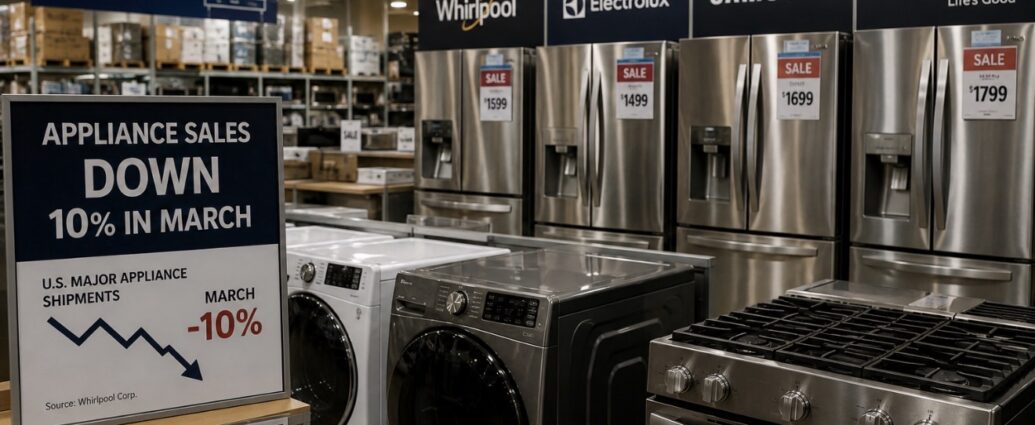
According to figures disclosed by Whirlpool during its May earnings call, U.S. major-appliance shipments fell 7.4% during the first quarter, with March alone collapsing 10% year over year — the steepest monthly decline since the aftermath of the global financial crisis.
Electrolux described the U.S. market as experiencing its worst volume contraction in a decade.
Built-in ovens, dishwashers, and higher-end kitchen packages — among the most discretionary categories in the business — dropped roughly 15% as consumers pulled back on large household purchases.
The timing lines up almost perfectly with the broader economic shock that followed the closure of the Strait of Hormuz after U.S. and Israeli strikes on Iran earlier this year.
Gasoline prices surged above $4.50 per gallon nationally for the first time in years. Consumer sentiment collapsed. Mortgage rates remained elevated. Inflation reaccelerated. Housing turnover stayed frozen near multi-decade lows.
Inside appliance showrooms, the result has become visible almost immediately.
Consumers are delaying purchases, trading down to cheaper models, or skipping replacement cycles altogether.
“The people who still come in are shopping differently,” one industry executive told analysts privately this month. “They’re fixing old units longer, and when they buy, they’re buying smaller.”
For Whirlpool, the downturn is now severe enough to resemble crisis conditions.
CEO Marc Bitzer told investors the current industry contraction resembles the environment seen during the 2008 financial collapse more than a normal cyclical slowdown.
“This level of industry decline is similar to what we observed during the global financial crisis,” Bitzer said during the company’s earnings call.
Whirlpool’s first-quarter revenue fell nearly 10% to $3.27 billion. North American operating profit effectively disappeared, plunging 96% to just $6 million. The company swung to a quarterly loss, suspended its dividend, slashed earnings guidance, and saw its stock fall toward levels not seen in roughly 17 years.
The pressure extends well beyond earnings.
Whirlpool now carries roughly $6.5 billion in long-term debt and is actively refinancing portions of its balance sheet as borrowing costs remain elevated. Bloomberg reported this month that Citigroup is working with the company on discussions surrounding a large bond refinancing tied to approximately $3 billion in obligations.
At the same time, Whirlpool is aggressively raising prices.
The company pushed through roughly 10% effective pricing increases in April — its largest in more than a decade — and plans additional hikes this summer.
Bitzer believes Whirlpool’s heavy domestic manufacturing footprint gives the company an advantage under the new tariff regime now reshaping global appliance economics.
Whirlpool manufactures roughly 80% of its U.S.-sold appliances domestically and sources most of its steel from American suppliers. Under the new Section 232 tariffs, imported appliances now face duties of up to 25%, with even steeper costs for products tied heavily to steel and aluminum inputs.
That tariff structure is rapidly redrawing competitive lines across the industry.
Manufacturers with substantial U.S. production capabilities may gain relative pricing advantages. Companies heavily dependent on imported appliances face rising pressure to absorb costs or pass them through to consumers already cutting back.
Electrolux is confronting the same challenge from Europe.
The Swedish company reported sharply lower North American sales and swung to a quarterly loss after demand for refrigerators and food-preservation products deteriorated significantly.
CEO Yannick Fierling blamed geopolitical instability and weakening U.S. consumer confidence for what he described as the largest first-quarter market decline in over a decade.
Electrolux responded with aggressive price increases of between 5% and 20% while downgrading its North American outlook and restructuring parts of its manufacturing footprint.
Investors reacted swiftly. Shares fell more than 20% after the earnings release.
Yet the downturn has not hit every company equally.
LG Electronics has emerged as one of the few major appliance manufacturers still showing relative resilience.
The South Korean company posted record first-quarter revenue while maintaining solid margins despite tariffs and rising raw-material costs.
LG executives outlined a strategy increasingly built around extremes rather than the traditional middle market: premium products for wealthier consumers at the top end, value-focused mass-market offerings at the bottom, and less emphasis on the middle-income segment now experiencing the greatest financial pressure.
The company is also leaning harder into subscription-style appliance programs, commercial sales, and emerging-market expansion across parts of Asia, Latin America, and Africa where appliance penetration remains lower and economic conditions differ from the U.S. consumer slowdown.
Samsung, meanwhile, has benefited from a crucial advantage: diversification.
While Samsung’s home-appliance business has weakened alongside the broader industry, its semiconductor division continues generating strong profits from artificial-intelligence infrastructure demand, helping offset softness elsewhere inside the conglomerate.
GE Appliances, now owned by China’s Haier Smart Home, has similarly emphasized supply-chain restructuring and domestic production adjustments to adapt to tariffs and weakening demand.
The broader economic implications now extend beyond appliances themselves.
Historically, the appliance market has functioned as a highly sensitive indicator of household confidence, housing turnover, and middle-class financial health.
People typically buy refrigerators, dishwashers, and laundry systems during home purchases, renovations, or periods of discretionary confidence.
Right now, all three drivers appear under pressure simultaneously.
Existing-home sales remain depressed. Borrowing costs remain high. Inflation continues squeezing household budgets. Energy prices have risen sharply.
Research from the National Retail Federation estimates appliance prices could climb another 19% to 31% under the most aggressive tariff scenarios currently under consideration.
The risk for manufacturers is straightforward: price increases help margins only if consumers continue buying.
The first-quarter data increasingly suggests many are choosing not to.
Repair technicians, by contrast, are staying busy.
For now, the appliance industry has entered an unusual and uncomfortable position: an essential category where demand still exists in theory, but where affordability, financing costs, and economic uncertainty are increasingly delaying the actual purchase.
The next clues may arrive this week.
Home Depot reports Tuesday. Walmart follows Thursday.
Together, they may reveal whether the appliance downturn is still largely isolated to housing-related spending — or whether it is beginning to signal something broader unfolding across the American consumer economy.
JBizNews Desk
© JBizNews.com. All rights reserved. This article is original reporting by JBizNews Desk. Unauthorized reproduction or redistribution is strictly prohibited.