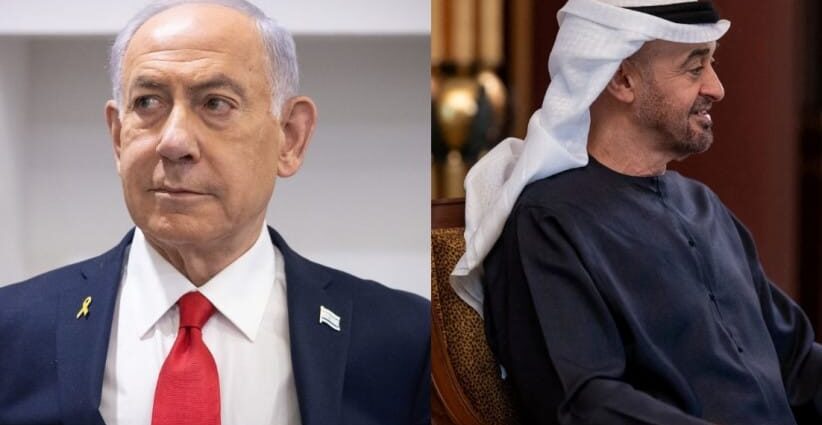
The Prime Minister’s Office’s unusual decision to confirm that Prime Minister Benjamin Netanyahu had visited the United Arab Emirates during the war with Iran was driven by concern that former prime minister Naftali Bennett was also expected to travel to Abu Dhabi, N12 reported on Sunday.
According to the N12 report, first published on its main evening broadcast, Netanyahu’s office feared that if Bennett’s planned visit became public while Netanyahu’s own wartime trip remained classified, it would create the impression that Bennett was a welcome guest in the UAE while Netanyahu was not.
The PMO confirmed last Wednesday that Netanyahu had visited the UAE at the beginning of Operation Roaring Lion and met with Emirati President Sheikh Mohammed bin Zayed Al Nahyan, describing the visit as a “historic breakthrough” in ties between the two countries. The UAE Foreign Ministry later denied that any such visit by Netanyahu or Israeli military officials had taken place, saying claims of undisclosed visits were baseless unless issued by official Emirati authorities.
N12 reported that Abu Dhabi had explicitly requested that the meeting remain confidential and that the public confirmation from Jerusalem triggered serious diplomatic tensions. The report said the decision to disclose the visit was not motivated by diplomatic considerations, but by a political calculation connected to Bennett.
Netanyahu was unwilling to allow Bennett’s visit to be public while his own remained hidden
Two sources familiar with the matter, who were cited by N12, said Bennett was expected to visit the UAE and meet bin Zayed and other senior Emirati officials. Netanyahu, the report said, was unwilling to allow a situation in which Bennett’s visit would be public while his own remained hidden.
The report added that the military censor had preferred to keep Netanyahu’s visit under wraps, but the PMO authorized publication despite what N12 described as accepted diplomatic norms in relations with the UAE. Bennett’s alleged visit has not been officially confirmed, and his office told N12 it would not confirm the details or address whether such a visit had taken place. Netanyahu’s office denied the report.
The episode comes at a sensitive political moment for Netanyahu. Bennett’s reported UAE plans came as the former prime minister has reemerged as Netanyahu’s most serious political challenger ahead of a possible election. A KAN 11 poll published last week found that a united Naftali Bennett-Yair Lapid framework was the only party currently positioned to threaten Likud, with Netanyahu’s party receiving 26 seats and Bennett’s Together Party, merged with Lapid, reaching 25.
That context made the UAE issue politically explosive. Netanyahu has long presented the Abraham Accords and ties with Gulf states as one of his signature diplomatic achievements. A public perception that Bennett could secure access to Abu Dhabi while Netanyahu’s own visit remained secret would have risked undercutting one of the prime minister’s central foreign-policy arguments at a time when the opposition is trying to frame him as politically weakened.
The UAE’s denial also reflected a broader regional sensitivity. N12 reported that Abu Dhabi was concerned about being seen as openly aligned with the anti-Iran axis at a time of heightened security tensions. The issue became more delicate after reports of Israeli-UAE coordination during the Iran war, including claims that Mossad chief David Barnea and Shin Bet chief David Zini visited the UAE and that Israel provided Iron Dome batteries to help protect the Gulf state.