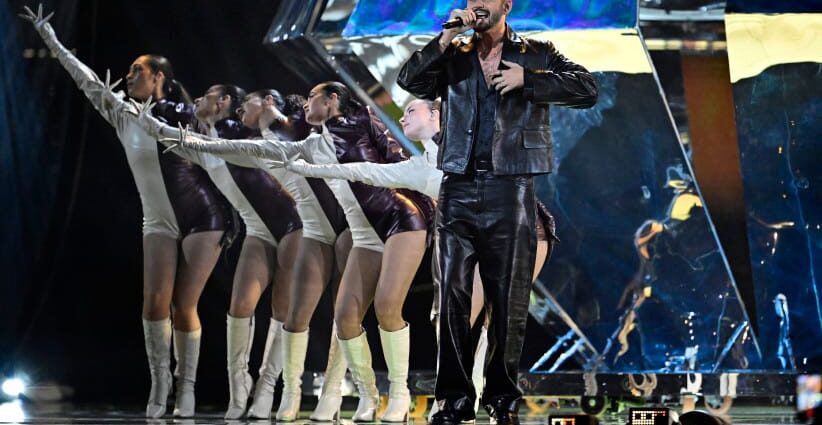
On Saturday night in Vienna, Noam Bettan walked onto the Eurovision stage carrying the hopes of Israeli fans on his shoulders. He also carried the weight of another year in which Israel’s place in the competition had been openly challenged, debated, and, in some quarters, opposed outright, leading to the boycott of the competition by five countries – Spain, Slovenia, the Netherlands, Ireland, and Iceland.
Bettan delivered a complete performance with the song “Michelle”. He was vocally assured and visually polished on stage, marking his second flawless outing of the week, following a strong semifinal during which boos were heard.
Bettan earned Israel second place overall. More telling, perhaps, was the public response. Israel received 220 points from the televote, briefly rising to first place during the voting sequence.
It is the third consecutive year that Israel has performed strongly with the public. Eden Golan finished second in the televote in 2024. Yuval Raphael went one step further in 2025, winning the public vote outright. And now Bettan has finished near the very top.
Three different artists with three very different songs, and yet the same outcome. Millions of viewers hold Eurovision where it should be – as a singing competition to enjoy rather than a platform to accentuate political views.
It would be easy to propose a coordinated campaign – as some critics have suggested – to explain Israel’s success.
If the campaign went ahead, it would be difficult to explain the consistency across multiple years, formats, and rule changes. This year, for example, voting limits were tightened, and greater scrutiny was placed on promotional activity, in part due to claims that previous Israeli successes were driven by online mobilization.
Exclusive questioning of Israeli participation a slippery slope
Questioning the right of Israel, and only Israel, to take part is a slippery slope. Other countries promoted their artists online, but only Israel’s campaign was questioned and censored.
After Raphael won the televote, there were calls for an investigation, and the European Broadcasting Union (EBU) conducted one, finding no irregularities in the voting.
There are no calls today to investigate why Bulgaria, which won the entire contest and led in the televote, did so well. We know where it leads when there are certain rules for Jews and other rules for everyone else.
Despite all that, Israel still performed strongly both on stage and in the results.
There is, in that sense, a growing disconnect between institutional attitudes and public sentiment.
Several countries, including those that boycotted the competition, pushed to have Israel excluded from the competition altogether because of Israel’s war against Hamas. The EBU ultimately rejected those calls, but the pressure formed part of the environment in which Bettan had to perform.
No other country has to deal with the external pressures and absurdity like Israel.
And Bettan handled himself with grace and poise throughout the entire week. He encountered the tension directly, both on the streets and on stage, where there were boos during rehearsals and in the semifinal. There were protests in Vienna, including a large demonstration timed to coincide with Nakba Day. The atmosphere was, at times, openly hostile.
And yet, when the final came, none of that mattered.
Bettan’s ‘Michelle’ an upbeat departure from former entries
“Michelle” itself marked a departure from Israel’s previous two entries. In 2024 and 2025, the songs bore the emotional weight of October 7 and a country at war. Bettan’s entry was an upbeat, multilingual pop song about love that focused more on normality than national trauma.
Offstage, Bettan was grace personified. Speaking after the performance, he stated, “I felt good, I felt I gave 100% in real time, it was crazy, it was fun, we’re done now… I love you, Am Israel Chai!”
At 28, with years of experience behind him, Bettan still found himself stepping onto that stage as the public face of Israel at a particularly charged moment.
Eurovision always comes with pressure, but this year, politics once again dominated the lead-up. The fact that he handled it with such composure, kept his focus, and delivered on the night says a great deal about him.
The boos that had accompanied earlier moments did not define the performance, nor the result. Rather, the music did.
Israel can take pride in that. And in Noam Bettan, who represented the country with professionalism and restraint, and blocked out all the outside noise to deliver a stellar performance.
Congratulations, Noam. You did the country proud.