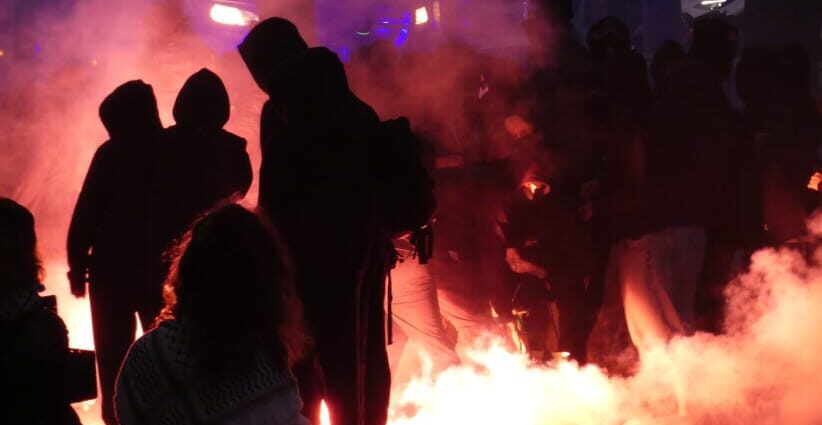
Violence by hooligan groups, religious factions, political mobs, or any other group is illegal, cannot be excused, and must be condemned and punished under the law. That is a basic norm of any civilized society. It applies whether the perpetrators are politically motivated youth, religious extremists, sports hooligans, or demonstrators.
Yet when violence is linked to Israel, there is a troubling tendency to generalize isolated incidents and recast them as proof of an official, state-sanctioned policy. In that context, the phrase “settler violence” has gained currency. It is often used not simply to describe criminal acts by individuals but to suggest that Israel as a state encourages or condones violence against Palestinians. That is a misleading claim.
There is no Israeli policy that authorizes or promotes violence against Arabs. Such conduct is illegal in Israel, just as it is elsewhere, and law-enforcement authorities are expected to act against it. If enforcement is weak or inconsistent, that may justify criticism of the authorities. But lax enforcement is not the same thing as an official policy of sanctioning violence. To use the term “settler violence” as though it describes an Israeli government practice is therefore inaccurate and unfair.
Discussing violence in Israel
A wider problem is the readiness to attach loaded buzzwords to Israel in ways that amplify hostility and misrepresent facts. Terms such as “genocide,” “apartheid,” “colonialism,” “illegal occupation,” “mass starvation,” and “indiscriminate violence” are often repeated as if they were settled descriptions, even when the legal and factual basis is contested. Such language can be effective rhetorically, but it also distorts public understanding by imposing inflammatory labels on complex realities.
This pattern is especially visible when comparing how violence is discussed in relation to Israel versus other societies. Around the world, football hooliganism causes assault, property damage, riots, injuries, and deaths. It has occurred in countries across Europe, South America, North America, Africa, and elsewhere.
Major political demonstrations and marches in Western capitals also sometimes turn violent, with attacks on police, damage to public property, and assaults on symbols or institutions. Yet these incidents are not typically used to brand entire countries as officially sponsoring “sports violence” or “demonstration violence.”
That contrast matters. The problem is not that violence elsewhere is ignored; it is condemned, as it should be. The problem is the double standard applied to Israel, where sporadic criminal acts by fringe groups are presented as though they reflect a national doctrine. That framing is not only misleading; it also suggests a selective moral outrage that is directed at Israel in a way not applied to others.
Criminal violence in various contexts
The comparison is even more striking when one considers that violence at sporting events and political demonstrations in many countries is sometimes more widespread, frequent, and destructive than the acts of extremists in Israeli communities. In those cases, no one seriously argues that the state itself is promoting violence. The conduct is treated as criminal behavior by individuals or groups, not as a defining feature of the country’s policy.
By contrast, “settler violence” is frequently deployed as a label that implies exactly that kind of state responsibility. It transforms incidents into an accusation of official policy and uses that accusation to intensify criticism of Israel as a whole. That is why the term is problematic. It does not merely describe; it judges, imputes, and generalizes.
The same double standard appears in the political reaction. European and North American officials frequently condemn incidents of violence by Israeli extremists as threats to regional security and peace. They demand that Israel, as the governing authority, protect civilians and bring perpetrators to justice. Those are legitimate demands.
But where is the equivalent language when hooligans riot at major sporting events, or when mass demonstrations turn violent, or when public property is vandalized and police are attacked in other countries?
None of this means that violence committed by Israelis should be minimized or excused. It should be investigated, prosecuted, and prevented. The point is that it must be described accurately. Individual criminal violence should be called: criminal violence. It should not be converted into a political slogan that imputes collective guilt to an entire society or state.
In that sense, the phrase “settler violence” is not a neutral description. It is a politically charged catchphrase that often serves to single out Israel and imply a level of state complicity. A serious discussion of violence requires precision, consistency, and fairness. Without those standards, language becomes a weapon, and the facts are pushed aside.
The writer served as the legal adviser to Israel’s Foreign Ministry and as Israel’s ambassador to Canada. He presently heads the international law program at the Jerusalem Center for Security and Foreign Affairs.