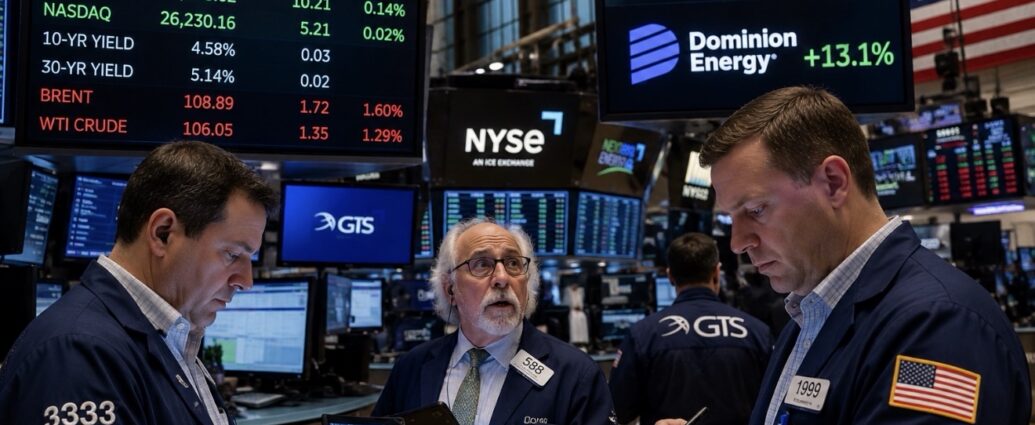
Wall Street opened the week trying to balance three different markets at once.
Stocks pushed modestly higher Monday morning. Oil climbed again after fresh geopolitical tensions in the Middle East. Bond yields stayed near multi-year highs, reminding investors that even as equities continue grinding upward, the cost of money across the economy remains elevated.
The result was a market that looked calm on the surface but increasingly tense underneath.
The Dow Jones Industrial Average rose roughly 139 points shortly after the open, while the S&P 500 hovered near fresh record territory reached last week. The Nasdaq Composite traded little changed as investors positioned themselves ahead of what is shaping up to be one of the most consequential earnings weeks of the quarter.
Hovering over nearly everything this week is Nvidia.
But before investors even reached Wednesday’s AI showdown, markets were hit Monday morning with the largest utility merger in American history.
NextEra Energy announced a $66.8 billion all-stock acquisition of Dominion Energy, creating what would become the largest regulated electric utility company in the world if approved.
The deal lands at a moment when electricity demand across the United States is beginning to surge under the weight of artificial-intelligence infrastructure expansion.
At the center of the acquisition is Dominion’s footprint in Virginia — home to the country’s largest concentration of hyperscale data centers and increasingly viewed as one of the most strategically important electricity markets in the world.
The region known as “Data Center Alley” has become ground zero for AI-era power demand.
Every new large-language model, cloud cluster, and AI server farm consumes staggering amounts of electricity, forcing utilities into what increasingly resembles an arms race to secure generation capacity before demand outruns the grid itself.
“Scale matters more than ever,” NextEra CEO John Ketchum said Monday morning as the companies unveiled the transaction.
The combined company would control roughly 110 gigawatts of generation capacity and serve approximately 10 million customers across Florida, Virginia, and the Carolinas.
Investors initially treated the deal cautiously.
Dominion shares surged roughly 13% after the announcement, while NextEra fell more than 3% as traders weighed regulatory risks, integration complexity, and the enormous capital demands tied to future AI-era infrastructure expansion.
The regulatory review could stretch well into next year, underscoring just how transformative the transaction may become for the broader utility sector.
Energy demand is now colliding directly with another force reshaping markets this year: geopolitics.
Oil prices climbed again Monday after the United Arab Emirates accused Iran of carrying out drone and missile attacks against civilian nuclear infrastructure over the weekend.
The escalation followed another round of increasingly aggressive rhetoric from President Donald Trump, who warned on Truth Social that “for Iran, the clock is ticking.”
Brent crude rose above $108 a barrel while West Texas Intermediate held near $106, levels that continue feeding inflation concerns throughout the global economy.
The bond market remains highly sensitive to those pressures.
The benchmark 10-year Treasury yield briefly climbed above 4.6% Monday morning before easing slightly, while the 30-year Treasury remained above 5.1%.
Those levels are increasingly important because they now directly shape mortgage rates, corporate borrowing costs, commercial real-estate financing, and consumer credit across the economy.
In many ways, bond markets are signaling a far less optimistic story than equities.
Investors continue betting aggressively on artificial intelligence, corporate earnings resilience, and economic durability. Bonds, meanwhile, continue reflecting concern that inflation and elevated government borrowing may keep interest rates structurally higher for longer than markets expected just a few months ago.
The biggest corporate shock Monday morning came from Berkshire Hathaway.
The conglomerate’s latest 13F filing — the first major portfolio disclosure overseen by CEO Greg Abel after Warren Buffett’s retirement transition — revealed sweeping changes across Berkshire’s investment holdings.
The company exited positions in Amazon, Visa, Mastercard, Domino’s Pizza, and UnitedHealth Group, while sharply increasing exposure to Alphabet and opening new positions in Delta Air Lines and Macy’s.
The moves are being interpreted across Wall Street as one of the clearest signs yet that Berkshire under Abel may operate differently from the traditional Buffett-era buy-and-hold strategy.
UnitedHealth shares fell nearly 5% following the disclosure.
Elsewhere in biotech, Regeneron Pharmaceuticals plunged more than 11% after a major melanoma-drug trial failed to outperform Merck’s blockbuster cancer therapy Keytruda in a closely watched Phase 3 study.
Analysts responded quickly with downgrades and price-target cuts, viewing the failed trial as a major setback for one of Regeneron’s most important future oncology programs.
Still, almost everything happening Monday feels like setup for Wednesday.
That is when Nvidia reports earnings after the close.
The AI giant now carries a market capitalization approaching $5.7 trillion and has effectively become the single most important stock in global equity markets.
Wall Street expectations remain extraordinarily high.
Analysts increasingly believe Nvidia’s Blackwell AI-chip rollout could become one of the largest product cycles in semiconductor history, fueled by hyperscale AI spending from companies including Microsoft, Amazon, Meta Platforms, and Alphabet.
KeyBanc raised its Nvidia price target again Monday morning, citing accelerating Blackwell shipments.
But expectations have become so elevated that many analysts warn the company may need a nearly flawless report simply to sustain current momentum.
“Investor positioning is already stretched,” UBS analyst Tim Arcuri warned clients.
The week also brings earnings from Home Depot, Target, and Walmart, offering one of the clearest reads yet on the condition of the American consumer after months of inflation pressure, higher gasoline prices, elevated interest rates, and slowing labor-market momentum.
The Federal Reserve will add another layer Wednesday afternoon when it releases minutes from its final meeting chaired by Jerome Powell before incoming Fed Chair Kevin Warsh formally takes over.
Markets are entering the week caught between two competing realities.
On one side sits the AI boom, record equity valuations, and massive infrastructure investment tied to the next phase of technological expansion.
On the other sits a world of $108 oil, rising Treasury yields, escalating geopolitical tensions, and an economy increasingly feeling the pressure of higher borrowing costs.
By Friday, investors may have a much clearer sense of which force is beginning to matter more.
JBizNews Desk
© JBizNews.com. All rights reserved. This article is original reporting by JBizNews Desk. Unauthorized reproduction or redistribution is strictly prohibited.