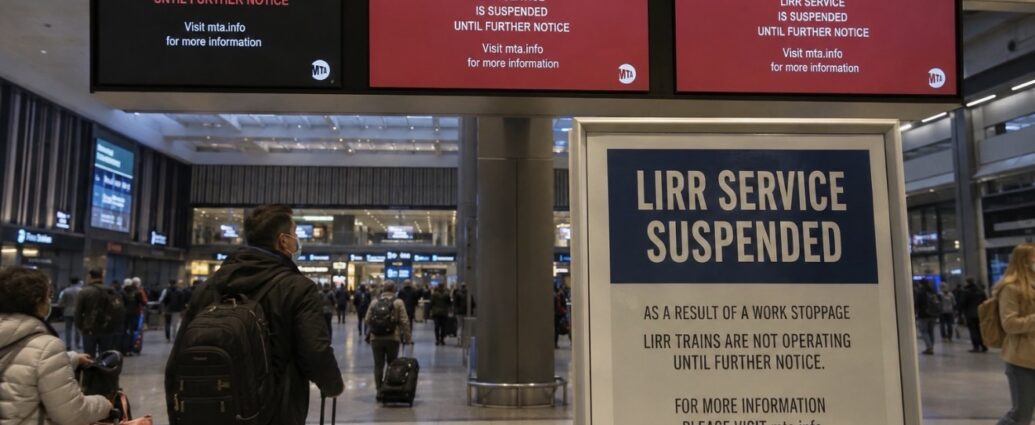
New York’s largest commuter rail system entered its third day of complete shutdown Monday morning as roughly 250,000 daily Long Island Rail Road riders woke up to traffic gridlock, overcrowded subway platforms, and renewed reminders of how dependent the region remains on mass transit nearly six years after the pandemic transformed office culture.
The strike — the first full Long Island Rail Road shutdown since 1994 and the largest commuter-rail stoppage in the United States in more than three decades — is now rapidly evolving beyond a transportation crisis into a broader economic stress test for New York’s fragile return-to-office recovery.
According to a joint statement issued Sunday evening by the Metropolitan Transportation Authority and confirmed by union representatives, five LIRR unions representing engineers, signalmen, and train crews officially walked off the job at 12:01 a.m. Saturday, May 16, after months of stalled negotiations over wages and healthcare costs.
Talks resumed Monday morning at MTA headquarters after a marathon overnight bargaining session ended without a breakthrough.
Meanwhile, Governor Kathy Hochul made an unusually direct public appeal to both employers and commuters.
“Effective Monday, I’m asking that regular commuters who can work from home, should. Please do so,” Hochul said Sunday, acknowledging that “it’s impossible to fully replace LIRR service.”
The message landed immediately across corporate New York.
Major employers including JPMorgan Chase, Goldman Sachs, Morgan Stanley, Citigroup, KPMG, Deloitte, EY, PwC, Northwell Health, and NewYork-Presbyterian advised many employees to work remotely wherever possible, triggering what has effectively become the city’s largest forced remote-work experiment since the COVID-era shutdowns of 2020.
Penn Station, normally one of the busiest transportation hubs in North America, appeared almost unrecognizable over the weekend, with departure boards flashing “No Passengers” while empty trains sat idle.
The LIRR carried roughly 82 million riders in 2025, according to MTA data, making it the busiest commuter railroad in North America and one of the core arteries feeding Manhattan’s office economy.
Now that artery is frozen.
And the financial burden is landing hardest on workers who cannot simply open a laptop from home.
Commuters attempting to drive into Manhattan Monday morning faced severe congestion along the Long Island Expressway, Northern State Parkway, and Belt Parkway, while ride-share prices surged sharply. Trips from western Long Island into Midtown Manhattan that normally cost between $80 and $120 were quoted as high as $250 to $400 during peak commuting hours.
Parking costs, tolls, gas prices, and additional subway transfers are rapidly compounding the burden.
A standard monthly LIRR pass from stations such as Hicksville or Ronkonkoma into Manhattan typically costs between $300 and $500. Replacing rail travel with private vehicles or ride-share services could push commuting expenses to between $80 and $200 per day, meaning a weeklong strike could cost some households nearly $1,000 in unexpected transportation expenses alone.
Hochul acknowledged Sunday that the burden falls disproportionately on workers who cannot operate remotely.
Nurses, retail employees, restaurant workers, construction crews, hospitality staff, and healthcare technicians remain among the most exposed.
“I do ultrasounds for pregnant women and gynecology, and I have to be there. I can’t do that remotely,” commuter Dana Camera told local reporters while waiting for limited shuttle service over the weekend.
The MTA has deployed temporary shuttle buses from six Long Island locations during peak hours and added capacity to portions of the subway system in Queens, but transit officials privately admit there is no realistic replacement for full LIRR service.
The political blame game is already escalating.
Governor Hochul blamed the Trump administration for failing to extend federal mediation efforts earlier this year after a previous strike threat was temporarily delayed in September 2025 through federal intervention.
President Donald Trump rejected that framing Sunday night on Truth Social.
“No, Kathy, it’s your fault, and now looking over the facts, you should not have allowed this to happen,” Trump wrote.
The National Mediation Board, which oversees rail labor disputes under the Railway Labor Act, continues facilitating negotiations but has not yet triggered the emergency-board process that could suspend the strike for an additional 60 days.
Union representative Mike Carlucci said he appreciated Hochul’s public support for commuters but argued the governor needs to become more directly engaged in the negotiations themselves.
Beyond the immediate disruption, however, the strike is reopening a much larger question hanging over New York’s economy: whether the city’s push back toward five-day office attendance remains sustainable in a region still deeply vulnerable to transportation breakdowns.
For many companies, the strike is becoming an involuntary real-time test of whether remote productivity remains viable at scale.
Commercial real-estate executives are watching closely.
Manhattan office landlords including SL Green Realty, Vornado Realty Trust, and Empire State Realty Trust have spent the last two years pushing aggressively for office normalization after pandemic-era vacancies devastated Midtown occupancy levels.
Now, many firms that had recently tightened in-office attendance policies are once again allowing broad remote flexibility almost overnight.
The ripple effects are spreading beyond offices.
Midtown restaurants, bars, and retailers reported sharp declines in weekend foot traffic. Madison Square Garden lost attendance tied to playoff games involving the New York Knicks and other events as suburban ticket holders struggled to reach Manhattan. Broadway theaters, hotel operators, and retail corridors are bracing for additional fallout if the strike continues deeper into the week.
For now, the outcome depends on whether negotiators can produce a deal before Tuesday morning’s commute.
If not, pressure will intensify on both Albany and Washington to intervene more aggressively.
In the meantime, one reality has already become unavoidable:
New York’s largest transit strike in decades has suddenly given remote work its strongest institutional endorsement since the pandemic itself.
JBizNews Desk
© JBizNews.com. All rights reserved. This article is original reporting by JBizNews Desk. Unauthorized reproduction or redistribution is strictly prohibited.