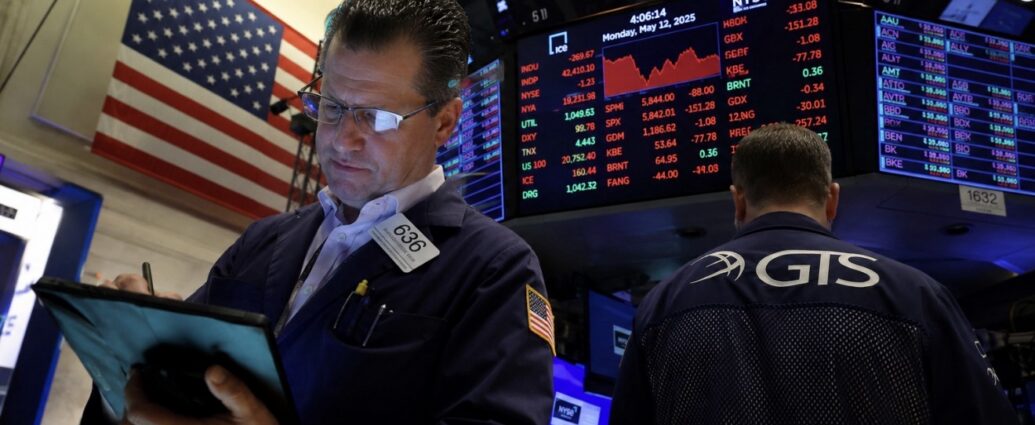
U.S. stocks closed mixed Monday as surging Treasury yields, renewed Middle East uncertainty, and mounting pressure across artificial-intelligence shares rattled investors heading into one of the most consequential earnings weeks of the year, with Nvidia Corp.’s results increasingly viewed on Wall Street as a referendum on whether the AI-driven market rally can continue carrying equities higher amid rising inflation fears and escalating geopolitical risk.
According to closing data from the New York Stock Exchange and Nasdaq, the Dow Jones Industrial Average rose 159.95 points, or 0.32%, to 49,686.12, supported by gains in industrial and financial names, while the S&P 500 slipped 0.07% to 7,403.05 and the Nasdaq Composite fell 0.51% to 26,090.73 as semiconductor and AI-linked stocks extended recent weakness. The Russell 2000 dropped 0.65% as higher borrowing costs continued pressuring smaller-cap companies, while the CBOE Volatility Index remained elevated above 18 as traders repositioned ahead of earnings from Nvidia, Walmart, and Target later this week.
Markets whipsawed throughout the session after President Donald Trump disclosed on social media that he was postponing a planned military strike against Iran following requests from the Emir of Qatar, the Crown Prince of Saudi Arabia, and the President of the United Arab Emirates. Trump said “serious negotiations” were underway and predicted a resolution “very acceptable” to both the United States and the broader region, temporarily easing fears that the conflict could escalate into a direct disruption of global oil flows through the Strait of Hormuz.
Oil prices initially surged before retreating sharply following Trump’s comments. Brent crude briefly climbed above $112 per barrel before pulling back below $110, while West Texas Intermediate crude retreated from intraday highs above $104 to roughly $102.50 by settlement. Energy traders continue viewing the Strait of Hormuz as the market’s central geopolitical flashpoint, with roughly one-fifth of global petroleum flows tied directly to the region.
While equities stabilized late in the day, the bond market painted a far more cautious picture about the inflation outlook. The benchmark 10-year Treasury yield climbed above 4.13%, its highest level in roughly a year, while the 30-year Treasury yield hovered near 5.13%, levels last seen during the pre-financial-crisis period in 2007. Long-dated sovereign debt sold off globally, with U.K. 30-year gilt yields reaching highs not seen since the late 1990s and Japanese government bond yields touching fresh multi-decade peaks as investors increasingly abandoned expectations for Federal Reserve rate cuts in 2026.
The rise in yields hit technology shares hardest, particularly across the semiconductor sector that has powered much of the market’s AI-driven gains over the past year. The S&P 500 technology sector fell more than 2% intraday before trimming losses into the close. Seagate Technology plunged nearly 7% after Chief Executive Dave Mosley warned during a JPMorgan investor conference that building enough manufacturing capacity to satisfy exploding AI-related memory demand would “take too long,” comments investors interpreted as evidence that supply-chain constraints inside the semiconductor ecosystem are worsening rather than improving. The warning dragged Micron Technology down nearly 6%, while Nvidia, Broadcom, and Intel also finished lower.
Additional pressure came from overseas after South Korean media reported that Samsung Electronics’ labor union would proceed with an 18-day strike beginning May 21 involving more than 45,000 workers, intensifying fears of further disruption across the global memory-chip supply chain tied to the artificial-intelligence infrastructure buildout.
Inside the Dow, 20 of the index’s 30 components finished higher. 3M gained 3.74% and Salesforce added 3.18%, helping offset weakness in technology-linked industrial names. Caterpillar fell 4.08% while Nvidia dropped 2.92% as some investors rotated away from high-valuation growth stocks toward defensive and cyclical sectors. Microsoft outperformed much of the broader technology complex after Bill Ackman’s Pershing Square Capital Management disclosed last week that it had accumulated a position in the software giant.
Analyst activity intensified ahead of Nvidia’s earnings release Wednesday afternoon. DA Davidson reiterated a buy rating on Nvidia and raised its price target to $300, implying roughly 37% upside from current levels, while Cantor Fitzgerald increased its price target on Applied Materials to $550 from $500 while maintaining an overweight rating tied to continued strength in AI semiconductor spending. UBS downgraded Dell Technologies to neutral from buy despite lifting its target to $243 from $167, reflecting a more cautious near-term view on valuation even as AI server demand remains strong. RBC Capital Markets also raised its target on Ford Motor to $13 from $11 while maintaining a sector-perform rating.
Cryptocurrency markets weakened alongside broader risk assets as rising yields continued reducing investor appetite for speculative trades. Bitcoin fell roughly 2% to near $76,400, its lowest level since late April, while gold and silver traded mixed as investors balanced inflation hedging against a strengthening U.S. dollar and expectations for higher-for-longer interest rates.
The broader market now enters Tuesday facing an increasingly difficult macroeconomic backdrop. Gasoline prices remain elevated, mortgage rates continue climbing alongside Treasury yields, and the prospect of near-term Federal Reserve easing has largely disappeared from futures markets. At the same time, corporate America is preparing to report earnings under the shadow of rising energy costs, tighter financial conditions, and growing geopolitical instability tied to Iran and the Strait of Hormuz.
For Wall Street, the next 72 hours may determine whether the market’s AI-fueled momentum can continue overpowering mounting macroeconomic pressure — or whether rising rates, energy inflation, and geopolitical risk finally begin forcing a broader repricing across equities.
JBizNews Desk
© JBizNews.com. All rights reserved. This article is original reporting by JBizNews Desk. Unauthorized reproduction or redistribution is strictly prohibited.