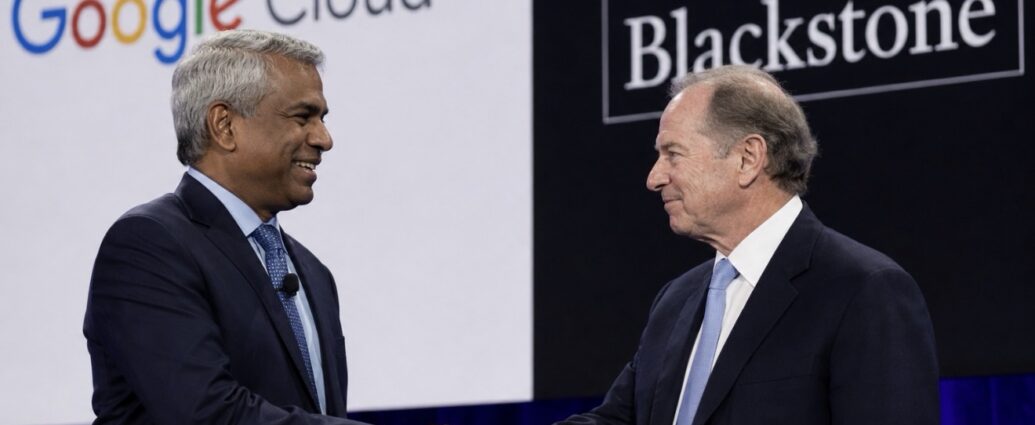
Blackstone Inc. and Alphabet Inc.’s Google unveiled a massive new artificial-intelligence infrastructure partnership Monday, launching a dedicated AI cloud company backed by as much as $25 billion in planned investment that will rent out Google’s powerful Tensor Processing Units directly to corporate customers in a move designed to challenge Nvidia’s dominance over the global AI compute market.
The venture immediately ranks among the largest standalone infrastructure bets of the AI era and signals a dramatic escalation in the race to secure the chips, data centers, electricity, and cloud capacity now powering the global artificial-intelligence economy.
“This is a generational opportunity to invest capital at scale building AI infrastructure,” Jon Gray, President and Chief Operating Officer of Blackstone, said in the companies’ announcement Monday. “The new company has enormous potential as it helps to meet the unprecedented demand for compute.”
The venture will be majority-owned by Blackstone, which is making an initial $5 billion equity commitment. Including debt financing and future expansion capital, total planned investment is expected to eventually reach approximately $25 billion, according to people familiar with the transaction.
Thomas Kurian, Chief Executive of Google Cloud, said the partnership will dramatically expand access to Google’s custom AI chips, known as TPUs, which until recently were primarily used internally by Google and select cloud customers.
“We are seeing extraordinary demand for AI compute infrastructure,” Kurian said. “This venture creates another path for organizations to access advanced TPU capacity at scale.”
The new company will be led by longtime Google infrastructure executive Benjamin Treynor Sloss, who spent more than two decades overseeing major portions of Google’s global technical infrastructure operations.
Under the arrangement, Google will contribute TPU hardware, software, networking technology, and operational services, while Blackstone will provide financing and infrastructure-development expertise spanning real estate, construction, energy systems, and digital infrastructure logistics. The venture plans to bring roughly 500 megawatts of AI data-center capacity online beginning in 2027, with expansion plans expected to grow significantly over time.
The scale is enormous.
Industry analysts estimate that a 500-megawatt AI compute footprint represents enough electricity demand to power roughly 400,000 American homes, underscoring how artificial intelligence has rapidly evolved from a software business into one of the largest industrial infrastructure booms in modern technology history.
The deal also fundamentally reshapes competition inside the so-called “neocloud” market — a rapidly growing segment where companies rent AI compute capacity to developers and enterprises outside traditional hyperscaler contracts.
Until now, much of that market has revolved around Nvidia graphics processing units, or GPUs, which dominate advanced AI training globally. Firms such as CoreWeave and Nebius Group have built multibillion-dollar businesses renting Nvidia-powered AI infrastructure to startups, model developers, and enterprise clients.
But the Google-Blackstone venture introduces something Wall Street has been waiting years to see: a scaled commercial distribution model for Google’s TPU chips outside Google Cloud itself.
For years, Google’s TPU program has quietly been viewed as one of the few credible technological alternatives to Nvidia’s accelerator dominance. Yet commercialization remained relatively limited because TPU access was largely tied directly to Google’s own cloud ecosystem.
“This is the strongest structural challenge Nvidia has faced so far in AI infrastructure,” said Dan Ives, managing director at Wedbush Securities, in a note following the announcement. “Google is effectively weaponizing its internal AI stack at industrial scale.”
The timing reflects the extraordinary surge in AI infrastructure demand globally. Major AI developers including OpenAI, Anthropic, xAI, and Meta Platforms have collectively committed tens of billions of dollars toward compute contracts, while hyperscalers including Microsoft, Amazon Web Services, Oracle, and Google continue ramping capital expenditures to historic levels.
The bottleneck increasingly is no longer software — it is physical infrastructure.
Industry executives say shortages now extend beyond chips themselves into electricity generation, transmission systems, transformers, cooling technology, construction crews, and permitting timelines. In major AI infrastructure hubs including Northern Virginia, Texas, and parts of the Pacific Northwest, utility constraints are already delaying some data-center expansion projects.
Google has steadily built momentum behind its TPU ecosystem in recent months. Earlier this year, the company signed a multibillion-dollar TPU compute agreement with AI startup Anthropic, a deal many analysts interpreted as proof that Google’s chips had reached competitive parity with Nvidia hardware for major frontier-model AI training workloads.
Monday’s announcement takes that strategy dramatically further.
By creating a separately capitalized infrastructure company backed by Blackstone’s balance sheet, Alphabet gains a scalable way to expand TPU adoption without bearing the full burden of financing massive data-center construction itself.
For Blackstone, the move represents one of its largest direct AI infrastructure investments yet and aligns with the firm’s broader strategy of targeting digital infrastructure as a defining private-capital theme of the coming decade.
Jas Khaira, Head of Blackstone N1, described Google’s TPU technology as “foundational to the AI economy” and said the platform represents exactly the type of long-duration growth investment the firm was created to support.
The venture also deepens the broader geopolitical and economic significance of AI infrastructure spending inside the United States. Massive AI buildouts increasingly require coordination with regional power grids, natural gas providers, transmission operators, and local governments as electricity demand from data centers rises sharply nationwide.
Neither company disclosed revenue projections or customer commitments for the venture. Commercial operations are expected to begin once the first wave of data-center capacity comes online in 2027.
Still, the strategic message was unmistakable: the AI infrastructure race is entering a new phase where the battle is no longer just about software models — it is about who controls the physical computing backbone of the artificial-intelligence economy.
JBizNews Desk
© JBizNews.com. All rights reserved. This article is original reporting by JBizNews Desk. Unauthorized reproduction or redistribution is strictly prohibited.