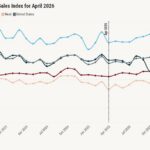
Mortgage applications for new home purchases fell 2.4% in April 2026 compared to a year earlier, the first annual decline since October 2025, according to the Mortgage Bankers Association’s Builder Application Survey released this week.
Applications also dropped 10% from March 2026 on an unadjusted basis, MBA reported. The monthly numbers are not adjusted for typical seasonal patterns.
“Ongoing economic uncertainty and higher mortgage rates contributed to lower purchase activity for newly built homes in April,” Joel Kan, MBA’s vice president and deputy chief economist, said in the release. “Applications to purchase new homes fell below last year’s pace, the first year-over-year decline since October 2025.”
MBA estimates new single-family home sales were running at a seasonally adjusted annual rate of 655,000 units in April, based on application data and assumptions about market coverage. That pace was down 8.6% from a revised March estimate of 717,000 units and below the April 2025 level, MBA said.
On an unadjusted basis, MBA estimates there were 60,000 new home sales in April, a 13% decline from 69,000 sales in March.
Kan said the slowdown comes amid “high levels of unsold inventory available in many markets” but noted MBA expects purchase activity to improve as price growth cools. For builders and lenders, elevated inventory can translate into more buyer incentives and rate buydowns as they work through standing stock.
Government-backed mortgages accounted for just over half of all applications for newly built homes in April, underscoring ongoing affordability pressures.
By product type, conventional loans made up 49.5% of applications. Federal Housing Administration (FHA) loans accounted for 35.7%, U.S. Department of Veterans Affairs (VA) loans 13.7% and U.S. Department of Agriculture (USDA) loans 1.1%, MBA said.
“FHA, VA, and USDA applications accounted for a little over half of all applications in April, as many borrowers continued to rely on government programs to help with affordability,” Kan said.
The average loan size for new homes slipped to $378,384 in April from $381,938 in March. A declining average loan size can indicate buyers are shifting downmarket or that builders are delivering smaller or more moderately priced product to meet payment constraints at current mortgage rates.
MBA’s Builder Application Survey has been a leading indicator for the U.S. Census Bureau’s New Residential Sales report, which also records new home sales at contract signing. For lenders, the April pullback signals near-term weakness in new-construction pipelines and reinforces the importance of FHA and VA channels.
This article was generated using HousingWire Automation and reviewed by a HousingWire editor before publication. The system helps convert company announcements and industry data into HousingWire-style news coverage.