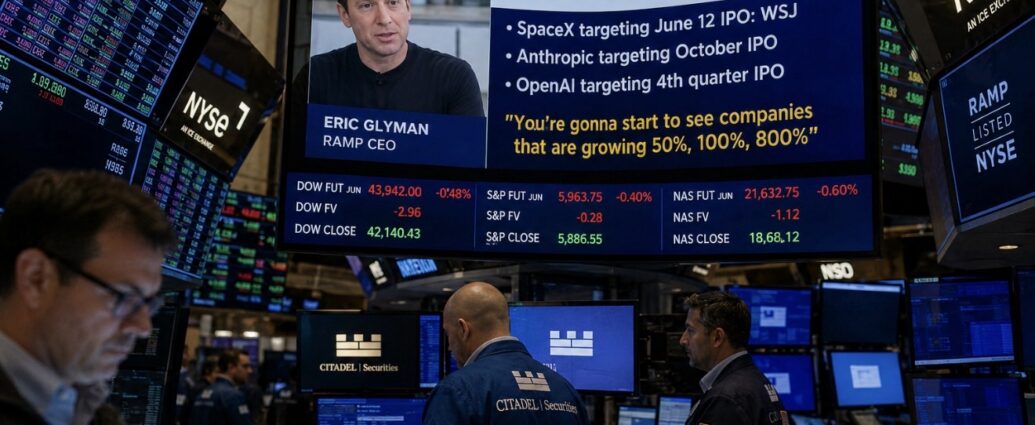
NEW YORK — Ramp CEO Eric Glyman said Tuesday that the coming wave of mega-IPO listings from SpaceX, Anthropic, and OpenAI could fundamentally reshape investor expectations across public markets, bringing Silicon Valley-style hypergrowth directly onto Wall Street after years of being largely confined to private capital.
Speaking during CNBC’s “Squawk on the Street,” Glyman argued that public-market investors have spent the past decade largely investing in mature, slower-growing companies while the fastest-growing firms remained inaccessible inside venture-capital portfolios. That dynamic, he said, is now beginning to reverse in dramatic fashion.
“You’re gonna start to see companies that are growing 50%, 100%, 800%,” Glyman said, referencing the expected public-market debuts of Elon Musk’s SpaceX and leading artificial-intelligence firms Anthropic and OpenAI. “That changes what people think normal growth looks like.”
The comments come as Wall Street prepares for what bankers increasingly describe as one of the largest IPO pipelines in modern financial history. According to reports cited by The Wall Street Journal, SpaceX is targeting a potential June 12 public debut at a valuation approaching $1.75 trillion, potentially raising as much as $75 billion in what could become the largest IPO ever completed. Anthropic is reportedly preparing for a listing as early as October, while OpenAI is evaluating a fourth-quarter offering after recently completing a financing round valuing the company at approximately $852 billion.
Data from Renaissance Capital show U.S. IPO issuance has already reached roughly $28.4 billion year-to-date, though analysts say that figure would be eclipsed quickly if even one of the three AI-era giants comes public on schedule.
Glyman’s appearance coincided with Ramp being ranked No. 5 on CNBC’s annual Disruptor 50 list, which highlights the country’s fastest-growing private technology companies. Founded in 2019 by Eric Glyman, Karim Atiyeh, and Gene Lee, the New York-based fintech company has rapidly expanded into one of the largest corporate spend-management platforms in the United States.
Ramp now serves more than 50,000 businesses and crossed $1 billion in annualized recurring revenue last year. Glyman said the company currently processes roughly 3% of U.S. corporate credit-card volume and about 1% of all corporate financial transactions, including expense management and bill payments.
The company’s growth has accelerated alongside the broader AI-driven productivity boom sweeping corporate America. Ramp combines AI-powered expense controls, accounting automation, procurement management, and corporate card infrastructure aimed at reducing manual administrative work for finance departments.
“Folks are very excited about the company,” Glyman said when discussing fundraising conditions, describing Ramp’s combination of rapid revenue growth and positive cash generation as “an unusual financial profile.”
He added that the broader business environment remains highly favorable for companies deploying automation and AI to improve productivity. “It’s an amazing time to be building a company,” Glyman said, noting that the average Ramp customer is growing revenue roughly four times faster than the broader U.S. economy.
Private investors have aggressively rewarded that momentum. Ramp raised $200 million in June at a $16 billion valuation, followed by a $500 million financing round in July that lifted the company’s valuation to $22.5 billion. Another $300 million round later in the year valued the company at $32 billion. Reports now indicate a new financing could push Ramp’s valuation toward $40 billion, representing one of the fastest valuation climbs in fintech.
The broader Disruptor 50 rankings further illustrate how concentrated investor enthusiasm has become around AI and infrastructure companies. CNBC estimated the 2026 Disruptor class now carries a combined implied valuation of approximately $2.4 trillion, with nearly $2 trillion concentrated among the top five firms alone.
Anthropic, ranked No. 1, has emerged as one of Silicon Valley’s fastest-growing companies. CEO Dario Amodei recently told CNBC the AI firm increased revenue roughly 80-fold during the first quarter, one of the most explosive growth rates ever recorded among enterprise-software companies. Reports indicate Anthropic is now pursuing another financing round that could value the company near $900 billion.
OpenAI, ranked No. 2, remains at the center of the global AI race following the explosive adoption of ChatGPT and its broader AI ecosystem. Meanwhile, firms including Databricks, Stripe, and SpaceX continue building what investment banks describe as the largest IPO backlog seen since the dot-com era.
For investors, the implications could be profound. Companies that have spent years compounding revenue at extraordinary rates inside private markets may soon trade directly alongside slower-growing public benchmarks like the S&P 500, fundamentally altering how investors value growth, profitability, and future earnings potential.
Glyman’s remarks captured what many on Wall Street increasingly believe is now unfolding: the long-standing divide between private venture-backed growth companies and public-market investing is rapidly disappearing. Over the next several quarters, some of the world’s largest and fastest-growing technology firms may begin trading in real time before everyday investors — potentially reshaping market leadership, valuation standards, and risk appetite across the entire financial system.
— JBizNews Desk
© JBizNews.com. All rights reserved. This article is original reporting by JBizNews Desk. Unauthorized reproduction or redistribution is strictly prohibited.