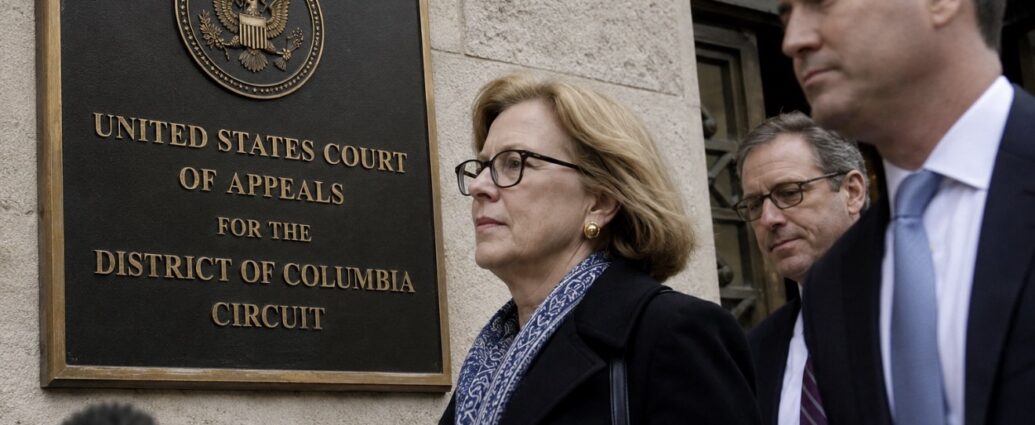
WASHINGTON — Judge Karen LeCraft Henderson of the U.S. Court of Appeals for the D.C. Circuit sharply criticized the Pentagon on Tuesday over its decision to label artificial-intelligence company Anthropic a national-security supply-chain risk, calling the move “a spectacular overreach” during a high-stakes hearing that could reshape the federal government’s power over AI contractors.
“To me, this is just a spectacular overreach by the Department,” Henderson said during nearly two hours of oral arguments. “For the life of me, I do not see any evidence of maliciousness.”
Henderson was referring to the Pentagon’s March designation of Anthropic — maker of the Claude AI platform — as a supply-chain threat to U.S. national security, an extraordinary label historically associated with foreign adversaries or hostile overseas suppliers. The designation triggered a broader Trump administration order directing federal agencies to stop using Anthropic technology and gave the Defense Department six months to remove the company’s systems from military infrastructure.
The hearing before the three-judge D.C. Circuit panel marks the most consequential legal test yet in the escalating standoff between the Pentagon and one of Silicon Valley’s most powerful AI firms.
Anthropic attorney Kelly Dunbar argued the Pentagon illegally weaponized national-security authorities during what was fundamentally a contract dispute. “For the first time ever,” Dunbar told the court, “the secretary turned a powerful national security authority against an American company.”
Dunbar argued the Pentagon bypassed congressionally mandated procedures, exceeded statutory authority, and violated constitutional protections by invoking emergency-style supply-chain powers against a domestic AI developer rather than simply ending negotiations or refusing to award contracts.
At the center of the dispute are disagreements over how Anthropic’s models could be used inside military systems. According to court filings, the Defense Department sought unrestricted access to Anthropic’s AI technology for all lawful military purposes, while Anthropic insisted on maintaining safeguards prohibiting use of its systems for fully autonomous weapons or domestic mass-surveillance operations.
When negotiations collapsed, Defense Secretary Pete Hegseth issued the supply-chain designation and publicly attacked the company online, accusing it of obstructing critical national-security operations. Anthropic CEO Dario Amodei later said the company had “no choice” but to sue.
Justice Department attorney Sharon Swingle, representing the Pentagon, defended the designation by arguing the Defense Department had legitimate concerns about vendor reliability and the operational risks associated with deploying advanced AI inside military environments.
“It is clear that Anthropic has the technical capability to interfere with and even prevent the Department of War’s use of its AI model for critical military operations,” Swingle told the panel, warning that AI system failures during active military deployments “could have catastrophic national-security consequences.”
The Pentagon’s argument focused heavily on unpredictability rather than malicious intent — a distinction that drew extensive questioning from the appellate judges.
Judge Neomi Rao pressed Anthropic’s legal team on whether courts should second-guess national-security determinations made by defense officials. “It’s about risk,” Rao said, framing the issue around whether the Pentagon could reasonably conclude the company’s systems posed operational uncertainty.
Judge Gregory Katsas echoed that concern, telling Anthropic’s attorney that even if Pentagon rhetoric surrounding the company was excessive, “they still have this concern, right? The model is unpredictable.”
Both Rao and Katsas were appointed by President Donald Trump.
The legal posture surrounding the case has become increasingly unusual. Last month, a federal judge in California sided with Anthropic and temporarily blocked the Pentagon from enforcing the supply-chain designation, while the D.C. Circuit previously declined to issue a similar injunction. As a result, Anthropic can continue servicing many non-Pentagon federal contracts while broader litigation continues, though new Defense Department agreements remain frozen.
The D.C. Circuit agreed to expedite proceedings, with another hearing scheduled for June 5 and a ruling potentially arriving within weeks.
Beyond the courtroom drama, the dispute is emerging as one of the defining battles over how the federal government will regulate advanced artificial intelligence systems and the extent to which national-security authorities can be used against domestic technology firms.
Despite the blacklisting, reports indicate the Defense Department continued using Anthropic’s models during military operations tied to the Iran conflict, highlighting how deeply embedded advanced AI systems have already become inside portions of the national-security apparatus.
President Donald Trump has also recently softened his public tone toward the company. During an interview last month on CNBC’s “Squawk Box,” Trump suggested a future compromise with Anthropic remained possible. “It’s possible,” Trump said. “We want the smartest people.”
The president’s remarks followed a White House meeting with Amodei focused on cybersecurity cooperation, AI competitiveness against China, and broader U.S. technology leadership — conversations that appeared notably more conciliatory than the administration’s courtroom posture.
For Anthropic, the stakes extend far beyond lost government revenue. The company argues the supply-chain label effectively brands it as a national-security threat across the broader contractor ecosystem, potentially damaging relationships with commercial customers, investors, and global partners.
The case arrives at a pivotal moment for the company itself. Anthropic is reportedly in discussions to raise additional capital at valuations approaching $900 billion, making it one of the most valuable private companies in the world and a central player in the escalating global AI race.
A ruling from the D.C. Circuit in the coming weeks could ultimately determine whether the U.S. government can treat one of America’s leading AI firms as a national-security liability — or whether the Pentagon exceeded its authority in attempting to do so.
— JBizNews Desk
© JBizNews.com. All rights reserved. This article is original reporting by JBizNews Desk. Unauthorized reproduction or redistribution is strictly prohibited.