Stocks may still have room to climb even if the Federal Reserve raises interest rates again — at least according to one closely watched market technician who says the AI-driven rally has not yet broken down.
Todd Gordon, founder of Inside Edge Capital and longtime CNBC market analyst, said Tuesday that the stock market’s biggest risk right now is not necessarily a small Fed rate hike itself, but whether inflation expectations spiral higher because of the Iran war and rising oil prices.
For everyday investors, the message is important: Wall Street is debating whether the current AI boom can continue even in a higher-interest-rate environment.
Markets have become increasingly nervous in recent weeks as Treasury yields surged sharply higher. The 30-year Treasury yield briefly climbed above 5.19% Tuesday — its highest level in nearly two decades — while investors have largely abandoned hopes for Fed rate cuts this year.
Higher yields matter because they increase borrowing costs throughout the economy, including mortgages, credit cards, business loans and corporate financing. They also tend to pressure high-growth technology stocks, whose valuations often rely on expectations of future earnings.
Despite that, Gordon believes the broader bull market remains intact for now.
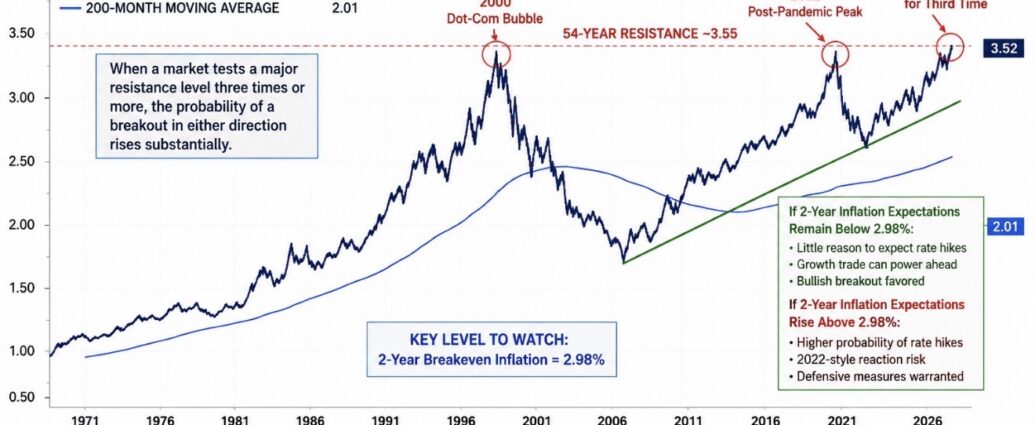
His analysis focuses heavily on inflation expectations, especially a market measure known as the two-year breakeven inflation rate. According to Gordon, the critical line is roughly 2.98%.
If inflation expectations stay below that level, he believes the market can likely handle modest additional tightening from the Federal Reserve without collapsing the AI-driven rally.
“If expected inflation remains contained, I see little reason to expect the growth trade to break down,” Gordon wrote in a note for CNBC Pro.
Much of the debate centers on oil prices and the Iran conflict.
Since the war began earlier this year, crude oil prices have remained elevated, fueling concerns that inflation could reaccelerate just as the Federal Reserve hoped price pressures were cooling.
If tensions ease and oil prices fall back toward more normal levels, analysts believe inflation fears could fade and allow stocks — especially AI and technology companies — to continue climbing.
But if the conflict escalates further and oil prices spike again, investors worry the Fed could be forced into a tougher stance that would hurt markets more broadly.
Gordon’s bullish case also rests on a major technical chart pattern involving the Nasdaq and S&P 500.
He noted that the Nasdaq-to-S&P ratio is testing a key resistance level that has only appeared twice before in modern market history — once during the dot-com bubble in 2000 and again before the 2022 tech selloff.
Technical analysts often view repeated tests of major market levels as signals that a powerful breakout could eventually occur.
Gordon believes the current setup could potentially resolve upward if inflation pressures stabilize.
Still, there are warning signs.
Some growth indicators are no longer rising as strongly as major AI stocks themselves, suggesting parts of the rally may be narrowing beneath the surface. Analysts say that can sometimes happen late in strong bull markets.
Meanwhile, other economists argue the real danger may not come directly from the Fed, but from growing stress inside the bond market itself.
Foreign governments including Japan and China recently reduced their holdings of U.S. Treasurys as they defended their own currencies against rising energy costs tied to the war. Weak demand at several recent Treasury auctions has also pushed yields higher.
That creates a separate challenge for markets because borrowing costs can continue rising even without direct Fed action.
Some analysts now warn the Fed risks losing control of inflation expectations if it appears too slow to respond to higher energy-driven inflation.
For investors, the next major test arrives this week with Nvidia’s earnings report, one of the most closely watched events in global markets because Nvidia has become the centerpiece of the AI boom driving much of the stock market’s gains.
Strong results could reinforce the bullish AI narrative and help stocks recover despite rising rates. Weak guidance, however, could increase fears that the market has become too dependent on a handful of technology giants.
For now, Wall Street remains caught between two powerful forces: surging enthusiasm around artificial intelligence and growing fears that inflation and higher interest rates may eventually slow the rally down.
— JBizNews Desk
© JBizNews.com. All rights reserved. This article is original reporting by JBizNews Desk. Unauthorized reproduction or redistribution is strictly prohibited.